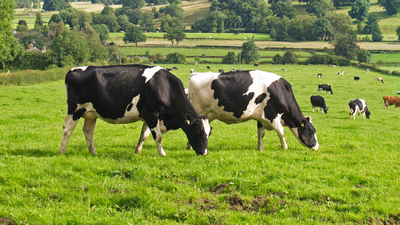
A quiet field can seem completely ordinary until you notice the pattern. Many cows and deer appear to be resting or grazing with their bodies lined up roughly from north to south. These strange details first attracted serious scientific attention in 2008, when Sabine Pigalle, Henk Burda and their colleagues reported that cattle and deer in many locations often followed the Earth’s magnetic axis.
Their paper published in PNAS suggested a possible form of magnetoreception, namely the ability to sense magnetic fields, and said the result opened “prospects for the study of magnetoreception in general.” Since then, the idea has been tested, challenged and debated, but it has not completely disappeared.
The science behind the cow’s compass phenomenon
Begal and his team studied thousands of cows using Google Earth satellite images, along with on-the-ground observations of cattle and deer.
In all, they examined more than 8,500 cows in hundreds of fields and nearly 3,000 deer in various locations. They noticed that many animals tend to stand or rest facing north and south.The researchers found that the animals align more closely with Earth’s magnetic north rather than normal geographic north. This suggests that the behavior was not random or simply caused by landscape features, but may instead show that cows and deer can somehow sense the Earth’s magnetic field, almost like a natural internal compass.
The study attracted attention because magnetoreception had already been observed in animals such as migratory birds, turtles and fish, but in large mammals it was considered a highly uncertain case. If cattle do respond to magnetic signals, the effect is likely to be subtle rather than dramatic. Cows do not move across continents, but may instead use the Earth’s magnetic field as a weak environmental reference while standing or resting.
What exactly is magnetoreception?
Magnetoreception is the ability of organisms to detect magnetic fields. Scientists have long known that migratory birds use the Earth’s magnetic field during their seasonal flights. Sea turtles, salmon, and some insects also appear to be able to sense geomagnetic signals.Researchers still don’t fully understand how animals achieve this. One theory involves microscopic crystals of magnetite, a naturally occurring magnetic mineral found in some living organisms.
Another possibility is that some chemical reactions inside the eye respond to magnetic alignment.But in cattle, no confirmed biological mechanism has been identified yet.
Why power lines became part of the story
In 2009, Borda, Bigal and their colleagues published a follow-up paper in the journal PNAS reporting that very low-frequency electromagnetic fields generated by high-voltage power lines appear to disrupt the alignment of cattle and deer.The fields “disrupt the alignment” of the animals with the geomagnetic field, the researchers wrote, and they noted that body orientation became more random in pastures located under or near power lines.This discovery raised the possibility that artificial electromagnetic interference might affect animal behavior in subtle ways. However, scientists caution that the evidence is still limited and the effect has not been conclusively proven in cattle.The animals themselves showed no obvious signs of distress. The proposed change was behavioral and statistical and not obvious to casual observation.
Scientific debate begins
The results of the cattle alignment quickly attracted both fascination and skepticism.In 2011, a separate research group led by Jan Hirt published a paper titled No alignment of cattle found along geomagnetic field lines. Their analysis argued that they could not reproduce the North-South pattern reported in the original research.Bigale and her colleagues responded later that year in the Journal of Comparative Physiology A. They argued that many of the grasslands included in the critique were not suitable for proper analysis due to steep terrain, nearby settlements, poor image quality, or the presence of power lines.Their response stated that “nearly half of all grasslands are unsuitable for analysis,” and they emphasized that a significant north-south alignment still emerged when only suitable sites were examined.The dispute highlighted how difficult it is to study animal behavior in uncontrolled, natural environments. Weather conditions, herd density, terrain and nearby infrastructure can affect orientation patterns.
A direct experiment challenged the theory
One of the strongest tests of the cattle alignment idea arrived in 2018.Researchers Debbie Weijers, Leah Hemric, and Ignace Heitkönig conducted an experiment in Portugal using cattle fitted with powerful neodymium magnets attached to their collars.
If cows truly depended on magnetic information, magnets would be expected to disrupt their orientation behavior.But the study did not find any significant preference for the north-south direction among the animals. The researchers also analyzed 659 heads of cattle and reported that the orientation of cows was more strongly linked to the position of the sun than to the Earth’s magnetic field.The results challenged the magnetic alignment hypothesis, and suggested that environmental factors such as sunlight and temperature may better explain the behavior observed in previous studies.Even after conflicting studies, the idea of the “cow compass” continues to attract scientific interest because it touches on a larger question: How many hidden sensory abilities exist in animals that humans do not fully understand?Magnetoreception is well supported in many species, especially migratory birds, sea turtles and some fish. However, whether cattle possess a meaningful sense of magnetism remains unproven.This debate has also contributed to broader discussions about whether artificial electromagnetic fields may influence wildlife behavior in subtle ways, although evidence for such effects in large mammals remains limited and actively debated.
More than just cows
Cattle are not the only mammals associated with magnetic alignment. Studies and reviews have discussed similar directional behavior in deer, foxes, and even dogs.One widely discussed study suggested that dogs prefer to align themselves north-south while defecating under quiet geomagnetic conditions, although this research has also faced controversy.Together, these observations suggest that sensitivity to the Earth’s magnetic field may be more widespread among mammals than scientists previously assumed, even if the mechanisms remain uncertain.
The quiet wonder hidden in an ordinary field
Part of what makes the story so compelling is how visible this invisible phenomenon is in everyday life.A cow grazing field looks ordinary until someone points out this pattern. Then suddenly the scene looks different. Animals no longer appear randomly across pastures.
Instead, they appear to be linked to an invisible environmental force that extends silently through the Earth itself.Whether or not the magnetic explanation ultimately proves correct, the research has already changed the way many scientists think about animal cognition. It serves as a reminder that even the most familiar creatures may still have hidden behaviors waiting to be understood.In 2008, researchers reported that cattle and deer often line up roughly north-south while grazing or resting, suggesting a possible response to the Earth’s magnetic field.
Subsequent studies have challenged this finding, and the strongest direct experimental test in 2018 failed to confirm fixed magnetic alignment in cattle.As a result, the “cow compass” remains an unanswered scientific question and is not an established fact. Scientists still don’t know whether cows really feel the Earth’s magnetic field or whether previous observations were shaped by environmental conditions and statistical limitations. Eh.