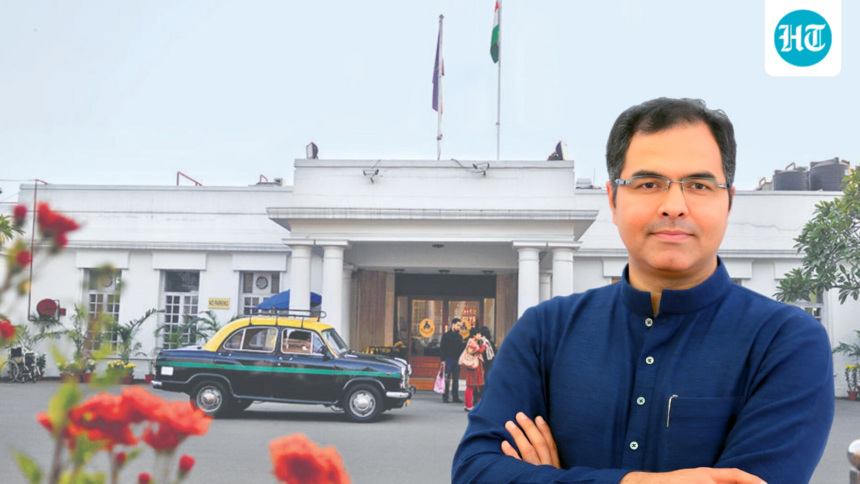
The Union government has ordered the Delhi Gymkhana Club, which operates on government land, to hand over its entire premises by June 5, 2026. The order draws curtains on the club’s over a century-old tale of colonial decadence, post-colonial privilege and enduring social and cultural apartheid.

Without forgetting the club’s long list of alleged financial irregularities, tax evasion and murky management, which has drawn legal wrath from several courts from time to time.
Thus, the government’s order sparked many debates about elitism, urban land use, national security, as well as decolonization.
The order states that the club premises “situated in a highly sensitive and strategic area of Delhi, are absolutely essential for strengthening and securing defense infrastructure and other vital public security purposes”. “The land is needed to meet pressing institutional needs, governance infrastructure, and public interest projects, integrated with the resumption of adjacent government land,” he adds.
In other words, the club’s government-owned land has a huge opportunity cost.
Why then could it not be used for the greater public good than the support of the aristocracy? If the common people, farmers or even the most marginalized sections of society can offer their private lands to the government for building national infrastructure like highways, roads etc., why can’t the country’s socio-economic elite be expected to do the same? This is also when their sports and social club operates on government land and not on private land.
This issue pits the indulgence of a privileged few against the greater public interest.
Furthermore, there have been several cases of financial irregularities and tax evasion by the club which have been reprimanded, punished and condemned by numerous courts, authorities or tribunals.
To cite but not limited to, the Delhi government, in 2014, moved to seize the club’s bank accounts over its failure to pay luxury tax for several years. Later that year, the club attracted the wrath of the Delhi Pollution Control Commission (DPCC) over inadequate waste management, lack of rainwater harvesting, and illegal use of borewells. Accordingly, the DPCC ordered the immediate closure of the club, and the National Green Tribunal imposed a hefty fine.
Then, in 2021, NCLAT dissolved the club’s board of directors due to gross mismanagement, following which the Union government had to take over its administration and management.
The NCLAT order described the gravity of the situation when it said: “Under the garb of the club’s distinctive personality which is a relic of the imperial past, the doors to membership are effectively restricted to persons with blue blood in their veins thereby perpetuating apartheid and destroying the dearest constitutional objective of securing social justice and equality of status and opportunity…”
Interestingly, although the club’s articles of incorporation state that its main aim is to “promote polo, hunting, racing, tennis and other sports and entertainment games”, only 2.77% of the club’s funds were spent on sports from 2014-15 to 2018-19, while an unusually higher amount was spent on catering food, wine, drinks and cigarettes instead.
Without forgetting the club’s vague and arbitrary membership rules and barriers to entry, making it a place for the few, of the few, of the few but at the expense of all.
Thus, the story of gymkhana is the story of the government lending its land to the national elite, to run its exclusive social enterprises with financial impunity, in the name of tradition.
Is supporting the Sheesh Mahal of indulgences for the national elite the best use of 27 acres of prime government land in the national capital?
Another important point is the location of the club.
Why is it necessary to have a social and sports club adjacent to a sensitive and secure location like the current home of the Prime Minister of India? Even if one accepts the utility of such a club, for the sake of argument, there are certainly better locations for establishing such a facility where it does not impede or impede the larger public interest.
Therefore, the government’s decision represents a long-awaited course correction.
I remember how Hon’ble Prime Minister Narendra Modi in his Independence Day speech in 2022 mentioned ‘five pledges’ to make India a developed nation by 2047. One of the pledges was to eliminate the colonial mentality that has been plaguing our country for a long time even after independence in 2047. The government’s decision is another example in a long list of decisions since 2014.
From installing a statue of Netaji Subhas Chandra Bose at the canopy next to India Gate, which once hosted a statue of British monarch King George V, to renaming the Raj Path to Kartavia Path, from renaming Raj Bhavans (residences of rulers) to Lok Bhavans, to removing British symbols from the insignia of our National Defense Forces, the Modi government has made governance of India more Indian than before.
The decision to acquire Gymkhana Club is a step in this direction as well.
After all, one cannot disagree that “Sabka Sath, Sabka Vikas” should take precedence over “Kuch ka Sath, Kuch ka Vikas”.
—
Parvesh Verma is a senior leader of the Bharatiya Janata Party (BJP) and is currently the Minister of Public Works Department (PWD), Water, Irrigation and Flood Control in the Delhi government. The opinions expressed in this article are his own.