Union Education Minister Dharmendra Pradhan has directed the Central Board of Secondary Education (CBSE) to depute a team of professors and technical experts from the Indian Institute of Technology (IIT) Madras and IIT Kanpur to assist the national board in “ensuring an error-free re-evaluation process”, officials said on Sunday.

Pradhan’s directions came in light of the recent developments and concerns raised by students and parents regarding the CBSE post-result services portal, officials said.
“The decision has been taken following reports of technical challenges in the CBSE post-exam services portal,” the Union Education Ministry said in a statement on Sunday.
IIT Madras will implement focused technological improvements to the systems and technical workflow and will specifically examine portal stability and server performance, she said. “The team will also examine the strength of the overall IT infrastructure and help take corrective actions to ensure that login authentication/user access systems/payment gateways are accurate and tidy.”
CBSE conducted the Class 12 board exams from February 17 to April 10 and announced the results on May 13 — which showed the overall pass percentage for Class 12 falling by 3.19 percentage points to 85.20%, down from 88.39% last year, the lowest since 2019, when the pass percentage was 83.40%.
This decline came in the first year of full on-screen marking (OSM) by CBSE for assessment of Class 12 answer papers.
Under OSM, answer scripts were scanned and uploaded to a secure digital portal where teachers assessed them on computer screens, digitally entering marks and annotated answers online, while totals were automatically calculated to eliminate human errors.
CBSE evaluated 9,866,622 answer books digitally, while 13,583 copies were manually scanned as repeated scanning failed to produce clear images.
On May 17, CBSE sharply reduced post-result re-evaluation fees and promised full refund if marks increase after revision.
Read also:CBSE 2026 Class 12 Revaluation: Requests for copy of assessed answer sheets start today at cbse.gov.in
Under the revised structure, the fee for obtaining a scanned copy of the assessed answer sheet is reduced to $100 of $700 per subject, while the fee for mark checking, which checks for clerical errors such as total answers and unmarked answers, has been reduced to $100 of $500. The re-evaluation fee for specific questions has been reduced to $25 of $100 per question.
CBSE started accepting applications from students for answer scripts on May 19.
On May 19, it extended for the first time the application deadline from May 22 to May 23, and on May 22, it extended the deadline to May 24.
CBSE has received 2.94 lakh applications for answer books so far for over 8.56 lakh answer books.
Last year, the number was much lower at 1.31 lakh applications for 2.82 lakh answer books.
More than 15.07 lakh students out of 17.66 lakh students have passed the Class 12 exam this year, compared to 14.96 lakh out of 16.92 lakh students in 2025.
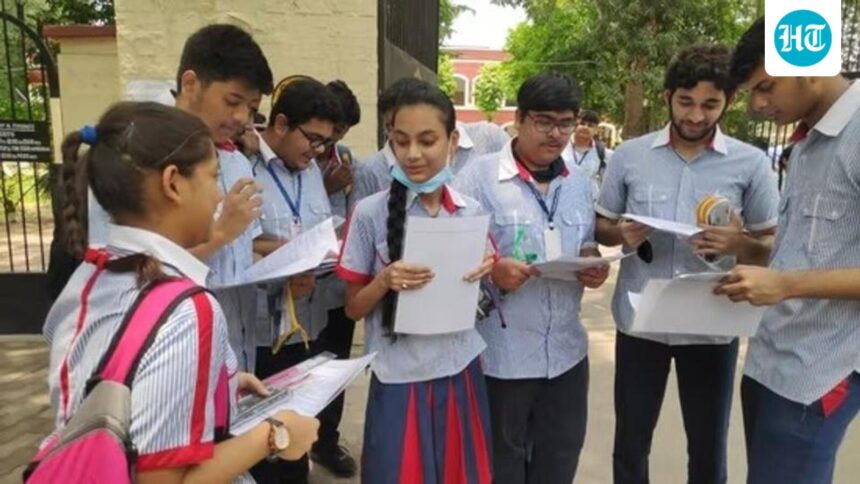
Since the CBSE re-evaluation portal was launched on May 19, a large number of CBSE students and parents across India have reported technical glitches, unclear scanned answer sheets, payment issues, and concerns surrounding assessment transparency.
A student from a private school in Delhi, who topped her school in Class 10 with 97.4% but scored 93% in Class 12 against the expected 95%, said she had applied for scanned copies of all six answer scripts on May 21 and completed the payment, but is yet to receive them.
“How am I supposed to raise objections by the May 24 deadline when I don’t even have access to my answer scripts?” She said, noting that the Central Bank of Securities will begin the re-evaluation based on the objections from May 26.
She said the portal kept crashing throughout the day, forcing her to apply around 2.45am when traffic was less.
“Many of us stay up late or wake up early just to reach the location. This happens while we are also appearing for CUET-UG, and constant checking of the location affects our concentration and preparedness,” she said.
The National Testing Agency (NTA) is conducting the Common University Entrance Test (CUET-UG) 2026 from May 11 to May 31.
Another student, Sarthak Siddhant, said he missed the Joint Seat Allocation Authority (JoSAA) 75% eligibility cutoff by a fraction of a percentage point, even though he expected his Class 12 score to be in the 87-88% range.
JoSAA is the central body that manages counseling and allotment of seats for admission to leading engineering institutes in India based on ranks in JEE Advanced (for IITs) and JEE Main (for NITs/IIITs/GFTIs).
He applied for scanned copies of answer scripts for all subjects, saying he expected better marks in all areas, but he has not received them yet.
Sarthak said he was unable to access the CBSE portal on May 19 through the original link shared by the board.
“On May 20, after being redirected to a new portal, I once again experienced a maintenance downtime and heavy traffic. I was finally able to apply at 6am on May 21, but even then I encountered a payment glitch. The payment went through, but the site showed it failed. It was only reversed 12 hours later after I was asked to wait for 24 hours,” he said.
The principal of a private school in Delhi has blamed the OSM system for the problems faced by students.
“First, CBSE gave low grades to students due to incorrect screening of answer copies under the new system. Now students seeking re-evaluation of Class 12 answer sheets in the hope of improving marks are faced with technical glitches, payment failures, unclear or incomplete scanned copies, and frequent portal crashes while submitting. They did not train teachers on the new system and applied in haste, and now we are witnessing the chaos unleashed by the OSM system.”
CBSE officially announced the large-scale OSM for Class 12 assessment on May 9, just a week before the 2026 board exams.
On May 17, in a press conference, Sanjay Kumar, Secretary, Department of School Education and Literacy (DoSEL), said it was “neither a new concept nor the first time it has been implemented.”
CBSE first piloted the system in 2014, assessing key Class 10 subjects in most districts and only two Class 12 subjects – Basic English and Economics – in the Delhi region. The initiative was later scaled back due to infrastructure and connectivity limitations before being revived this year following widespread technology and software upgrades and teacher training.
Kumar said the OSM system provided flexibility and objectivity by allowing answer scripts from one area to be evaluated elsewhere, unlike the previous area-linked manual checking system.
According to CBSE Chairman Rahul Singh, nearly 3 lakh teachers have logged on to the CBSE portal for OSM training, while 77,000 teachers have participated in the assessment.
“The teachers only evaluated each transcript in OSM and AI was not used in evaluating the answer scripts,” Singh said.
The OSM ensures “greater uniformity, accuracy, confidentiality and speedy processing of assessment-related activities,” CBSE said in a statement issued on May 17.