Growing up on a struggling farm in the middle of the French countryside is no easy task. But imagine growing up there with an Edward Scissorhands-style back brace strapped to your body at all times, making you wander around town like a pre-teen metal monster.
Such is the sad fate of 11-year-old Kristoff, the dysfunctional young hero in animator Louis Clichy’s animated debut film, Iron boy (Le corset), which premiered at the Un Concern Regard sidebar at Cannes and has just been picked up by Sony Pictures Classics.
Iron boy
Bottom line Lyrical and authentic.
place: Cannes Film Festival (What Look)
ejaculate: Gary Clichy, Rod Paradot, Dimitri Colas, Aurélie Vasseurt, Brun Moulin
exit: Louis Clichy
Screenwriters: Louis Clichy, Frank Salomé
1 hour and 29 minutes
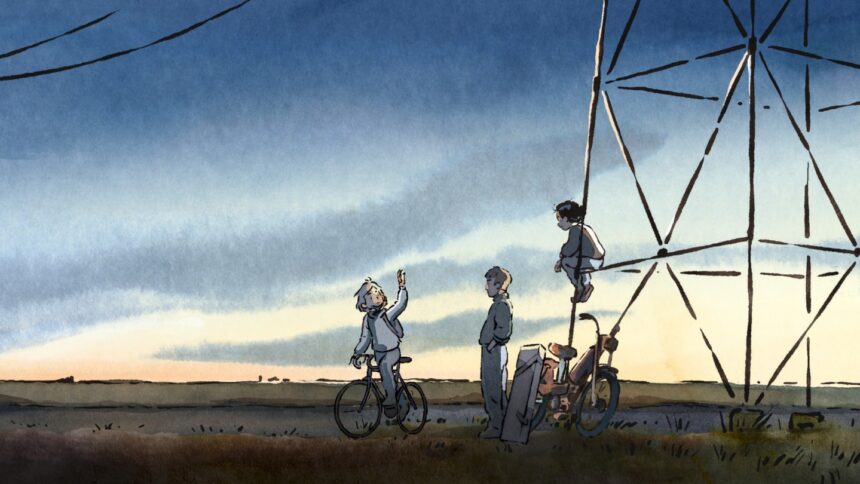
What makes this hand-drawn stand out from other entries of the genre is Clichy’s attention to detail, especially the way he depicts rugged countryside living in the 1980s, a time when French agriculture was consolidating and family farms were facing extinction. Director who previously worked on Pixar films Wall-E and highercontrasting strict rural realism with poetic flights of fancy whenever Christophe manages to escape his world and find his own voice, adding lyricism to a harsh existence.
Life already seems hard enough for the boy who lives with his father (Dimitri Colas), mother (Aurélie Vasseurt) and brutish older brother (Rod Paradot) on a farm that can no longer make ends meet from day to day. Things suddenly become more difficult when Kristoff begins to lose his balance, leading to a series of medical tests that determine that he needs to wear a brace to correct some type of spinal condition.
And so Iron Lad was born, and he’s certainly not happy about it. Forced to wander around, and even sleep, wearing a steel jacket with his neck permanently raised, Kristoff begins to withdraw from his classmates and family. All seems lost for a while until he meets Michel (Alexandre Astaire), the organist at his local church who decides to take the boy on as a page-turner, eventually teaching him how to play himself.
The film’s best scenes show Christoph emerging from his metal shell into the higher realms of classical music – in this case Gabriel Fauré’s heart-wrenching melodies. mass (Terrence Malick also memorably used it for recording The thin red line), which he listens to on his Walkman while riding his bike between home and church. By framing Christophe’s small, stiff body against the green fields surrounding him or the buildings in his monotonous provincial enclave, Clichy powerfully captures those wonderful moments you have as a child when your world suddenly opens up with beauty, and you realize that you are not alone.
Kristoff’s life also changes when he meets Klara (Brune Moulin), a rebellious girl in his mandatory swimming class who eventually takes a liking to him. As small-town outlaws, they form a bond that involves, among other things, stealing from local stores and using Kristoff’s back brace as cover when the metal detector goes off. Like Michel, Clara pushes her friend to see beyond the limited horizons of his existence, helping him survive a difficult year spent literally in slavery.
Despite Christophe’s many efforts to escape his origins, Clichy never portrays his home front as a terrible place, but rather as a loving family torn apart by financial worries and alcoholism. Their youngest son’s back problems are actually the least of the family’s problems, especially when a deal with a more enterprising neighboring farmer ends up going bankrupt.
This leads to a conclusion that can strain credulity somewhat, though it brings a level of emotion that feels earned rather than contrived. Continuing the French (and Belgian and Swiss too) tradition of artistic animated films – Persepolis, My life is like a zucchini, I lost my bodyetc. – which mixes realism and fiction, biography and fiction, Iron boy It offers an honest and graceful portrayal of growing up in a working-class family, where you are given nothing but the will to be free.