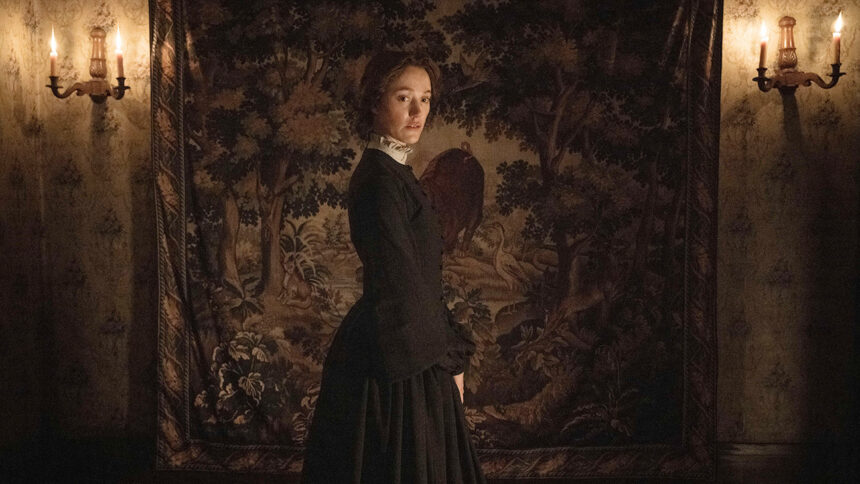
The 21st century has seen no shortage of stylish horror laced with twisted veins of dark humor – Peter Strickland In the fabricJennifer Kent BabadookHelena Ryan Bodies Bodies BodiesSam Raimi Drag me to hellpretty much every feature in Jordan Peele. Many skilled directors can play with tension and fear while making us laugh nervously. But others end up as films in which the dueling forces cancel each other out, and neither work as horror films nor as comedies. Zachary Wiggon Victorian psyche It’s one of those awkward amalgamations that ultimately seems ridiculous.
Adapted from the novel by Spanish author Virginia Vito, the film mutes any intimidation factor by winking at the audience with a wildly exaggerated performance from a band whose most consistent director’s observation seems to be “Go bigger!” At times, the film veers almost into parody territory, but it never commits to the part enough to be anything more than a mismatched genre hybrid, despite its atmospheric imagery and strong design elements.
Victorian psyche
Bottom line We are not amused.
place: Cannes Film Festival (One Look)
release date: Friday 25 September
He slanders: Maika Monroe, Jason Isaacs, Ruth Wilson, Thomasin McKenzie, Evie Templeton, Jacoby Jobe.
exit: Zachary Wiggon
screenwriter: Virginia Veto, based on her novel
Rated R, 1 hour 41 minutes
A late entry into Cannes’ Un Certain Regard section — and a puzzling choice — the film will open in the US on September 25 via Bleecker Street.
Scream queen Maika Monroe switches teams to play the antagonist, Winifred Naughty, who arrives at Ensor House, a stately country mansion decorated with Gothic gargoyles, to take over as governess to the two precocious children of feisty aristocrats Mr. and Mrs. Bounds (Jason Isaacs and Ruth Wilson).
In one of several voice-over clips that accompany the chapter breaks, Winifred notes that the Bounds’ house is a “more dignified house” than the one in which she previously worked, the first of many allusions to the mysterious past from which she is escaping. We learn that the twins who were in charge of her at a job have disappeared, that the child who was in her place before that has drowned, and that the town she comes from has gained notoriety when a series of children are found murdered.
There are faint echoes Wuthering Heights and Jane Eyre In the vicinity of the Yorkshire Moors. But if you start getting… Turn of the screw Phoebe, you are being misled. Winifred — whose preferred diminutive, which is also the name of the demon inside her, is Fred, not Winnie — is not the one freaking out here. Instead, she terrorizes, and her unsettling fear emerges early when she finds a severed ear in her bedroom and snacks on it.
Monroe slaps the tics across his face and drifts around the dimly lit house in a state of manic distraction from the start. You’ve reached extremes of insanity from the moment we met. This is as much a fault of Feito’s adaptation and Wigon’s direction as it is the actor’s performance, but it leaves 19th-century Patrick Bateman nowhere to go, depriving the film of any element of shock value.
We learn through Winifred’s voiceovers that her mother tried to kill her when she was eight years old. “Your soul is covered in darkness,” she told her daughter. But instead of fearing that darkness, Fred embraced it: “Anyway, we’re together now until the end.” She was raised by a clergyman who was not her father. It is inferred that he has questionable ideas about parental rights.
In a funny touch of feminist commentary, Pounds’ parents were determined to have their naughty son Andrew (Hamnet Survivor Jacobi Jobe) gets the best possible education but is less bothered about morose daughter Drisella (Evie Templeton). “We don’t want her to waste her fertile years in an institute.” When she first meets them, Fred wonders about the children: “Are they quiet or stupid?”
Trouble arises when the gardener reveals to Winifred that he knows of her sinister past, and demands £50, “or some other sort of arrangement”, to keep her quiet. Maybe the sharp end of the ax wasn’t what he had in mind.
Uptight maid Miss Lamb (Thomasin MacKenzie) proves less difficult to manage, as Fred frightens her wits with false talk of an ogre roaming the Moors. And the Pounds clan, far from being a model of respectability, has its own seedy history, nonchalantly outlined by Mr. B when Winifred admires photographs of the family dating back generations. An ancestor was executed for sodomizing his horses, Mr. Bounds’ father was a pedophile, and his mother had syphilis.
Seemingly having found her corrupt people, Winifred vows to claim legitimacy by becoming a member of the Pounds family and making Miss Lamb her lady’s servant. But the voices inside her kept whispering: “Let Fred out!” This means that no one is safe. Hallucinatory images seep into reality as she imagines slaughtering the entire family. Or is it her imagination?
While Wigon’s last advantage, havenhe was both playful and in control, and this guy had all the self-control Pee Wee Theater (Which I’d rather watch). The biggest problem is that it’s not even for a minute scary, despite Ariel Marx’s stormy orchestral score pushing all the right outrageous buttons. Only in a neat ending that wraps things up like an old English legend does it become devilishly unsettling.
There is a strong sense that Vito’s novel received more attention through questions such as who is truly sane or crazy, and whether evil exists in all of us. But this thematic potential is weakened in a film that keeps hurtling forward without gaining any more momentum.
The entire cast is better than the material; The film seems convinced that it’s funnier, smarter, and more disturbingly subversive than it actually is. I’m not sure I’ll fully buy Monroe in villain mode, but she gets points for throwing herself into it with deranged enthusiasm. Isaac and Wilson are such professionals that they have a bit of fun, taking in the scenery with relish. But that’s fun, along with most other things Victorian psychewearing thin.