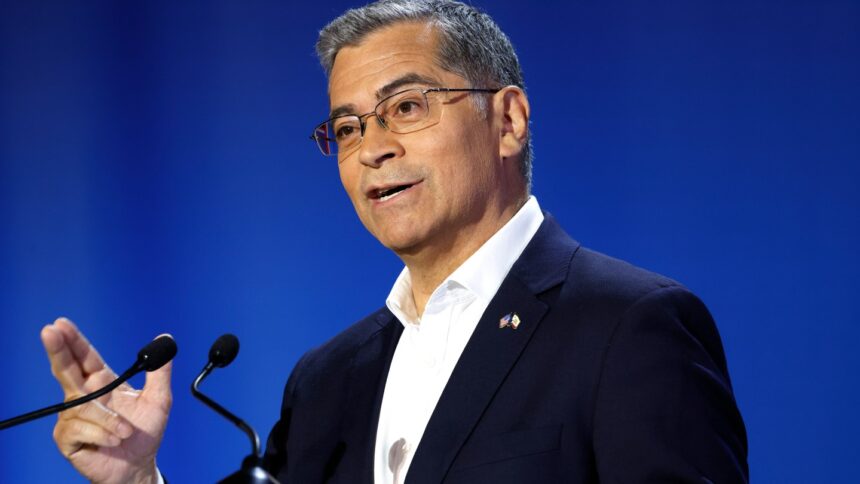
Since surging to the top of California gubernatorial polls several weeks ago, Xavier Becerra has not offered his plan for how to save entertainment, even as several challengers have done just that.
That will change on Friday, as Biden’s former Health and Human Services Secretary and California AG will release his proposals to save Hollywood from crisis, joining fellow front-runner Steve Helton (R) and third-place contender Tom Steyer (D) in sharing their vision.
Among Becerra’s most eye-catching proposals is California’s “Content Performance Disclosure Requirement” — essentially a law or rule that stipulates that studios/streamers must provide “meaningful performance data” to everyone from directors to crew. Such participation must come in a “unified form that gives workers what they need to bargain fairly.”
Hollywood Reporter A version of the plan was shown, which the candidate is expected to speak about next week on a final drive across the state before the June 2 primary.
The lack of transparency over viewership data on the small screen has long been troubling for creators, who say they are left completely in the dark about how good their work is, and therefore what they should be getting. During the strikes three years ago, many directors and actors took up the issue; They won streaming bonuses in the deal, but not much of it materialized. Either “they’re all making a lot more money than anyone knows and they’re willing to tell us… [or] “They’re making a lot less money than anyone knows, and they don’t want Wall Street to look under the hood,” Steven Soderbergh said. Things improved only intermittently.
Becerra is expected to explore fair labor legal options that could require streamers to release data to a wide range of creative participants. Currently, many union deals only require that a few people pitching are given fixed numbers, with non-disclosure agreements abound, while crew members never see the ring. Another potential tool would be to tie tax credits or permits to such disclosures, although screwing up the production pipeline is the last thing any California lawmaker wants to do right now.
Becerra had 22 percent in the latest poll, just below Hilton’s 23 percent, and is suddenly comfortably ahead of Steyer’s 15 percent, with no other threat. If the results hold, Becerra will have a seat ahead of Hilton on the November ballot and, barring any surprises in October, will likely make it to the governorship. Of course, these days, as Eric Swalwell might note, surprises come in every month.
In his plan, Becerra also says he will advocate for the “California Entertainment Summit,” a place where “unions, crew organizations, producers, studios, streaming companies, and tech companies” have a “binding mandate: to produce a public business plan, not a report.”
Such efforts aim to combat the feeling that the issue has generated too much talk and not enough action — a growing frustration in Hollywood expressed by everyone from top directors to union leaders as jobs continue to leave the state.
“Each workstream will have a designated leader and mentor,” Becerra’s plan says.
Notably, Becerra will not call for eliminating the $750 million annual tax credit cap, as competitors including Steyr and Hilton have done. Nor will he propose a specific increase in the ceiling of funds allocated to individual projects (Hilton wants this increase to sometimes reach 60 percent from the current 35 percent to 45 percent).
But Becerra wants the credit ratio to grow, only “guided by ongoing evaluation of where we are losing business.” Among those potential areas, he said, are “independent post-production and visual effects production.” [and] broadly episodic television” but also added that he would be open to where the data leads. Under that system, a production might automatically qualify for larger credits if it can prove it can create jobs in one of those groups. The move is a bit counterintuitive, or at least ahistorical; generally states measure production gains and losses by the presence of mega-franchises like the MCU films, which generate the most revenue. (Notably, the MCU films have largely moved production from Georgia out of the states, to the U.K. now.)
Unlike Steyer and Hilton, Becerra did not say the tax breaks should be expanded to include above-the-line costs; So far the credits have focused only on what’s below the line. The unions wanted to keep this allotment, but producers, wanting to use credits for stars and directors, pushed for expansion.
In contrast to Hilton’s plan, which seeks to stimulate production with direct cash benefits, Becerra’s plan focuses on more conceptual mechanisms, such as focusing on specific areas of job loss. Of course, at some point, the solution is out of the hands of all these plans, as one of the biggest reasons California is losing Hollywood production is rising housing, food, and transit costs.
Like many of his competitors, Becerra’s plan also emphasizes, without an abundance of detail, the importance of pushing for a federal entertainment tax credit, loosening of shooting regulations, the ability of actors to control their likeness to AI, and the general need for oversight of AI.
After remaining silent longer than his opponents, Becerra now seemed ready to throw some punches. He said the current system was “designed for an industry that no longer exists,” and in justifying government intervention, he noted that he believed “the market alone cannot plan its way through widespread disruption so quickly.”