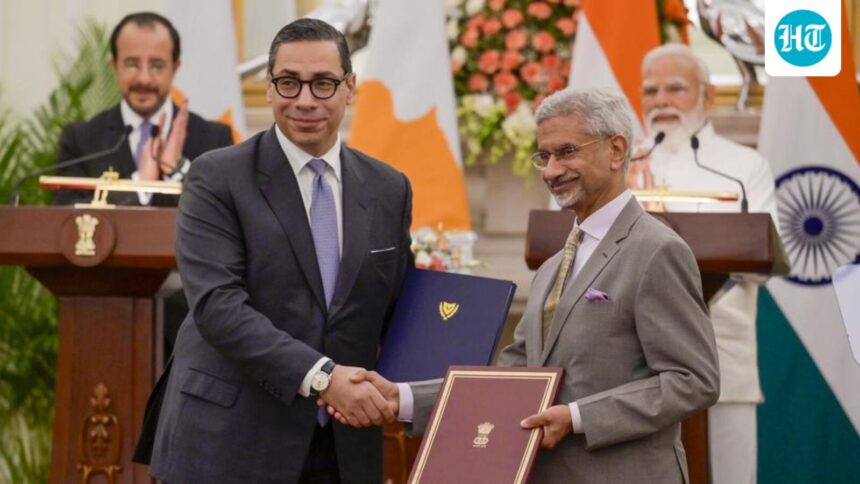
India and Cyprus have strengthened their ties in a strategic partnership and entered into agreements to enhance cooperation in key areas such as defence, technology and counter-terrorism, with Prime Minister Narendra Modi and Cypriot President Nikos Christodoulides focusing on strengthening trade and investment ties.

Christodoulides, who is making his first visit to India after becoming president, began the trip by traveling to Mumbai with a 60-member trade delegation before arriving in New Delhi for talks with Modi. Cyprus currently holds the rotating presidency of the Council of the European Union, and discussions also covered the benefit of the proposed India-EU trade deal.
In a joint media interaction with Christodoulides, Modi said Cyprus has emerged as an important investment gateway between India and Europe and is among the top 10 investors in the country, with investments nearly doubling over the past decade.
“The India-EU FTA has opened up many new opportunities. Leveraging this, we aim to double investment in the next five years. To achieve this commitment, we are elevating our trusted relationship into a strategic partnership,” Modi said.
Cyprus is currently the ninth largest source of FDI inflows to India and the second largest in the EU region, with cumulative inflows of $16 billion since 2000. Most of these investments are concentrated in key areas such as services, software, automobiles, cargo handling, construction, shipping, and pharmaceuticals.
Cyprus and India are working together to address challenges in an increasingly fragmented world, Christodoulides said, and the EU-India partnership must become stronger in an era of increasing geopolitical uncertainty due to shared responsibilities and a shared commitment to stability, resilience and prosperity. He said the European Union and India could play a “critical role” in global stability.
Modi said the new strategic partnership will also open up capital for trade by connecting financial and service centers on both sides, provide new opportunities for Indian companies in infrastructure, energy and agriculture sectors in Cyprus, and bring new investments into India’s shipping and maritime sectors.
He described defense and security cooperation as an important pillar of relations. “Today, we decided to strengthen cooperation in the field of cybersecurity, maritime security and counter-terrorism,” Modi said.
Connectivity initiatives such as the Indo-Pacific Initiative (IPOI) and the Indo-Middle East-Europe Economic Corridor (IMEC) also figured in the discussions between the two leaders. Cyprus has joined the International Implementation Plan and co-chairs the pillar on trade connectivity and maritime transport.
The two sides signed a memorandum of understanding to establish a joint working group to combat terrorism to create a framework to enhance cooperation through information exchange and capacity building. Both sides condemned all forms of terrorism, and Cyprus expressed its solidarity with India in the fight against cross-border terrorism, Sibi George, Secretary (West), Ministry of External Affairs, said at a press conference.
The two leaders also condemned last year’s Pahalgam terror attack and the terrorist incident near the Red Fort, and called for decisive global efforts to fight terrorism, combat terrorist financing and eliminate safe havens and terrorist infrastructure.
The two sides also finalized a roadmap for defense cooperation for the period 2026-2031, covering areas such as joint training and exercises. This would also create opportunities for Indian defense companies to work with their counterparts in Cyprus, including collaborating on projects under the EU’s €150 billion Security Action for Europe (SAFE) programme, which aims to strengthen Europe’s defense industrial base.
Other memorandums of understanding signed by the two sides cover cooperation in the areas of innovation and technology, diplomatic training, higher education, research, cultural cooperation, and coordination in search and rescue matters. The two sides also agreed to hold a cybersecurity dialogue and a consular dialogue, and Cyprus opened a mall in Mumbai.
George said the consular dialogue will benefit 16,000 Indians living in Cyprus, including 5,000 students. The two sides also agreed to work on a mobility partnership and social security agreement. “We are in the final stages of discussions on a mobility partnership agreement, which will help streamline our travel movements [professionals]”Especially in the field of information technology,” he said.
Financial connectivity also figured in the discussions, and India’s Unified Payments Interface (UPI) digital payments systems will become operational in Cyprus from 2027, George said.
The Indian side reiterated its support for Cyprus in the context of Turkey’s recognition of the Turkish Republic of Northern Cyprus, which includes a third of the island in the Mediterranean that was captured by Turkish forces in 1974. “Shared belief in values like democracy and the rule of law is the foundation of our partnership. We respect the sovereignty and territorial integrity of all countries. India is and will remain fully committed to these principles,” Modi said.