

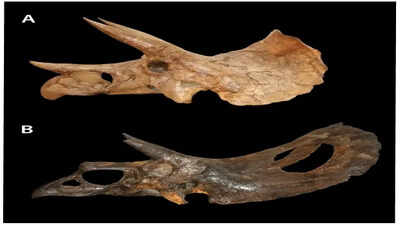
Workers discovered a fossilized skeleton that was initially thought to be a triceratops. Further examination revealed that it was a much rarer Torosaurus species. Image Credits: Torosaurus Not a Triceratops: Embryonic Development in Chasmosaurid Ceratopsids as a Case Study in Dinosaur Taxonomy (Figure 1)
Imagine you’re working with heavy machinery on an ongoing construction project in the city, when suddenly everything comes to a halt due to a collision with an object that turns out to be a massive prehistoric artifact.
Well, this actually happened in the summer months of 2017 in Thornton, Colorado, a busy area on the edge of Boulder County. While construction workers were digging up some soil to build the foundations for a new public safety building, they stumbled upon a large skeleton of a fossilized horn located right before their eyes.The excavation team stopped working with their heavy machinery and called local paleontologists to examine the unknown find.
The media and locals quickly announced that the fossil belonged to the legendary Triceratops, a name instantly recognizable due to its three-horned appearance.However, when a specialized excavation team carefully removed the thick layers that surrounded it over the course of twelve grueling days, its true identity began to change. In an official document published by the University of Colorado Boulder titled The Dinosaur Found at Thornton, it turns out that the perfectly preserved specimen was actually a Torosaurus, an incredibly close, but very rare, standard-horned dinosaur.
Review the prehistoric family tree at the construction siteAs described above, the evolution from a field hypothesis to a scientifically sound nomenclature reflects the nature of paleontology as a process of continuous data revision. As reported in an unprecedented study published in the journal PLoS One, identifying these enormous creatures is particularly complicated due to the dramatic development of their enormous cilia and horns during development.The research proves that while some scientists have previously argued that the two names represent different life stages of exactly the same genus, the distinct, open, window-like holes found in the pet’s frilled structure. Torosaurus Separate it out once and for all as its own unique branch of the dinosaur family tree.
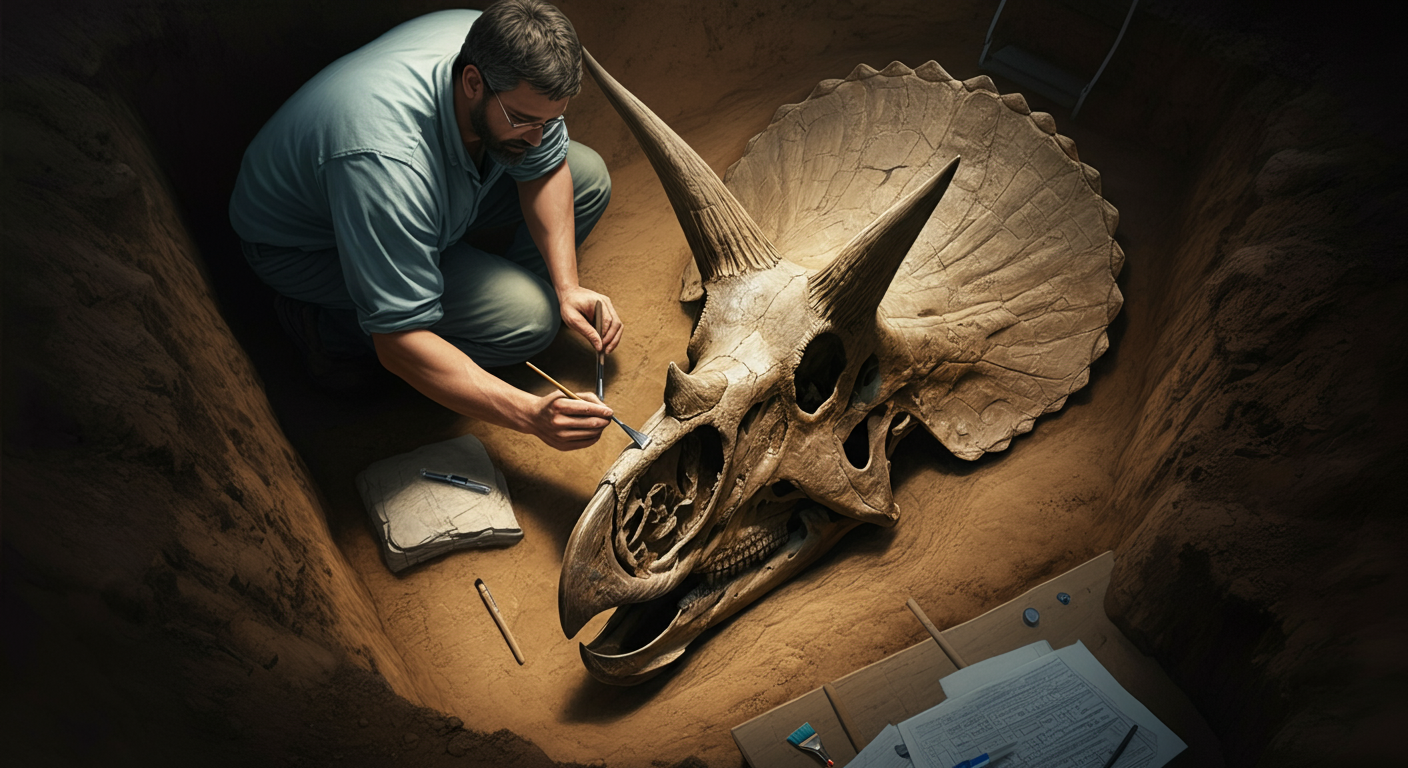
Construction workers in Thornton, Colorado, have discovered a massive fossil, initially thought to be a Triceratops. After careful excavations, paleontologists determined that it was a rare, closely related torosaurus species.
Thornton’s discovery proved to be an absolute bonanza for science as the determined team succeeded in recovering around 80 per cent of the giant animal’s skull along with 15 per cent of its body.
This astonishing amount of preservation made this discovery one of the most intact Torosaurus skeletons ever found anywhere in Colorado history, and turned a routine civilian endeavor into a landmark event for geoscience in North America.Discover the lost Cretaceous floodplains Buried under asphaltFinally, the reward for all these efforts came once the remains were carefully wrapped in plaster jackets and sent to the collections of the Denver Museum of Nature and Science.
This amazing discovery extends across the Denver Basin, which represents the remains of the fossilized Cretaceous floodplains that buried the last generation of dinosaurs that lived on our planet, about 66 million years ago.Today, the beautiful fossil remains provide a stunning biological snapshot of the Old West, illustrating that what is now a paved urban safety center was once fertile ancient floodplains where rare armored giants routinely roamed.
This stunning discovery is a powerful reminder that our modern cities rest directly on top of deep, forgotten landscapes.As we walk down bustling city sidewalks or pass ordinary municipal buildings, the deep history of our planet lies just a few feet beneath the concrete, waiting for a chance encounter to bring it back into the light. It shows that amazing scientific progress often depends on local workers stopping at the right moment and being curious to look closely at the ordinary dirt beneath their tools.It is indeed an amazing experience when we realize how, through an ordinary building activity aimed at meeting the needs of the modern era, we can extract an extremely rare specimen of a horned king from the prehistoric era.