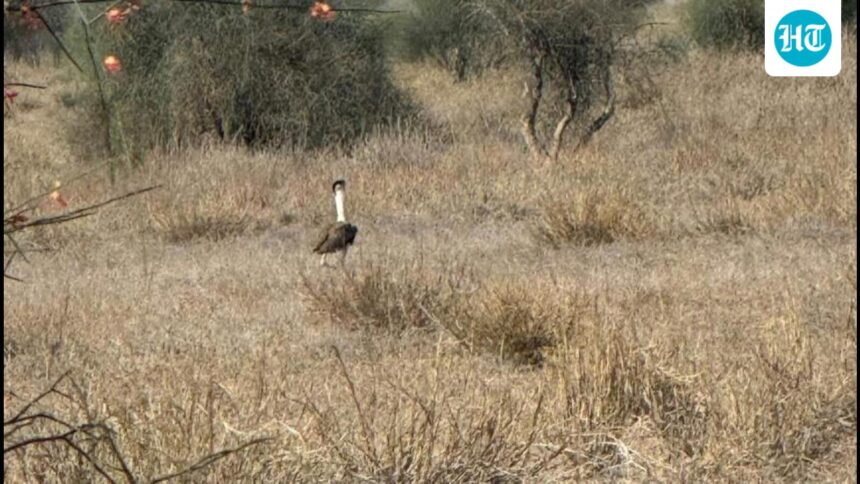
Nine great Indian bustards were spotted together in the wild on ‘Godawan Day’, observed to promote conservation of the endangered species, in Jaisalmer Desert National Park (DNP) on Thursday.

Forest department officials said the group included five females and four males of the Great Indian Bustard. Wildlife experts described this sighting as a major success for conservation efforts, as the shy bird is rarely seen in such numbers together.
This rare sighting occurred in the Sudasari district during a safari led by Rajasthan’s Forest and Environment Minister, Sanjay Sharma. Sharma unveiled special statues of Gowdawan to spread awareness about desert wildlife conservation at an event held at Sudasari Breeding Centre.
Sharma, who reviewed the conservation and artificial breeding projects, said the Rajasthan government is fully committed to protecting this species from extinction. “There are 130 Godawans in the forests of Jaisalmer… 87 birds are being protected at the Advanced Breeding Centre. The total number of Godawans has risen to 217,” he added.
Sharma said the government will strengthen natural habitat protection, egg safety measures and breeding center facilities to conserve this famous bird in the Thar Desert.
The great Indian bustard, the state bird of Rajasthan, is critically endangered, with only about 120-130 species left in the wild, especially in Jaisalmer and Barmer.
Breeding centers at Ramdevra and Sudasari in Jaisalmer are using incubation and artificial insemination to increase the numbers of this species.
The first great Indian bustard chick in India was hatched through artificial insemination in October 2024 after the first successful artificial incubation in 2022. By May 2026, the number of families of this species had reached 87, including 27 produced through artificial insemination. Scientists are preparing the baby birds for release into the wild as part of efforts to rebuild the species’ populations.