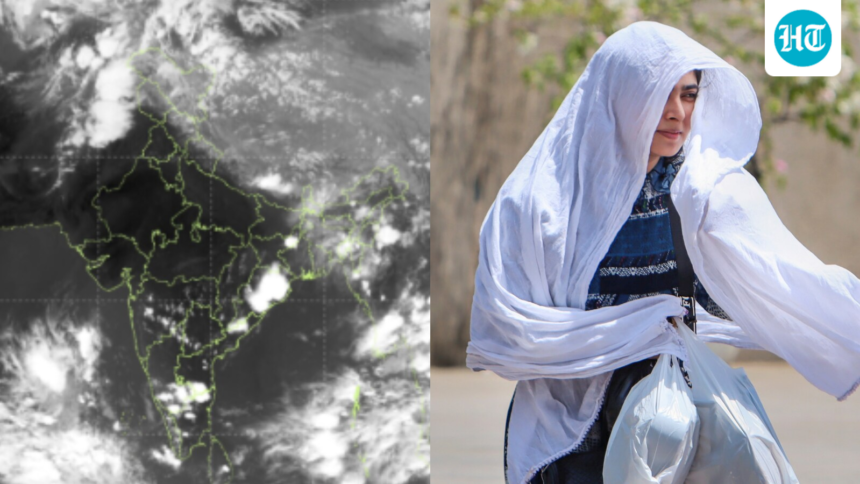
Delhi region, National Capital Region and several areas in northern India continue to experience severe heatwave conditions, while satellite images released by the India Meteorological Department (IMD) showed a westerly disturbance near the northern region of the country.

The Meteorological Department issued an ‘orange’ warning for Delhi, Ghaziabad, Noida and Gurugram on Thursday. The maximum temperature is likely to remain above 45 degrees Celsius.
Will it rain in Delhi?
A western disturbance has started affecting northern India and the Himalayan region, Naresh Kumar, a scientist at IMD, told news agency ANI.
Satellite observations from the INSAT-3DS weather system on May 21 detected a wide area of cloud cover near India, especially across Afghanistan and Pakistan.
The images also showed a strong influx of moisture spreading across the Arabian Sea, along with increased cloud activity over northeastern India and parts of the Bay of Bengal.
Scattered low to moderate clouds, along with areas of intense to very intense convection, were present over the southeastern Bay of Bengal and Andaman Sea, the IMD said in its weather bulletin. Scattered low and medium clouds carrying intense to very intense convection were also observed over the central and southern parts of the Arabian Sea.
The western disturbance may bring rain in Jammu and Kashmir, Himachal Pradesh, Uttarakhand, Punjab, Haryana, Delhi and western Uttar Pradesh in the coming days. However, there is no clear indication yet how strong its impact will be, meteorologists told India Today.
Heatwave conditions across North India
The heat wave is expected to continue in parts of northwest India, central India and most parts of eastern India during the next six to seven days, IMD’s Naresh Kumar said.
“We have issued a 6-7 day ‘orange alert’ covering Punjab, Haryana, NCR-Delhi region, Uttar Pradesh, Madhya Pradesh, Vidarbha, coastal Andhra Pradesh and Odisha. Further, we have issued a 3-day ‘red alert’ for eastern Uttar Pradesh, eastern Madhya Pradesh and certain parts of Vidarbha,” he said.
He added that the western unrest began to affect the region as of Thursday. As a result, heatwave conditions in Jammu and Kashmir are likely to ease from today onwards, he added.
“For NCR-Delhi region specifically, temperatures in the region are currently exceeding 45 degrees Celsius and a similar scenario is expected to continue for almost the entire week… Therefore, we have also issued an ‘Orange Alert’ for NCR-Delhi region.”
Meanwhile, Delhi recorded its hottest May night in nearly 14 years, with the minimum temperature reaching 31.9 degrees Celsius on Thursday, according to the Met Office.
The previous highest minimum temperature was recorded on May 26, 2012, when it reached 32.5°C.
With input from agencies