

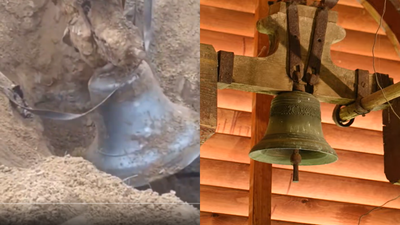
What started as a routine day of excavation in a Lithuanian field turned into an extraordinary rediscovery when farmer Lorinas Druzas came across a large metal object buried under the soil near the town of Antasava in the Kupiškis region.
As the earth was cleared, a huge church bell, which locals believe has been lost since World War II, slowly emerged. The bell belongs to St Hyacinth’s Church and is said to have been cast in 1908 before disappearing during the chaos of the wartime occupation. Although the discovery itself was made in 2024, the story resurfaced and spread widely online in 2026 after videos and photographs of the excavation went viral on social media.The rediscovery immediately attracted attention because the bell was not only historic, but also remarkably well-preserved after spending more than eight decades underground. Local reports stated that the bell was hanging in the church tower before it disappeared under mysterious circumstances in the early 1940s.Parish priest Remantas Godelis later explained that the villagers removed the bell and buried it themselves when war reached the area.
According to local memory, residents feared the bell would be confiscated and melted down for military use.Videos showing the bell emerging from the soil were widely shared online after the discovery, helping to turn what began as a local archaeological curiosity into an internationally discussed war story.
Why did the villagers bury the bell during World War II?
The decision to bury the bell reflects a much larger wartime reality unfolding across Europe.
During World War II, occupation forces confiscated thousands of church bells due to the desperate need for bronze and copper to make bullets, artillery components, and other military equipment.Church bells across occupied territories were often removed from their towers and taken to collection depots sometimes referred to as ‘bell graves’, where many were eventually melted down. To prevent this fate, some communities secretly hid bells underground, drowned them in lakes, or hid them inside barns and forests.The Antashava bell appears to have been one such case.
Historical confusion surrounding the Russians and Germans
Some online retellings of the story claim that villagers buried the bell to hide it from Soviet forces. However, historians point out that Lithuania in 1942 was under Nazi German occupation, not Soviet control.These historical details are important because Nazi authorities throughout occupied Europe conducted widespread metal confiscation campaigns during the war. Historians believe that the villagers’ concerns were most likely related to German wartime seizure efforts, although Soviet forces also seized religious properties during subsequent periods of occupation.Local oral history appears to have blended different periods of occupation over time, which may explain why accounts of who threatened the bell sometimes differ between generations.
A story that has survived from local memory
According to the parish priest, various versions of the bell’s disappearance have persisted in local folklore for decades. Some linked it to World War I, others to World War II, while others linked it to Stalin’s era after the war.Despite the conflicting details, one thing has remained constant: villagers believe the bell was deliberately hidden to save it from destruction.However, over the decades, the exact burial site appears to have been forgotten. The bell remained hidden under the agricultural land, and generations passed without knowing exactly where it was hidden.
Similar bell stories in wartime across Europe
Antashava’s discovery is not entirely unique. Similar stories have emerged from other parts of Lithuania, Estonia and Eastern Europe, where communities attempted to protect church bells during wartime occupation.One of the most famous examples comes from Estonia, where the Imasti church bell was said to have disappeared during the war in 1943 under similar circumstances. Throughout occupied Europe, church communities often treated bells not simply as metal objects, but as symbols of local identity, religion, and continuity.This emotional connection explains why some villagers take extraordinary risks to hide them.
What happened to the bell after it was found?
After rediscovery in 2024, the bell was examined by church representatives and heritage specialists, who reportedly found it largely intact despite decades of being underground.At the time of the original reports, the bell had not been permanently returned to the church tower. Experts are still assessing its condition and determining what restoration or maintenance work may be required before any reinstallation.Parish officials expressed hope that the bell would eventually return to St. Hyacinth’s Church, where two small bells are currently still in use.
More than just a buried object
Today, the rediscovered bell is considered more than just an unusual archaeological find. It represents a piece of wartime history and a reminder of how ordinary villagers tried to protect parts of their cultural and religious heritage during one of the most destructive periods in Europe.For decades, the bell remained silent under a Lithuanian field. Now, after 82 years underground, her story has resurfaced.