

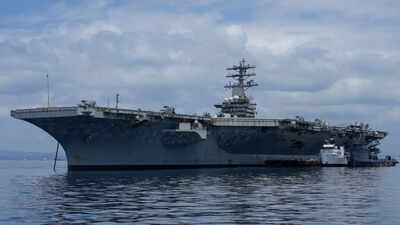
The US aircraft carrier USS Nimitz and its strike group entered the Caribbean Sea amid rising tensions between Washington and Havana.This publication comes at a time when US President Donald Trump has intensified his rhetoric against Cuba and hinted at possible action against the island nation.The carrier strike group includes the Nimitz-class aircraft carrier USS Nimitz, Carrier Air Wing 17 equipped with F/A-18E Super Hornets, EA-18G Growlers, and C-2A Greyhounds, as well as the destroyer USS Gridley and the refueling ship USNS Patuxent.US Southern Command (Southcom), which oversees US military operations in the Caribbean and Latin America, confirmed the deployment on Wednesday.In a post on X, Southcom said: “USS Nimitz has proven its combat prowess around the world, ensuring stability and defending democracy from the Taiwan Strait to the Persian Gulf.”
Trump’s statements after Accusation of Raul Castro
This deployment comes shortly after the US Department of Justice formally charged former Cuban President Raul Castro in connection with the downing of two civilian planes that were operated by the exiled Brotherhood of the Rescue group in 1996.Trump said the administration had Cuba “on our minds” after the impeachment.
“It’s very important,” he said, adding that it was a “very big moment” for Cuban Americans and those who want to reunite with their families in Cuba.The indictment accuses Castro of ordering the shooting down of two unarmed civilian aircraft over international waters in 1996, killing four people. Charges include murder and destroying an aircraft.“For nearly 30 years, the families of four murdered Americans have been waiting for justice,” Acting U.S. Attorney Todd Blanche said in Miami.
Increasing American pressure on Cuba
The Trump administration has steadily increased pressure on Havana in recent months through sanctions, diplomatic pressure and warnings of possible action.US authorities recently arrested former Venezuelan President Nicolas Maduro, raising further concerns in Cuba.CIA Director John Ratcliffe met with Cuban officials in Havana last week and warned that the window for talks “will not remain open indefinitely.”US Secretary of State Marco Rubio, a Cuban-American, also issued a message in Spanish supporting the US fuel blockade of Cuba while blaming the communist government for frequent power outages and economic hardship.
Cuba is facing a deep economic crisis
Cuba faces severe economic problems represented by fuel shortages, food scarcity, and widespread power outages. However, Trump tried to downplay fears of direct military escalation.“There will be no escalation. I don’t think there should be an escalation. Look, the place is falling apart. It’s chaos, and they’ve kind of lost control,” Trump said.The USS Nimitz, commissioned in 1975, recently participated in joint naval exercises with the Brazilian Navy off Rio de Janeiro before entering the Caribbean.