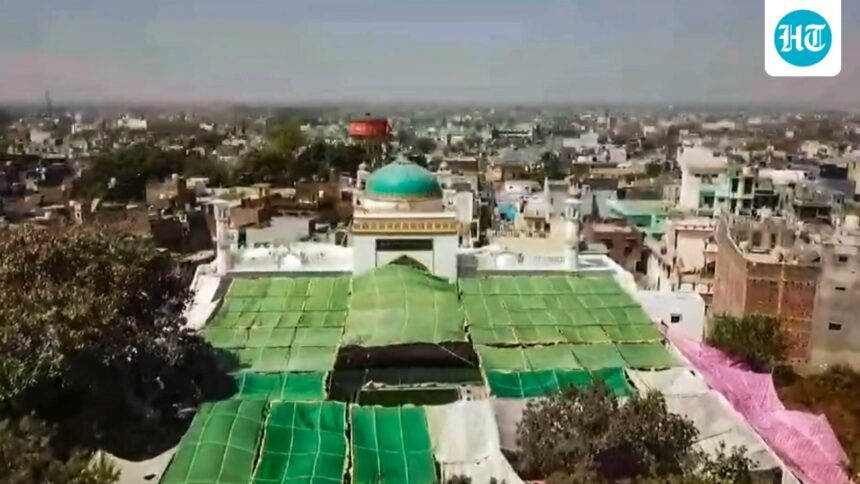
The management committee of the Shahi Jami Mosque of India (ASI) protected mosque in Sambhal which is the subject of an ongoing litigation in the Supreme Court has sought urgent permission from the ASI to repair a damaged boundary wall and a dilapidated main gate.

Hindu petitioners have opposed the move, saying it is an attempt to destroy evidence of the existence of a temple they believe lies beneath the structure.
In his letter to the supervising archaeologist of ASI’s Meerut division, committee chairman Zafar Ali said that on February 11, monkeys dislodged a portion of the wall near the police guard post adjacent to the main gate. The message warned that the remaining part could collapse at any time, endangering worshipers and police personnel present at the site. The committee added that the main gate was also in an advanced state of deterioration, posing a daily danger to large numbers of passers-by, and called for immediate intervention to repair them.
The application found no applicants on the other side of the dispute. “This permission should be completely denied. We will ensure that it is denied. It is an attempt to cover up the Hindu artefacts in this temple in the name of restoration,” said Hari Shankar Jain, lawyer and lead plaintiff in the civil suit pending before Civil Judge (Higher Division), Sambhal. Jains specifically claimed that the main gate contained significant archaeological evidence indicating that any repair work would disappear permanently. He added that the petitioners will go to the competent courts to deny permission.
ASI’s lawyer Vishnu Sharma, who had earlier opposed the committee’s demand to whitewash the mosque before Ramadan in February, said the legal status of the mosque was pending before the Supreme Court. He pointed out that any structural or maintenance decision must follow the directions of the Supreme Court.
Last year, the committee had asked the Allahabad High Court for permission to whitewash the building. The court agreed to this conditional on an inspection by ASI; The ASI report filed before the Supreme Court found that the mosque was structurally sound. The report also noted that over the years the committee had completely replaced the original floors with tiles and painted interior surfaces with thick layers of colored enamel, to hide the monument’s original texture.
Adding to the legal complexity is a 1927 agreement between the directors of the mosque and the Secretary of the State Council of India, which prohibited the committee from carrying out any repair or modification without the prior written approval of the district magistrate. The ASI and the Uttar Pradesh government have consistently cited this agreement to prevent independent maintenance work by the committee.
Shahi Jama Mosque, one of the three mosques built during the reign of Mughal Emperor Babur between 1526 and 1530, has been a centrally protected monument under the ASI since 1920 under the Conservation of Ancient Monuments Act, 1904 (which became the Ancient Monuments, Archaeological Sites and Monuments Act, 1958). Interestingly, AMASR was recently in the news after the Madhya Pradesh High Court said that the fact that the Bhojshala in Dhar falls within its jurisdiction as a protected monument, means that the Places of Worship Act, 1911 will not apply to it. The court then decided to declare Bhojshala a temple of Goddess Saraswati.
The current legal dispute in Sambhal dates back to November 19, 2024, when a civil suit was filed claiming that the mosque was constructed after the demolition of the Harihar temple dedicated to Kalki. A court-ordered survey conducted on November 24 of that year led to violent clashes in which four people were killed and 30 police officers were injured. A three-member judicial committee was then formed to investigate whether the violence was spontaneous or intentional. Twelve related criminal cases are still pending before the courts, and the ownership dispute is now also before the Supreme Court.
With the Supreme Court considering the matter, any authorization for repair – no matter how structurally urgent the commission’s case – remains conditional on judicial approval, leaving the crumbling wall and the broader dispute unresolved.