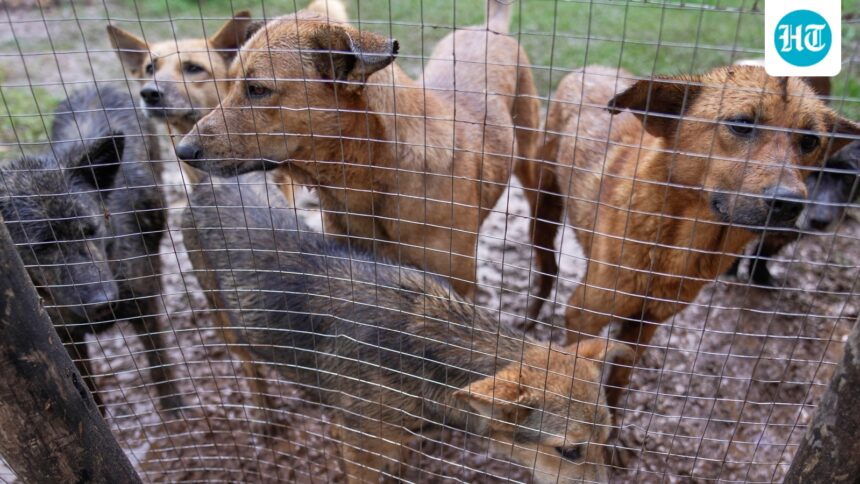
Even as the Supreme Court on Tuesday reiterated its November 2025 directions mandating removal of stray dogs from institutional areas, the capital does not have a single permanent dog shelter, does not have a reliable number of stray dogs in the places covered by the order, and has moved at a crawl to expand capacity since the first directions were issued, stakeholders and several senior officials told HT.

The court order only applies to institutional areas – schools, hospitals, sports complexes, railway stations and bus stops – and not to residential areas or streets. The removal process can only be carried out by municipal authorities after following due process, and not by individuals.
Dog shelters in delhi
Delhi’s first permanent shelter for aggressive dogs – at an estimated cost $3.5 lakh crore, designed to house 1,500 animals – is planned in Dwarka Sector 29 but remains on paper. A senior municipal official, who requested to remain anonymous, said the money was settled only recently. “It may take six to eight months to develop the Dwarka facility. Currently, we do not have any space to keep dogs permanently as the ABC centers are only for sterilization and monitoring,” the official said.
Plans to scale up sterilization infrastructure — with new centers in Bijwasan, Byla Road, Usmanpur, and two sites in Rohini — have also been hampered by inter-departmental delays.
A second MCD official said the agency plans to double its capacity to accommodate 1,600 to 1,700 stray dogs at the Bijoasan centre, which will be used to expand the sterilization program and keep the dogs under supervision.
The official added: “The projects will be accelerated, after the Supreme Court reiterated its order.”
$110 per dog per day
Even when the shelter is built, MCD will need additional sustainable funding to operate it. Civil authority estimates $110 per dog per day in permanent shelters, to cover the costs of feeding, transportation, medical expenses, cleaning and staffing. “Initially the plan was to plan for the cost of keeping a few thousand dogs,” the official said.
MCD does not know how many stray dogs there are in Delhi, or how many dogs occupy institutional spaces covered by the Supreme Court order.
No official census has been conducted for 16 years; The current estimate is as high as one million. A third municipal official said the sterilization drive has been intensified – with 101,394 dogs sterilized between April 2025 and March 2026. “Our field staff are facing threats from FIRs from individuals, but now that the court has made it clear that FIRs will not be lodged, the campaign is expected to accelerate,” the official said.
What the activists said
Maneka Gandhi, a former union minister and animal rights activist, said the court did little more than rewrite its November order without addressing six months of nationwide non-compliance.
She said the extent of the non-compliance forced the court’s hand. “I think during those six months, the Supreme Court realized that there was non-compliance at the national level — and not one state or one district did what they said. And as a result, they said, ‘OK, now if you have a problem, go to the Supreme Court. That’s it,'” she said.
Jagdish Mamjin, former Business Committee Chairman of Unified MCD, author and expert on municipal affairs, questioned whether the Security Council order was practical. “[The order has] It is proven on paper. After more than six months, the Union and state governments, as well as civic agencies, have not implemented it.
“The Supreme Court has directed the arrest of stray dogs from public places… and fencing of buildings to prevent entry and movement of stray dogs. Has this been implemented anywhere in the country? Do the civic agencies and state governments have land available to build several dog kennels for the permanent maintenance of stray dogs? The kennels should have adequate medical facilities and staff… No appointments or arrangements have been made for veterinarians, dog handling staff, specially modified vehicles/cages etc.”