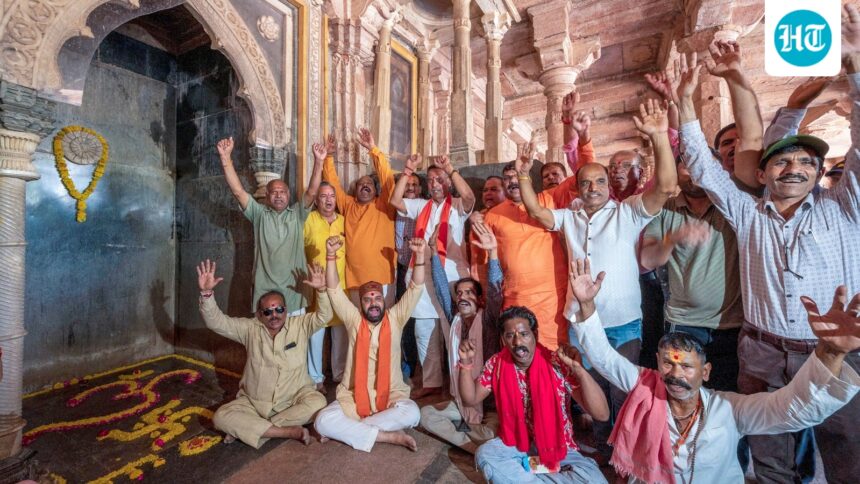
The Archaeological Survey of India (ASI) has allowed Hindu devotees unrestricted daily worship rights at the Bhojshala complex in Dhar district of Madhya Pradesh, after the Indore bench of the Madhya Pradesh High Court declared the disputed site to be a temple dedicated to Goddess Vajdevi (Saraswati).

The ASI order, dated May 16 and reviewed by HT, supersedes all previous orders, including the April 7, 2003 directive dividing access between Hindu and Muslim worshipers on separate days of the week. The Supreme Court order quashed this two-decade-old order.
The May 16 order added that the site will remain a protected monument under the Ancient Monuments, Archaeological Sites and Monuments Act (AMASR) 1958, with worship times decided by the supervising archaeologist in consultation with the district administration.
The 11th-century monument has been the subject of a long-running dispute, with Hindu groups asserting that it is a temple dedicated to the goddess Saraswati, while the Islamic sect asserts that it is a mosque dedicated to a Sufi saint.
The Supreme Court on Friday said the site was a temple, based on a 2024 Archaeological Survey of India report that said the Bhojshala-Kamal Mula Mosque complex was constructed using remains of earlier temples, with the mosque built centuries later.
The court also quashed the 2003 ASI order that restricted Hindu prayers and allowed prayers at the site, and said the Muslim side can approach the state government to acquire land at an alternative site in Dhar district to build a mosque.
Advocate Vishnu Shankar Jain, representing the Hindu petitioners, said: “The ASI order has brought the Supreme Court directions into effect and Hindus can now visit and worship in the complex without any restrictions.”
Dhar City Judge Waqar Sadiq said that the Muslim petitioners would approach the Supreme Court.
He added, “The Muslim community has no intention of accepting any alternative land.”