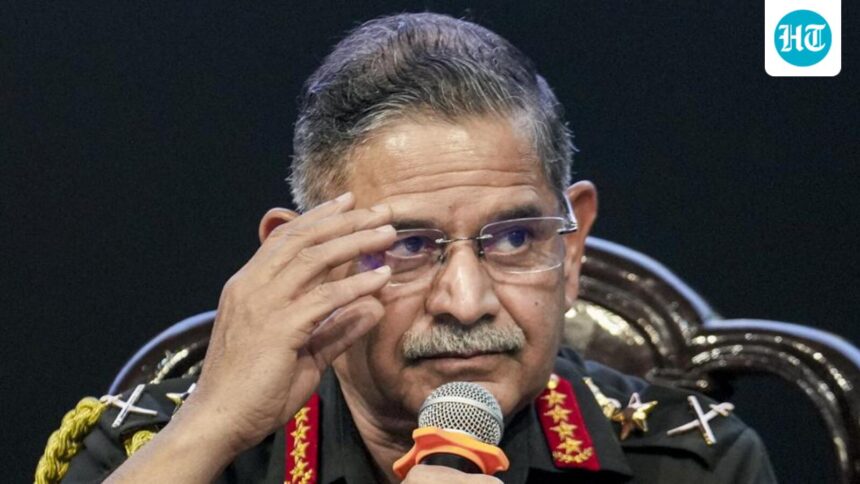
Army Chief General Upendra Dwivedi on Tuesday said Operation Sindoor – India’s response to the April 22 Pahalgam terror attack – presented military precision, diplomatic signals and economic resolve as a coherent national act.

“It struck and dismantled a deep infrastructure of terrorism, punctured a long-standing strategic assumption (Pakistani nuclear blackmail), and then deliberately and intentionally stopped,” he said at a symposium organized by the Center for Land Warfare Studies.
Operation Sindoor, which began in the early hours of May 7, 2025, was New Delhi’s strong response to the Pakistan-backed Pahalgam terror attack that killed 26 people. It caused four days of strikes and counter-strikes with combat aircraft, missiles, drones, long-range weapons and heavy artillery before the two sides reached an understanding on cessation of all military actions on May 10.
The army commander said: “The deliberate pause after 88 hours was intelligent power in its fullest expression, as we know exactly which tool to use, with what intensity, and when to transform the military moment into a strategic moment.”
On May 8, Defense Minister Rajnath Singh said that Operation Sindoor signaled India’s collective resolve and new military ethos, and that the “short-term, deep, high-intensity, high-impact operation” had forced Pakistan’s surrender.
Dwivedi said the strategic weakness today is not military shortages but dependence on foreign supply chains, critical minerals and digital infrastructure. “Resilience means systematically eliminating those dependencies not as an economic preference but as a security necessity. It involves strategic partnership with like-minded countries, as well as encouraging government strategic partnership with Tier 1 industries for sustainable production lines.”
He added that whoever controls the technology stack in the next decade will tend to control the outcome of the conflict. “We should not just absorb emerging technologies. Rather, we must work to localize them, operate them, and lead them. As they say, the follower pays the price, and the leader sets the terms.”
He added that contemporary conflicts now impose sustained demands not only on armed forces but also on industrial production, research systems and governance structures. “We must build a defense industrial base that is not only self-sufficient, but strategically competitive, transforming national security requirements into industrial capacity and ultimately into export leverage.”