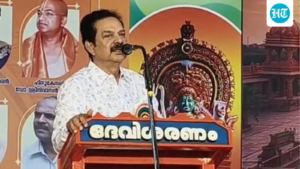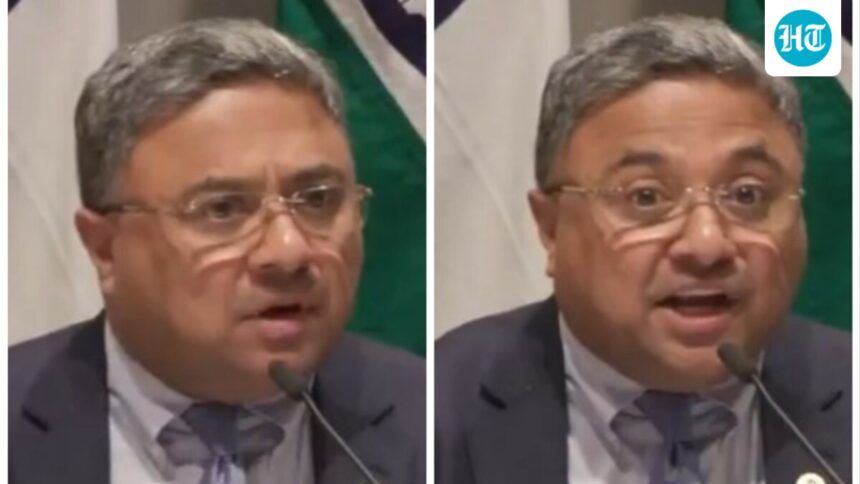
MEA correspondent Sibi George emphasized India’s cultural heritage and commitment to equality and human rights, and argued against questioning media freedom.

The lack of media interactions during Prime Minister Narendra Modi’s joint press statement with his Norwegian counterpart on Monday during his trip to Europe came under scrutiny in a subsequent Ministry of External Affairs (MEA) briefing, where journalists pressed officials over the Prime Minister not taking questions from “the freest press in the world”.

Prime Minister Modi is currently in Norway on the fourth leg of his five-nation tour, and was scheduled to head to Italy on May 19. He arrived in Oslo after visiting the United Arab Emirates, the Netherlands and Sweden.
A Norwegian newspaper commentator Helle Ling on X shared a video of PM Modi leaving the joint statement venue and said in the caption that PM Modi did not answer her question. “The Prime Minister of India, Narendra Modi, did not answer my question. I did not expect him to do so,” she said in the post, sharing the video in which a woman can be heard saying out loud: “Why don’t you take some questions from the freest press in the world.”
The journalist wrote with the video: “Norway ranks first in the World Press Freedom Index, and India ranks 157th, competing with Palestine, the UAE and Cuba. Our mission is to question the powers with which we cooperate.”
Exchange tension in the MEA piston
Prime Minister Modi’s press post as he exited the press conference – which sparked mixed reactions – was also leaked to a press conference at MEA during the Prime Minister’s visit later, where Indian officials faced questions about “trust” and “human rights”.
“Why should we trust you,” asked the same Norwegian journalist who posted a video of PM Modi, adding, “Can you promise that you will stop the human rights violations happening in your country.”
She also wondered whether the Prime Minister “will start taking critical questions from the Indian press?”
In response, Middle East Affairs (West) Minister Sibi George gave a summary of ‘What is India’.
Let me give a background on what India is… What is a country? The state today has four elements. One, population, two governments, third sovereignty, and fourth territory. So, this is what makes a state a state. We are proud…that we are a civilizational country that is 5,000 years old. Continuous civilization, continuous civilization. “I have contributed greatly to the world.”
While narrating everything that came from India, George can be seen asking someone to let him answer the question without interruption. “Please don’t interrupt me,” George said, looking angry.
He watches
“You asked why a country should trust India, let me answer that question… India is a civilizational country that has something unique to offer the world… The whole world has suffered from Covid… What did we do? We did not hide in the cave, we did not say we will not save the world. We came out to extend a helping hand to the world… This builds trust, and we are very happy to appreciate this trust.”
George went on to resolutely list global platforms, such as the G20 summit and the AI summit, where India raised key issues and brought confidence, and engaged in another exchange with the journalist – who immediately demanded answers – over being allowed to finish his talk.
George said: “Please let me answer… That is my prerogative. You are asking a question, not asking me to answer in a certain way.”
‘Go to court’: MEA’s bold stance
Sebi George then emphatically asserted, “We hear a lot of people asking why this, why that, but let me tell you this. We are one-sixth of the world’s total population, but not one-sixth of the world’s problems. We have a constitution that guarantees the basic rights of the people. We have equal rights for women in our country, which is very important.”
Sibi George then said that India has given equal rights to women since the first day of independence, unlike many other countries, which shows its firm belief in equality and human rights.
“In 1947, we gave the freedom to vote to our women. We gained freedom together and had the right to vote from day one. I know many countries where women got the right to vote decades later. We believe in equality, we believe in human rights. If anyone’s rights are violated, they have the right to go to court. We are proud to be a democracy.” He said.
Sibi George said people do not understand the vast scope of India’s media system and are making statements after reading some reports published by “ignorant NGOs”.
“You know how many stories there are here. We have a huge number of breaking news coming every day in the evening. At least 200 TV channels in Delhi alone, in English, Hindi and many languages. People have no understanding of the size of India. People have no understanding. They read, you know, one or two news reports published by some ignorant and ignorant NGO, and then they come and ask questions,” he said.
Responding to another query about PM Modi not taking media questions, Sibi George told a journalist that as a state in charge of the visit, it is his responsibility to address the media.
“I’ve been doing it and I’ll continue to do it,” George said.
Meanwhile, in another post on X, the Norwegian journalist said that he and her colleague raised questions about why India should be trusted, “given the human rights violations, and also about the visit.”
“I tried several times to get them to talk specifically about human rights, but I was unsuccessful,” she said, adding that the actors spoke about India’s efforts during Covid as well as yoga, among other things.
In a separate post later, the woman clarified that she was not a “spy”, saying she never thought she would have to write this. It was not clear who or what she was referring to.
“I never thought I would have to write this, but I am not a foreign spy of any kind, sent by any foreign government,” she said in the post, stressing that her work is journalism, “primarily in Norway now.”

Nayanika is a Senior Content Producer at Hindustan Times, based in New Delhi, with over six years of experience in the digital media industry. It specializes in providing clear, in-depth coverage across public, national and international events, with a strong focus on breaking news and in-depth explainers. Known for her ability to decipher complex developments, she enjoys deconstructing multi-layered political and policy issues into accessible, reader-friendly narratives that deliver information without distraction. She previously worked in India’s leading newsrooms, including India Today, News18 and Outlook, where she has been tracking news, covering major events for the last six years and leading teams. Nayanika holds a Master’s degree in Political Science and has a keen interest in international relations and world affairs. Her academic foundations shape her analytical approach to stories, enabling her to connect the dots between local events and broader geopolitical currents. She is particularly drawn to stories that require context, nuance, and clarity—turning complex topics into compelling reads. Outside the newsroom, Nayanika is a passionate gourmet who loves to cook and share meals with her loved ones. When she’s not writing or keeping up with the latest headlines, you can often find her exploring local markets for the freshest ingredients, looking for inspiration for her next culinary experiment.Read more