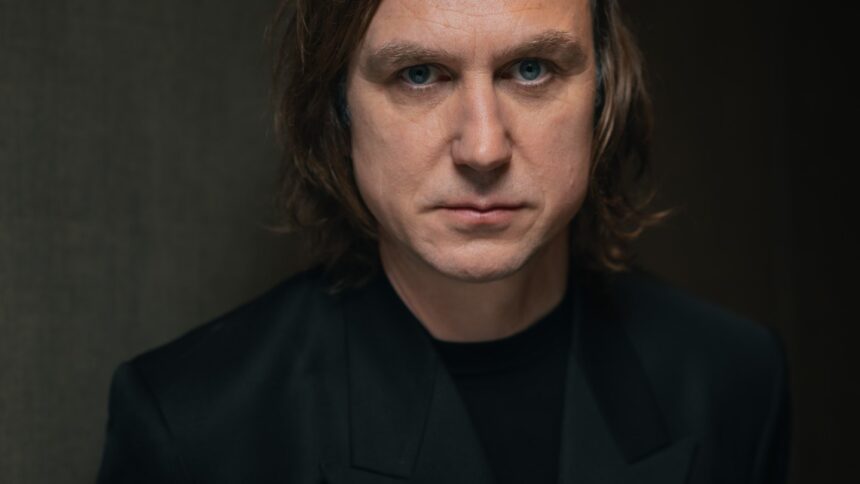
The world is about to see more of Lars Edinger.
The German actor is a towering leading man in his country, both on stage, as a member of Berlin’s Schaubuhne Theater troupe, and on screen, playing an introverted husband in a toxic relationship in Maren Ade. everyone (2009) to Matthias Glasner death (2024), the most disruptive conductor of the Berlin Philharmonic Orchestra since Cate Blanchett’s Lydia Tarr. He has wandered around the outskirts of the international scene. He was friends with Kristen Stewart’s famous employer in the Olivier Assayas film. Personal shopper (2016), playing the main Nazi villain in the Netflix limited series All the light we can’t see (2023) and last year, he was the crazy wallet thief pursued by George Clooney in Noah Baumbach’s film Jay Kelly.
But soon the 50-year-old actor will join the DCU and plan to conquer the world and bring it together as Brainiac, the villain in James Gunn’s film. Superman sequel Man of tomorrow.
Before that, Cannes was getting a double dose of Lars. He has two films at the festival this year. He plays Klaus Barbie – the notorious “Butcher of Lyon” – in Laszlo Nemes’ World War II drama. Mulanis featured in competition, an architect who collaborates with both the Nazi and Communist regimes in East Germany in Volker Schlöndorff’s sweeping historical drama. Visitplays its out-of-competition premiere at Cannes.
Edinger likely won’t be able to make it to the Croisette this year, as his duties at DCU mean he will be filming in the US during the festival, but he is speaking to Hollywood Reporterthought about playing everyone from Nazi war criminals to comic book supervillains, and why he’s drawn to characters that force audiences to confront uncomfortable parts of themselves.
Why I said yes to the role of Klaus Barbie in… Mulan? It’s as if you were asked to play Hitler.
Well, honestly, it was the guy Klaus Barbie himself that attracted me. I probably wouldn’t have said yes if it had been another fictional Nazi character. I never understood why actors flat-out refused to play Nazis, because I always assumed those roles were attractive and complex. But then, my last role – which I told myself would be my last Nazi role, my last wartime role – was him Persian lessons. This was an extreme experience, where I came face to face with my demons. My father was born during the war. My grandfather fought in it. I was raised by these people. I grew up with them, and it has a very direct impact on my character, my personality – it’s always there in my life.
After that movie, I realized I’d better free myself from that, and stop going back to that trauma over and over again. Because it is a trauma that Germans carry with them: World War II, the Holocaust, the Holocaust. Then came a movie with Shawn Levy, All the lights we can’t see. And I was drawn back, because colleagues like Mark Ruffalo were involved, and the fact that he was American, and Shawn Levy made it interesting. But I said to myself: Definitely the last time.
Then the call came from Laszlo Nemes. I thought about going back to Son of Saul — A very good film and a very skillful use of the technique of telling a concentration camp story from one person’s perspective, mainly through the face of the protagonist.
I thought, “László Nemes is certainly an interesting interlocutor to engage with this topic again.” And regarding Klaus Barbie specifically – you are absolutely right, he occupies an extreme place; There is almost no one who does not know this name. This is what attracted me: dealing with this character. Especially with the history surrounding him – not in the film, but what I find very fascinating: how he was treated after the war, how long he remained active, even working for the Americans and ending up involved in the drug trade. As a biography, this is quite astonishing and reveals a lot about an era. That’s what really interests me: when something documents a period, it captures what defines the time.

Do you find empathy for all the characters you play, even the one who seems like a monster?
Of course, my goal as an actor is to feel empathy for the character — empathy in the sense that I understand it, which is that I’m trying to inhabit the character’s logic and perspective. My method is to start by gathering as much material as possible. With Klaus Barbie, this is possible – you can watch how he spoke, and how others described him. There is the wonderful documentary by Max Ophuls Terminus Hotel (1988), where survivors recount their experiences with him.
I absorbed all of that, and then at a certain point I put it aside and just worked from the script, from the script. Experience has taught me that too much imitation can paralyze you. I’m trying to be more free, and treat it as a fantasy again. Interpretation by Klaus Barbie in Mulan Different from the original. The historical Barbie is described as being extremely sadistic and physically aggressive – someone who would enter a room and hit people on the head, leaving them unconscious during interrogation. Often, they could not even remember what they said next, because the torture had rendered them insensitive. This violence, this physical violence, does not appear in our film. This was a deliberate choice – I discussed it with Laszlo, and at first I wasn’t sure it was right. But what he emphasizes is that we are dealing with imagination.
And there’s a tension there: the film is always tempting the viewer to step out and think, “That’s how it was.” This is what the movie plays with. That’s the big responsibility you have, and the big danger is that you’re partly falsifying history, because the viewer always thinks they now know what it was like. You are watching Fall (2004), and leave the cinema believing that you know what happened there [Hitler’s] The basement. He is, in a sense, a killer. You have to keep this responsibility in mind as an actor.
Your other role in Cannes is visit, Which also shows someone working within a totalitarian regime: an architect, an artist, whose choices make him complicit, first with the Nazi regime, then with the East German dictatorship. Was that the draw?
Yes, exactly – the topic is actually very comparable. In that film and in the source novel, The Architect’s Wife [played by Susanne Wolff] It is more important, while my character works very well within the system at first. This was very important to me, because in hindsight, it’s always easy to say you would have resisted, you would have walked away. But from within the system, from within time itself, it is often not so simple.
I can equally imagine that generations after them will distance themselves from certain behaviors – for example, capitalism has its dark sides that we often ignore, as we work within the system knowing full well how unfair it is.
When I say that I play a sympathetic character, I mean that I want to bring the audience into the same struggle that the character is experiencing, and also feel the parts that they share with these characters. The greatest danger in art and filmmaking is keeping the art at arm’s length, observing from a safe distance. My great ambition is always to engage with these characters, to convey the tones I share with them, and to put myself in relationship with them rather than at a distance from them. To be truly empathetic.

You don’t seem interested in being liked. You are constantly choosing roles that are not designed to win an audience. Is provocation part of the goal?
I think the classic hero character is actually a much less realistic character, it’s pure fantasy. And you react to him differently, because the hero creates a distance: you feel that you cannot recognize him, and you look at this figure.
There’s a quote by Charles Manson – the serial killer – who said: “Look at me and you’ll see a fool. Look at me and you’ll see a God. Look directly at me and you’ll see yourself.” Obviously it’s always interesting to quote a serial killer – but the idea itself is interesting: you can recognize yourself in the figure. This is the highest ambition of art: confronting people with themselves. To be Being likable is not really a criterion. I pursue characters – or they pursue me – that I feel bring out certain parts of myself, and of the viewer, that they may not be aware of but can discover there. It is always a form of reflection and self-examination. The anti-hero, in my experience, is a much better vehicle for identification than the classic hero.
And yet you play the villain in the new Superman movie, Man of tomorrow. What attracted you to a franchise like this?
It’s not as different as you think. Even if they seem surprising at first, these films have a serious philosophical ambition. They carry a lot of metaphorical weight for me. Let’s just take the word “super” – it is used as a superlative for something excellent and wonderful. But the word “super” really just means “above” or “above.” So Superman is the superior human. You have a super ego. There is already a deep psychological dimension built in.
Last week I was on set during rehearsals and she asked me if I could watch some parts of the filming, which had already begun. I saw an actor dressed as Superman, hanging on wires in front of a blue screen. I looked at that picture and thought: This is the essence of fiction. It’s an image as significant as Hamlet holding the skull: Superman, in that Superman pose, hanging from wires in front of a blue screen.
Being in the world of Superman was never a dream or a burning desire of mine. But now that it has happened, I can see a certain inevitability in it, almost inevitable.
You are known as a theater actor – you village famous. Is there a relationship between your theatrical work and what you present on screen?
Yes, the theatrical quality has helped me greatly in this context SupermanAlso, because it includes a different record of performance, one that is primarily unrealistic and allows for a more expressive style of play. When I watch a movie like James Gunn Guardians of the GalaxyI find it has a great theatrical quality – in dealing with good and evil, and in a certain tendency towards metaphor. Brainiac is described as the embodiment of Satan. I find that almost Shakespearean. The King, the Fool – there are a lot of similarities for me.
German actors are often labeled as villains abroad. Does that bother you?
Well, that’s not really my way of thinking, honestly – I can understand that, but I think one of the great mistakes of our time, or perhaps of humankind in general, is the desire to divide everything into good and evil. In psychology this is called black and white thinking – extreme thinking. It’s described as a cognitive distortion, a form of insanity, which I find interesting: it’s basically borderline behaviour, to say that there is only black and white, good and evil, and to lose sight of how the world actually presents itself – in the contrasts, in the gray areas, in the nuances.
I think that’s why I try, even with dark characters, to portray them as contradictory beings. I’ll do the same thing when I play a good person: I’ll look for the darkness within the good. My general ambition in art is to play against this kind of thinking, against moral simplification. I share a lot [Bertolt] Brecht – I take a Brecht reading tour through German-speaking countries, always concluding with “An die Nachgeborenen.” [which translates] “For those yet born.” “I live in a dark time,” he begins. Brecht describes those dark times. I guarantee you: Everyone in the room hearing this for the first time will think I’m talking about now, our present moment. But it was written [before] World War II. It describes something essential to human beings – what makes us human. “The fate of man is man.” This is what interests me: studying what makes a person. That’s why I care to say: With Klaus Barbie, it’s not about the monsters. It’s about humans.