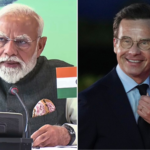
Tata Electronics and Dutch chip equipment major ASML signed an agreement on Saturday to boost India’s semiconductor manufacturing ecosystem, as Prime Minister Narendra Modi and his Dutch counterpart Rob Jetten held talks on boosting cooperation in areas ranging from trade to technology.
The Netherlands was the second stop on Modi’s five-nation tour, which began in the United Arab Emirates on Friday. Besides their bilateral meeting, Modi and Cetin also held discussions with CEOs of leading Dutch companies in sectors such as energy, ports, health, agriculture and technology.
Prior to the meeting with the CEOs, ASML and Tata Electronics signed the agreement in the presence of the two leaders, who welcomed the decision of the two companies to partner on India’s first front-end semiconductor manufacturing unit in Dholera, Gujarat.
“Through this partnership, ASML will enable Tata Electronics’ upcoming 300 mm (12″) semiconductor plant to be successfully set up in Dholera, Gujarat. This collaboration is an important step in the context of extensive strategic cooperation between India and the Netherlands in the field of critical technologies, such as semiconductor technology,” a joint statement from the two companies said.
ASML is best known for its monopoly on photolithography machines, which are essential for the production of advanced microchips. Tata Electronics is setting up its first semiconductor chip manufacturing plant in India with an investment of… $91,000 crores.
The collaboration between the two companies will focus on deploying ASML’s suite of advanced lithography tools and solutions for Dholera manufacturing. The use of industry-leading ASML technologies is expected to ensure smooth operations at India’s first commercial 300mm semiconductor plant, the statement said.
The partnership will look at accelerating local talent training, lithography-intensive skills development, and proactive supply chain resilience. Given the importance of lithography in chip manufacturing, the two companies will work to develop the R&D infrastructure necessary for the manufacturer’s long-term success.
Tata Electronics’ Dholera unit aims to manufacture semiconductors for applications across automotive, mobile devices, artificial intelligence and other key verticals to serve customers globally. Tata Electronics has partnered with key global customers and ecosystem companies, starting with Powerchip Semiconductor Manufacturing Corporation in Taiwan.
Addressing the Dutch CEOs, Modi noted that more than 300 Dutch companies are “part of India’s story” because of their trust in the country. This makes the Netherlands the largest investor in India and the second largest trading partner of Europe.
While NXP Semiconductors, Philips and Prosus are creating world-leading solutions using Indian talent, companies like APM Terminals, Damen Shipyards Group and Royal Vopak are transforming ports, shipping and logistics sectors in India, Modi said.
“Optimism towards India is clearly visible in all your words today. We guarantee that this optimism will translate into results,” he said, adding that India is a symbol of size and stability. “No one in the world can match India’s speed – whether in infrastructure, clean energy, or connectivity. That is why India contributes 19% to global growth today.”
In the context of stability, Modi said his government has “transformed our economic DNA” through ongoing reforms. “Our direction has been clear: to provide policy predictability to the private sector and expand opportunities for it,” he added.
The India-EU FTA, negotiations for which were concluded in January, will become a strong foundation for shared prosperity, he added.
“In order to unleash the full potential of this FTA, Prime Minister Jaiten and I are taking several important decisions today. We are elevating this trusted India-Netherlands partnership into a strategic one. We are launching an ambitious joint roadmap on green hydrogen. We are making our technology relationship future-ready,” Modi said.
Earlier in the day, the Leiden University Library returned the 11th century Chola copper plates to the Indian government in the presence of Modi and Jitin. The group of 21 large panels and three small panels are royal charters issued by the Chola kings. These charters formalize the dedication of Annamangalam village to the Buddha Vihara called Cholamanivarma at Nagapattinam in Tamil Nadu. The paintings contain texts in Tamil and Sanskrit.
The Ministry of External Affairs said the return of these objects is significant “as they are not just artefacts of the past, but a priceless story of India’s heritage and civilisation”.
Modi also met with King Willem-Alexander and Queen Máxima of the Netherlands at Huis Ten Bosch Palace in The Hague, and exchanged views on strengthening bilateral relations, including by deepening people-to-people ties. The leaders expressed their satisfaction with the ongoing initiatives in the areas of education, innovation, semiconductors and green partnerships.