


Indian consumers may soon feel the pinch a little harder.Your budget could be headed toward higher prices, even if the warning signs haven’t hit your full grocery bill yet. Global analytics firm Crisil noted that the sharp rise in wholesale inflation may soon factor into daily household expenditures, and today’s relatively weak retail inflation may become more expensive in the coming months.In a recent Quickonomics note, the company highlighted the growing gap between Wholesale Price Index (WPI)-based inflation and Consumer Price Index (CPI)-based inflation, arguing that the current mismatch may not persist.April 2026 saw CPI inflation rise sharply to 8.3%, a significant rise from 3.9% in March, while CPI inflation rose only marginally to 3.48% from 3.40%. The main driver behind the rise in wholesale inflation was the conflict in the Middle East, which led to higher global commodity prices and intensified pressures on energy and industrial inputs.
According to CRISIL, the full impact of these disruptions has not yet been meaningfully reflected in consumer inflation.“In April 2026, CPI-based inflation (at 8.3%) decisively outpaced the benign CPI, which was at 3.5%, influenced by the conflict in West Asia. The upside risk of conflict-induced inflation was not meaningfully reflected in the CPI. Between March and April, CPI inflation gradually moved to 3.48% from 3.40%, while CPI inflation rose to 8.3% from 3.9%, reflecting higher input and energy costs.”
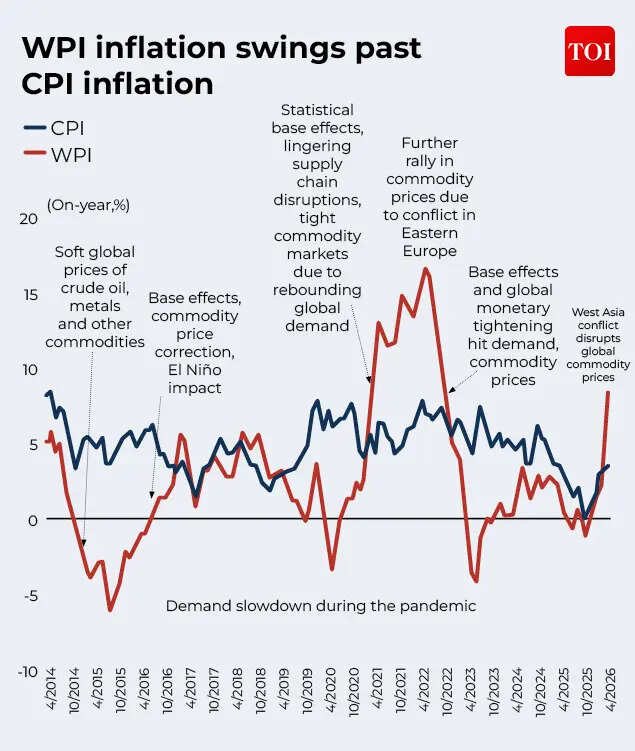
Credit: CrisisThis means that while households are currently experiencing relatively moderate inflation in the retail sector, producers and manufacturers are actually facing a sharper rise in costs.This difference stems from the way the two inflation measures are structured, Kreisel explained.
- WPI captures price movements in wholesale markets and is more closely linked to production costs and commodity cycles, making it highly responsive to global disruptions.
- On the other hand, the CPI tracks the prices consumers pay for goods and services and includes a broader basket, including services.
Because of this difference, the wholesale price index has historically been much more volatile. Crisil noted that during the 2017 to 2026 fiscal period, CPI volatility was about three times that of the CPI.The recent increase in wholesale sales was particularly evident in the fuel and raw materials categories.Between February and April:
- The inflation rate in crude oil prices increased from -1.3% to 88.1%.
- Furnace oil jumped from -15.5% to 74.2%
- Natural gas prices increased from -4.7% to 24.9%.
- Metal prices accelerated from 11.5% to 12.1%
The report also highlighted rising inflation in chemicals, plastics, fertilisers, metals and manufacturing inputs, all of which form the backbone of industrial production.
| Consumer Price Index Inflation Rate (%) | February 26 | March 26 | April 26 |
| Metals | 11.5 | 3.2 | 12.1 |
| Crude oil | -1.3 | 51.6 | 88.1 |
| Natural gas | -4.7 | 3.9 | 24.9 |
| Liquefied petroleum gas | -4.6 | -1.5 | 10.9 |
| Oven oil | -15.5 | 9.7 | 74.2 |
| Manufacture of vegetable and animal oils and fats | 0.4 | 1.7 | 4.4 |
| Manufacture of basic chemicals | 3.4 | 4 | 7.8 |
| Manufacture of fertilizers and nitrogenous compounds | 1.3 | 2.6 | 3.6 |
| Manufacture of paints, varnishes and similar coatings | -0.3 | 0.1 | 2.2 |
| Manufacture of plastics and synthetic rubber in its primary form | -0.3 | 1.8 | 8.8 |
| Manufacture of polyester flakes or polyethylene terephthalate flakes | -4.5 | 5.5 | 16.7 |
| Manufacture of rubber and plastic products | -0.2 | 1 | 2.1 |
| Manufacture of other non-metallic mineral products (glass, ceramics) | 0.5 | 1.3 | 2.3 |
| Basic metal manufacturing | 4.9 | 4 | 7 |
Such increases are important because high production costs often do not remain confined to factories for long.From wholesale to consumers’ pocketsCrisil warned that sustained wholesale inflation tends to fuel consumer inflation over time as companies take on higher costs to protect profit margins.
While transmission is not immediate, sectors facing long-term cost pressures may eventually raise prices for end consumers.This could affect fuel, transportation, packaged products and a wide range of household essentials.The agency expects CPI inflation to reach 5.1% this fiscal year, much higher than 2% in the last fiscal year.“Higher PPI inflation means higher input costs for industry. This puts pressure on companies’ margins.
“Faced with a surge in input costs, companies will start passing the same on to end consumers (moving wholesale prices into the CPI) to avoid excessive pressure on margins,” the rating firm said. Factors expected to push retail inflation higher include continued rise in crude oil prices, increasing domestic fuel costs, a depreciating rupee that increases import expenditures, and the possibility of food price inflation due to heatwaves and a lower-than-normal expected monsoon associated with El Niño. At the same time, the statistical downside from last year’s unusually weak CPI reading may exacerbate higher inflation.