

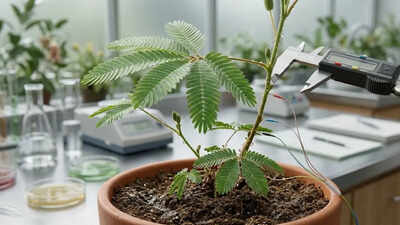
Scientists tested whether the shy plant could actually “count” events
According to the report published in William & Mary, research by Professor Peter Vishton and student Paige Bartosz set out to determine whether plants can perform “census,” the ability to track certain events. They chose Mimosa pudica because of its clear and rapid leaf movements. The team hypothesized that if a plant could learn to anticipate light, it might do so by counting the cycles it has already experienced.
The “shy plant” that counts every step
The researchers wanted to show that plants count rather than just tell time. Therefore, they changed the usual setting for a 24-hour day. They experimented with a “3-day light cycle” with random, non-daily light and dark times, as described in a report published in William & Mary. Surprisingly, plants showed associative learning; They began opening their leaves just before light appeared, showing that they were counting the number of times events would occur rather than following a normal clock.
Intelligence without a central brain
The research focused on comparing “circadian rhythms” and “digital tracking.” Since the lighting patterns were random, the basic internal clock would not work. But it seems that plants can determine the order of cycles. They essentially determined the ordinal position of the dark period cycles, and the light would come next. This points to the idea that plants may learn in a complex way, as if they can calculate what is happening around them.This discovery holds great importance for evolutionary biology. It reveals that creatures can process numbers and learn from their surroundings without needing a central brain or neurons. Interestingly, this type of intelligence may operate at the cellular level through complex chemical or electrical signals. As a result, the research challenges how we traditionally define the mind. It appears that even plants, which lack a mind, have an advanced way of remembering and responding to their environment.
Why define a job Plant intelligence
Professor Vishton points out that this behavior does not parallel human reasoning, but fits the definition of intelligence based on function. Research shows that the Mimosa pudica plant can learn, remember, and use the information to modify its physiological responses in the future. This means that complex thinking may be a fundamental feature of all living cells, not just brain cells.