As Eurovision approaches a breakthrough, Vienna’s divisions over the contest are on full display — especially in the city’s cultural heart, Maria Theresien Platz, where different political factions have staged opposing demonstrations over the past two days.
On Thursday, a small number of Israel supporters gathered at Platz Square, named after the empress who once ruled the Habsburg Empire and is considered among the most anti-Semitic monarchs of her time.
The event, marketed as a Eurovision Flashmob, was anything but mob-like. Participants wore T-shirts that read Mazel Love, held hands and sang Hava Nagila. Some wrapped themselves in Iranian flags dating back to before the 1979 revolution, and as a light drizzle fell, a band played jazz.
However, I was feeling a wave of tension, continuing the tense atmosphere from earlier in the week. A few of the older men in the crowd either belonged to the Secret Service or liked to wear Bluetooth headphones while looking in all directions every few seconds. Police trucks were parked nearby.
Osnot Slomovitz, a longtime Vienna resident who was born in Israel, told me she came to support Noam Bitan, this year’s Israeli contestant, whom she saw perform live. “It was amazing,” she said. “The song is very good.” Bitan and Israel will compete against 24 finalists on Saturday; Odds makers consider Israel to be the fifth most likely country to win the top prize.
When asked if she wanted to discuss Eurovision politics, Slomovitz replied that it was very complicated. “I am raising my children here and we try to live in peace and quiet,” she said. “We have a lot of security in our area – which is sad actually, but this is the way we have to live.” The competition continued this year with Israel, but without five boycotting countries and a group of sponsors who also withdrew.
Nearby, a woman wearing a keffiyeh dotted with Stars of David stood next to two well-dressed men in matching olive-green jackets; Their names were Amit Kotler and Yaniv Dornbusch, both of whom were covering Eurovision for Israeli publications.
Security for Israeli contestants is so strict that even TV broadcast directors historically do not know all the protocols, said Kotler, who has been writing about Eurovision since 2018 and works as a presenter for Channel 13 News in Israel. This year, the Shin Bet, Mossad and Austrian elite units are guarding the racer, according to reports.
Kotler pointed to a procession of trucks with tinted windows making their way around what looks like Westbahnstrasse, which borders the stadium where the Eurovision contest is being held, led by several police guards. He said that Noam was in one of them.
However, Kotler says Vienna felt much more comfortable than the last two Eurovision editions he covered in Basel and Malmö. “Last year, there was not a single day on our team that he didn’t break down and cry,” he says. “The reception was so hostile.”
In the 2026 press barracks, the Israeli press team shares tables with German and Greek reporters. “Greek journalists love us,” Kotler says. “One of them was wearing a hostage pin last year, so we started sitting next to them.”
However, none of the journalists seem particularly optimistic about Israel’s future in the competition. “If we win, it will be the end of Eurovision, I think,” Dornbusch said. “It’s going to be complicated,” Kotler interrupted.
***
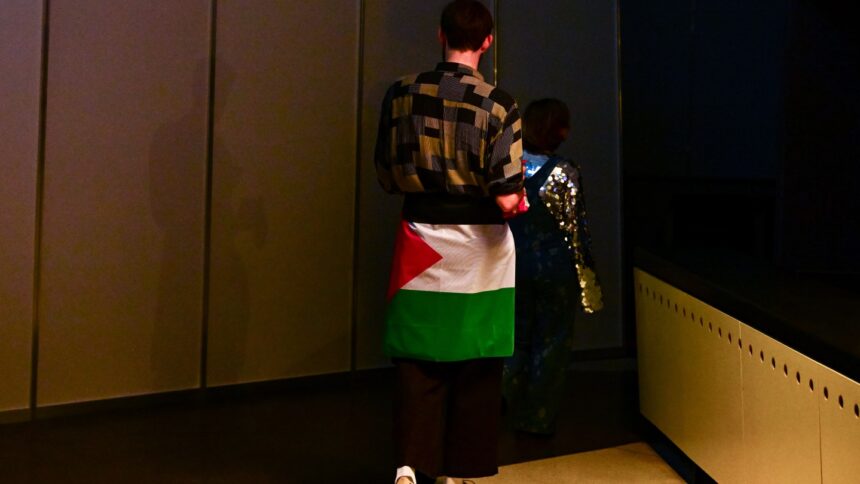
The next day, a different crowd descended on Maria Theresin Square. A group called Palestine Solidarity was hosting an alternative “singing protest” to coincide with Nakba Day, when Palestinians mourn the loss of their lands after the 1948 war that created the modern state of Israel.
Flyers for the event have spread everywhere across Vienna over the past month, featuring a microphone filled with stage blood and the Eurovision logo engulfed in flames.
More than a hundred demonstrators attended the event, which was co-sponsored by former Pink Floyd member Roger Waters. Many of them wore keffiyehs and watermelon earrings and waved Palestinian flags. Protesters also hung banners along the famous hedges surrounding Vienna’s famous Natural History Museum.
One woman held aloft a sign reading “I hate neutral bitch,” a reference, I believe, to the European Central Broadcasting Union, whose founding regulations pledging neutrality look outdated to many in 2026. (A few days ago, Amnesty International called Israel’s participation in Eurovision a “betrayal of humanity.”)
On stage, artist and educator Tobuki, a self-described pan-Africanist, helped lead the proceedings. “Silence is violence,” he told the crowd. “So it’s great to be here, and it has to be much louder so that people in the Museum District can hear us,” he added, referring to the café set up for Israeli Eurovision fans. Notably, the Israeli fan café was only achieved after Vienna’s most popular café chain rejected the prospect of hosting Israeli fans. Recently, it has been distorted.
Next to him, a singer named Nina Malika explained the importance of confronting the Eurovision “propaganda” with a “much more beautiful musical protest.”
“The settlers can continue their path with impunity, yet the terrorist apartheid state is still invited to participate in Eurovision,” she said. “The boycott of Israel is certainly necessary today, including in the field of arts.”
***
Back at the press barracks, each table was vaguely organized by nationality within a conference space decorated with pink and purple hearts. It seemed suspiciously like in high school, where journalism badges determined not only where you belonged but also the prestige of your publication, your station within the journalistic caste system.
However, my semi-final rehearsal was technically amazing. The first thing I notice is how gracefully the stage lights swirl—“like ballerinas,” I write in my notes—and the way the stairs glow in a breathy interlude that suggests awareness.
Cameras also slide silently, with the precision of surgical robots.
Even more impressive are the stagehands, who can shift sets between acts in just 35 seconds – giving me hope for humanity in our brave fight against AI. Beyond the 166 million viewers around the world, it’s clear that being on this stage means a lot to many.
That night, I called a friend – an Austrian researcher and big Eurovision fan – to discuss the significance of the event and the potential larger protest tomorrow on the main road leading to the stadium.
She says she is going to protest and Concert.
“I’m so divided,” she said. “I understand why people don’t want to watch Eurovision this year, but I also don’t think that me not watching it helps either party. Basically, I don’t think punishing the whole country [of Israel] Because Netanyahu’s policy is fair.”
She says she was upset last year when the crowd booed Yuval Rafael – who survived the October 7 attack when he pretended to be dead under the bodies of his murdered friends. “I didn’t think that was true,” she says.
“One of the reasons I like Eurovision is that it has been somewhat naive historically,” she continues. “It’s like this perfect world where you can pretend, for one night, that everything is fine. You can imagine a future where all the countries can compete against each other with ridiculous sets and costumes and fire and wind effects.”
“But,” she adds. “I also understand why some people find it impossible to have fun, especially this year,” he added.