Logo text
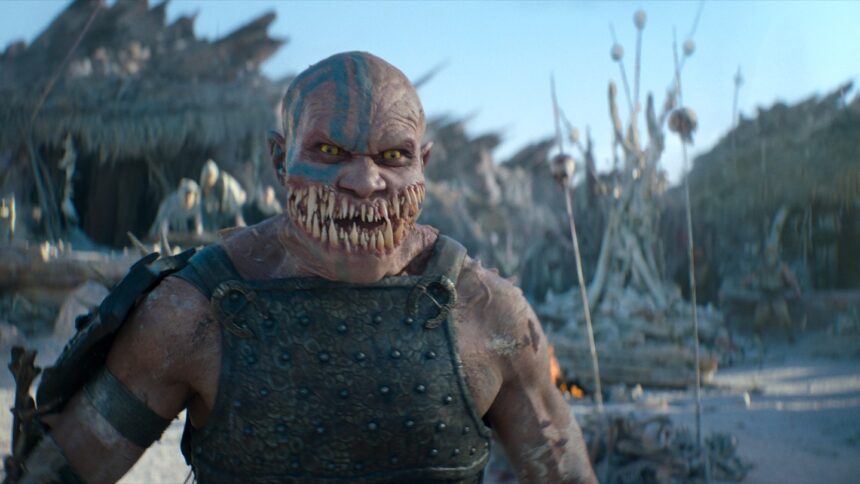
In the fall of 2021, just weeks away Mortal Kombat Opening in theaters, director Simon McQuaid created a doc examining what the film did right, what it could have done better, and what he wanted in a sequel. Among his dream characters: Baraka, the sharp-toothed mutant from the toys.
The character is now a highlight Mortal Kombat IIwhich has grossed $65 million globally since its release on May 8. Baraka’s fight with Johnny Cage (Karl Urban) is one of the highlights of the film, adding humor to the events, and he also returns at the end of the film.
It took months of planning to make it all happen. McQuaid struggled to find the right actor to play the role – someone of imposing size but who could also achieve a pool mix of humour, violence and sweetness.
“I look at all these different tapes and everyone is playing them [straight]. He does not feel the other world. “The longer we went on, the more I said to myself, ‘This is going to be so hard,’” McQuaid says.
Fortunately, assistant director P.J. Voeten had just filmed Furiosa: The Mad Max Saga And remember actor CJ Bloomfield, who had a small role as a member of Chris Hemsworth’s biker gang. Bloomfield came to audition and passed on the first try.
McQuaid and his team then spent months developing the iconic fight scene in Tarkatan Village, where Johnny Cage talks to Baraka.
“I wanted it to feel like a community that had been there for a long time and had their own rituals,” McQuaid says of practically building the set, and even including the Children of Tarkatan, something that doesn’t exist in the game.
He also wanted to lean into humor, which McQuaid got Mortal Kombat Blessing co-author Ed Boon. “I told him, ‘You’ve got to trust me, Ed, and I think we can balance that,'” he recalls.
While McQuoid blocked the dramatic scenes with assistant director Voeten and cinematographer Steven Winden, the stunt team led by Kyle Gardiner worked to battle using cardboard boxes to recreate set designer Yuhi Taneda’s Tarkatan Village in the parking lot of the Village Roadshow headquarters in Australia.
Those weeks of prep work meant there was no second guessing when they arrived on set, which required hours of sitting in the makeup chair for Bloomfield.
“There’s a lot less waste, and you can put more on the screen,” says McQuaid. “When the actors arrived, I wanted them to be completely immersed in what they would be wearing and have conversations about their character.”

One of McQuoid’s favorite shots in the film is of the young Tarkatan girl, whom the camera follows through the village to show the audience her range. “It took us about 17 takes or something like that with a little piece of equipment called Trinity, which is a very sophisticated Steadicam,” he points out.
In all, it took the team three days to film the fight. Along the way, the actors contributed their own ideas.
“Carl is very good at improvising and adding phrases like ‘Not the face’ and ‘I’ve got Saturn in the best fight,’” McQuaid recalls.
The actors did most of the fighting themselves, while Urban’s stunt double, Gareth Hadfield, performed other aspects, training for months on wire to master the mid-air spin, followed by the trademark split. (Hadfield also played Cage in countless videos created by the fight development stunt team.)
The film ends with Johnny regaling Baraka with stories of his heroism. Screenwriter Jeremy Slater had something similar in mind, but after seeing the chemistry between the characters, he switched to focusing on it more.
“Once Carl and CJ developed this beautiful relationship, it helped us say, ‘OK, I know what we need to do.’ He just fell out of the truck,” McQuaid says.