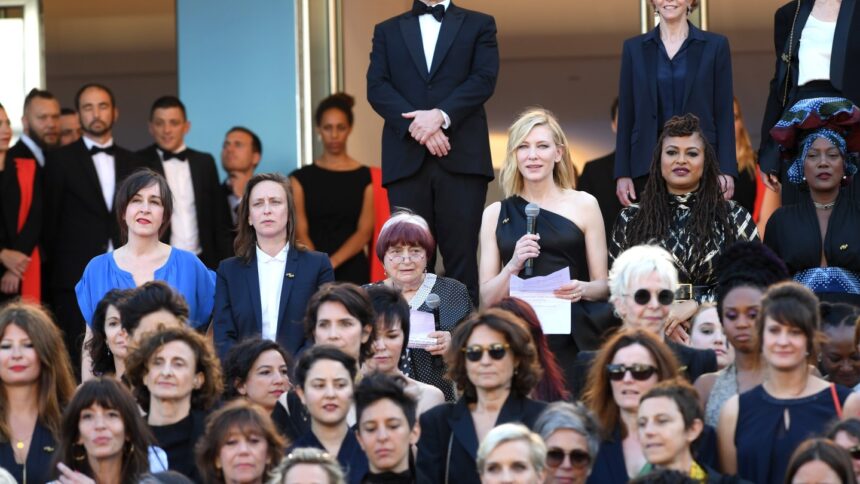
In 2018, Ava DuVernay, Cate Blanchett, Agnès Varda, Kristen Stewart and more than 80 other female filmmakers stood on the steps of the Palais at the Cannes Film Festival to protest gender inequality in the global film industry. That year, only three films were directed by women in the festival’s prestigious competition section.
Thierry Fremaux then signed a pledge from Le Collectif 50/50, the French association dedicated to promoting sexual and gender diversity in the film industry. The pledge outlined the steps the festival will take to move towards increasing the inclusion of women in its lineup, including establishing gender statistics for its annual programme, while working to achieve gender equality on boards and programming committees.
Nearly eight years later, and despite some gains, this year’s competition section has five female directors, down from last year’s seven (the record for the most female directors ever in a major competition section). At the 2026 festival’s opening press conference on May 12, Cannes president Fremaux said defensively: “Films are selected based on their quality, not the gender of their directors.”
When asked about its efforts to achieve parity in the festival’s main competition, a festival spokesperson contacted for comment said: THR “The Cannes Film Festival has been committed to gender equality for several years in all areas under its direct responsibility,” he said.
“The word quota scares everyone,” says Fanny De Casemaker, general delegate at Le Collectif 50/50. “People in the industry always give responsibility to someone else. We truly believe that every step in the film industry carries a great responsibility.”
It was the introduction THR With a range of data, such as the fact that the juries have been gender-balanced since 2011, their chairs since 2013, and the official selection panel is currently a team of five women and four men. Furthermore, the permanent staff organizing the festival and film market now includes more than 50% women, including leadership positions.
The proportion of women — out of the total number of directors — who have feature films in official selection this year (Competition, Un Certain Regard, Out of Competition, Midnight Show, Special, and Can Premiere) is 34%, up 8% from 2025. But that number dwindles to just 22% in the festival’s prominent competition program, which features films that often go on to win awards and big distribution deals.
“We’re having a real difficulty breaking through the glass ceiling for auteurs. There’s still a perception that auteurs are men,” says Kirsten Schiffer, executive director of Women in Film, who points out there are a few exceptions, such as Chloe Zhao and Jane Campion. At Cannes, a festival that considers itself the global home of authors, female directors can face even more biases.
The competition department is where the crux of the problem lies, says Faith Elizabeth, founder of UK-based women’s empowerment organization Yes She Cannes, a fixture on the Croisette since 2018. “The competition is much more important in terms of selection, because they are competing for the Palme d’Or,” she says. THR. Yes She Cannes holds events aimed at supporting filmmakers and products, and arranges concrete support systems for those entering the industry.
The 2026 short film competition is close to parity, with four out of 10 films directed by women, while 44% of specials are directed by women. However, Elizabeth wonders: “Does it? [women] Delving into different categories is not prestigious? Although it sounds good overall, are we just increasing the numbers by putting more women in smaller selections?
This year’s Un Certain Regard section includes the highest percentage of female directors, with 10 out of 19 films directed by women. (The Un Certain Regard festival also opens with the latest film from director Jane Schoenbrunn, who is nonbinary.) “What Un Certain Regard shows us is that it is possible. If the main competition really wants to, they can,” says Schiffer, who points to the recent history of other prestigious festivals adding more women to their competition sections.
Of the 22 films in the Berlin Film Festival competition section, nine were directed by women. The Sundance Film Festival, America’s preeminent platform for independent filmmaking, has held par in the US dramatic competition division for several years. Seventy percent of the films participating in the 2026 competition were directed by women.
Schiffer and other insiders point out that many of the issues preventing female directors from the highest levels of the international film industry are systemic, from education and mentoring to financing and distribution. After making her debut in the festival’s 2019 competition, where only four films were directed by women, Fremaux said: “Cannes and any festival, we are the last stage of that journey.”
Major film schools such as the University of Southern California, New York University, and the American Film Institute routinely graduate more women than men, but funding for independent productions still goes mostly to projects by male directors, as is the case with projects with larger budgets.
“We have a global crisis in how to finance independent cinema, and it affects women and marginalized people first,” says de Casemaeker.
Schiffer says she and her team at WIF have a shorthand for this phenomenon: “When the money comes in, the women go out.” She says. “per book club, You have many, many more Action and thriller films by Jason Statham.
Director Daphne Shamon She launched her nonprofit Breaking Through the Lens in 2018 at the Cannes Film Festival, coincidentally the same year the demonstration was held on the palace steps. The organization’s focus is to help women filmmakers find ways to finance through grants, coordinated meetings, and industry mentorship. “We intentionally focus on the funding stage, because we believe that is where the problem lies, and that is where change needs to happen,” says Shamoun.
At the Breaking Through the Lens event at Cannes last year, Stewart spoke about the difficulties she faced when finding financing for her directorial debut. Water chronology. While the goodwill of female filmmakers is high, Chamoun points out that this does not translate into funding. “There’s a lot of desire to get better. But when push comes to shove, there are very, very few people who put their money where their mouth is.”
As a US-based independent producer and business development executive, Luna Chang sees it as her mission to fund women-led stories, as well as films focused on Asian and minority representation and social awareness. She came to Cannes as a producer of a short film competing in La Cinef entitled Tian tian di mi mi (Our secrets), a coming-of-age story by director Linti Liang.
Zhang is admittedly comfortable with the amount of female talent that will be premiering at Cannes this year, but he says there is still an industry-wide crisis when it comes to decision-making. “People are still threatened by females, and they don’t want to acknowledge women’s power,” Zhang says. “It’s their ego that blocks their way, or [they’re] I’m not sure that women can make things happen [well] As can men.”
Beyond private financing, there are ongoing equity talks when it comes to dealing with state-funded projects. Some countries, such as Sweden, have implemented quotas for the funding that comes from their film commissions. It is worth noting that one of the titles of the Women’s Directing Competition at the Cannes Film Festival this year is: Gentle monster Produced by Marie Kreutzer, it is a Swedish co-production.
Elizabeth says:[When] We have organizations that can give opportunities to different voices – not just voices that can necessarily pay for this vision – [then] We can see the landscape changing.
There is general recognition that progress is being made, but not as quickly as promised. “It’s a very slow development,” De Casemaeker says.
Chamoun praises Cannes for The artistic excellence and gains made by the festival’s programmers have buoyed him so far, but she would like to see the festival engage more with organizations like hers. “Festivals should select films on merit. They should recognize that as well [the number of female directors] “It’s very shocking,” says Chamoun. “I never wanted to be at the festival because they had to meet some quota, but that doesn’t mean setting goals isn’t a good thing.”
The Cannes Festival comes at a time when female representation in the director’s chair is in a precarious situation locally. The larger US entertainment industry, which has cut diversity programs and is currently going through a period of austerity due to economic headwinds, has also declined in terms of representation in the director’s chair. In 2025, the number of female directors behind the year’s 100 highest-grossing films is at a seven-year low, with women representing just 8.1% of all directors on these films, according to USC’s Annenberg Inclusion Initiative.
“We believe that the goal of achieving justice and parity is possible,” says de Casemaeker. “We just need more concrete goals. Parity was a promise, but we don’t need more promises.”