

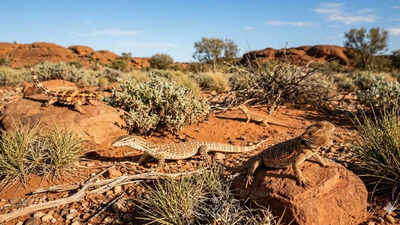
Australia simply does not have a large lizard population. In many areas, they dominate the landscape almost quietly, moving through shrubs, rocks and dry grass in numbers that only become apparent after spending some time there.
The continent has an unusually high concentration of reptile species, especially lizards, compared to most parts of the world. Scientists have tried for years to understand how a single landmass produced such extraordinary diversity while other animal populations remained relatively limited.The explanation appears to be linked to Australia’s long environmental history. The continent changed slowly over millions of years, becoming drier, hotter, and more fragmented.
Habitats expanded and disappeared repeatedly. These transformations created opportunities for reptile populations to separate, adapt to local conditions, and eventually evolve into completely different species. What exists today is the result of accumulation over enormous time periods rather than a sudden evolutionary event.
How ancient climate change increased lizard diversity in Australia
Australia was once much wetter than it is now. Large forest areas covered parts of the continent before long-term climatic drought changed vegetation patterns and turned much of the interior into open forest, shrubland and desert.
According to research published in ScienceDirect titled “Evolution and divergence times in the Australian lizard group Sphenomorphus,” major diversification among Australian lizards appears to be closely linked to these ancient climate shifts. The study reconstructed evolutionary relationships across the sphenomorphine group, finding that many lineages expanded during periods when arid environments spread across the continent.Dry conditions were not necessarily in the reptiles’ favor.
Lizards can survive with relatively limited resources and adjust their activity to temperature extremes. In landscapes where rainfall became unpredictable and food supplies fluctuated, these traits helped them persist while conditions became increasingly difficult for many other animals. Environmental change was gradual rather than sudden.
This is important. Populations had time to adapt to local habitats as the ecosystems around them transformed over millions of years.
Why has geographic isolation increased lizard diversity in Australia?
Australia’s long geographic isolation also shaped what happened next. After its separation from Antarctica, the continent remained isolated enough for animal lineages to evolve with relatively little external competition arriving later. According to the study, which looked at the diversity of Australian desert lizards, many species have evolved to occupy very specific ecological niches. Some prefer loose sand dunes while others remain attached to rocky outcrops, forest edges or dense grasslands.
Even closely related species often avoid direct competition by being active at different times of day or hunting different prey. This level of ecological separation allows for an unusually large number of lizards to exist within the same general landscape. Areas that appear visually uniform to humans may actually contain dozens of distinct microhabitats shaped by shade, soil texture, shelter, and temperature variation.Recurring climate instability will likely intensify the process. Habitats expanded during wet periods and contracted during dry phases, separating populations long enough that they gradually diverged genetically.
Why have lizards become one of the most successful lizard groups in Australia?
Skinks became particularly successful across Australia. Although many of them appear superficially similar, they occupy a remarkable range of environments and lifestyles. Some burrow under the sand most of their lives.
Others climb vegetation or remain hidden under leaves and fallen wood.The recent phylogenetic study published in ScienceDirect, entitled ‘Unraveling the sphenomorphine: a phylogenetic framework and general assessment of the radiation of the most species-rich vertebrates in Australia’, suggests that the sphenomorphine radiation has been steadily exposed as new environments emerge across the continent. Certain groups have adapted well to dry inland habitats while others have remained associated with wetter coastal forests and tropical regions.This flexibility has helped produce diversity over time. When environmental conditions changed, some populations expanded into new areas while isolated populations adapted to local pressures.
Eventually, these groups became separate species. Australia now contains over a thousand species of lizards, with lizards being one of the largest components of this diversity.
Desert conditions that encouraged lizard diversity in Australia
Deserts are often conceptualized as biologically sparse, but Australian deserts support unusually rich reptile communities. In some areas, scientists have recorded very high concentrations of lizard species living in relatively small areas.According to a Physics.org report, Australian desert reptiles suggest that environmental unpredictability may actually encourage coexistence rather than limit it. Rainfall falls irregularly, temperatures change sharply between day and night, and food availability is constantly changing. Under these conditions, species survive by exploiting slightly different resources or periods of activity. Small differences become important.
One species may feed shortly after sunrise while the other remains active later in the day.
Some prefer open ground exposed to sunlight, while others stay near shady plants or rock shelter. Over evolutionary time, these differences have reduced direct competition enough for many species to survive together. Thus, the diversity of Australia’s reptiles reflects a long-term interaction between climate, geography and adaptation rather than a single specific cause.