

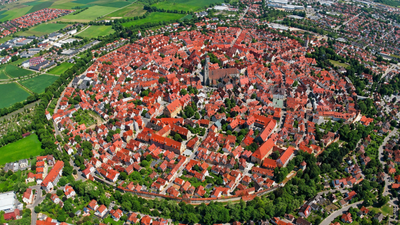
Nördlingen is not an ordinary German city. With its red roofs, church spiers and ring of ancient walls, it wears its medieval charm beautifully. But beneath the picturesque streets and historic towers lies a story shaped by a meteorite, a giant crater and deep space debris.
Hidden beneath its historical magic is evidence of a catastrophic cosmic event. The entire town lies within the Nordlinger Ries, a huge meteorite crater formed about 15 million years ago when an asteroid collided with Earth. The impact created rocks filled with microscopic diamonds that were later used to build much of the city itself. Millions of years later, NASA recognized the site’s unusual geology and brought Apollo-era astronauts there to study terrain similar to the moon’s surface.
The diamond-filled meteorite crater on which the German city of Nördlingen was built
Scientists estimate that the asteroid responsible for Reiss Crater was approximately 1 to 1.5 kilometers across. Moving at tremendous speed, it struck southern Germany with enough force to create a crater about 25 kilometers across.The impact released tremendous heat and pressure, melting and shattering the surrounding rock in an instant. Debris from the explosion was scattered over large parts of Europe, while underground carbon-rich material was compressed to form microscopic diamonds.
For centuries, the true origin of the crater remained unknown. Many early researchers believed that the circular basin was volcanic. It was only during the twentieth century that scientists confirmed that the structure was formed as a result of a meteorite impact, after the discovery of shocking minerals that could only be produced under extreme impact pressures.Much of Nordlingen was created with Suevite, a rare rock that formed directly during an impact event.
Suevite contains fragments of molten and broken rock that were fused together by the intense forces created by the asteroid’s impact.The rock also contains countless microscopic diamonds. Although too small for jewelry, diamonds are common in many of the crater rocks used in local construction.For centuries, residents extracted this material and used it to build houses, towers, churches and defensive walls.
As a result, many of the buildings in Nördlingen are literally built from the remains of an asteroid impact.One of the city’s most famous landmarks is the Church of Saint George. The towering bell tower, known locally as “Daniel”, was built using stone taken directly from the pit area.
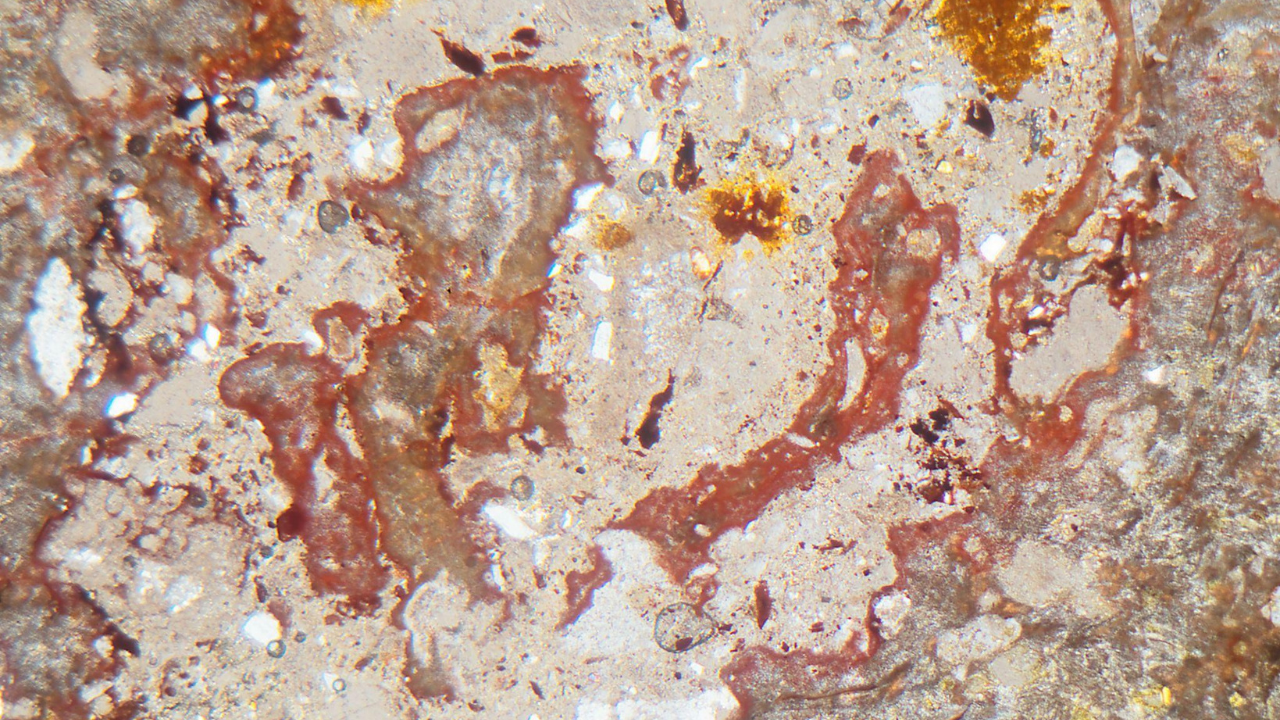
A microscopic view of Soviet rocks from Reiss Crater near Nördlingen, which formed during the impact of a giant asteroid about 15 million years ago.
Why does the Nordlingen region appear circular from the sky?
Aerial photographs of Nördlingen reveal the city’s almost perfectly circular layout. The shape reflects the ancient crater basin in which the settlement developed.Unlike many medieval European cities that expanded irregularly over time, Nördlingen remained largely confined within its protective walls and natural boundaries created by the collision structure. Today the city is considered one of the best preserved medieval settlements in Germany.The crater’s wider view still dominates the surrounding Bavarian countryside and remains visible through satellite images.
NASA trained astronauts in Nördlingen
During preparations for the Apollo missions to the Moon, NASA scientists searched for sites on Earth that could help astronauts understand the geology of the Moon. Reese Crater quickly became an important training site because its topography closely resembled impact zones found on the Moon.Apollo-era astronauts visited the crater to study impact formations, crater structures, and unusual rocks resulting from violent impacts.
Field training helped astronauts learn to recognize geological features they might encounter during lunar missions.Members associated with the Apollo 11 Moon landing program were among those who studied the site before traveling to the Moon.
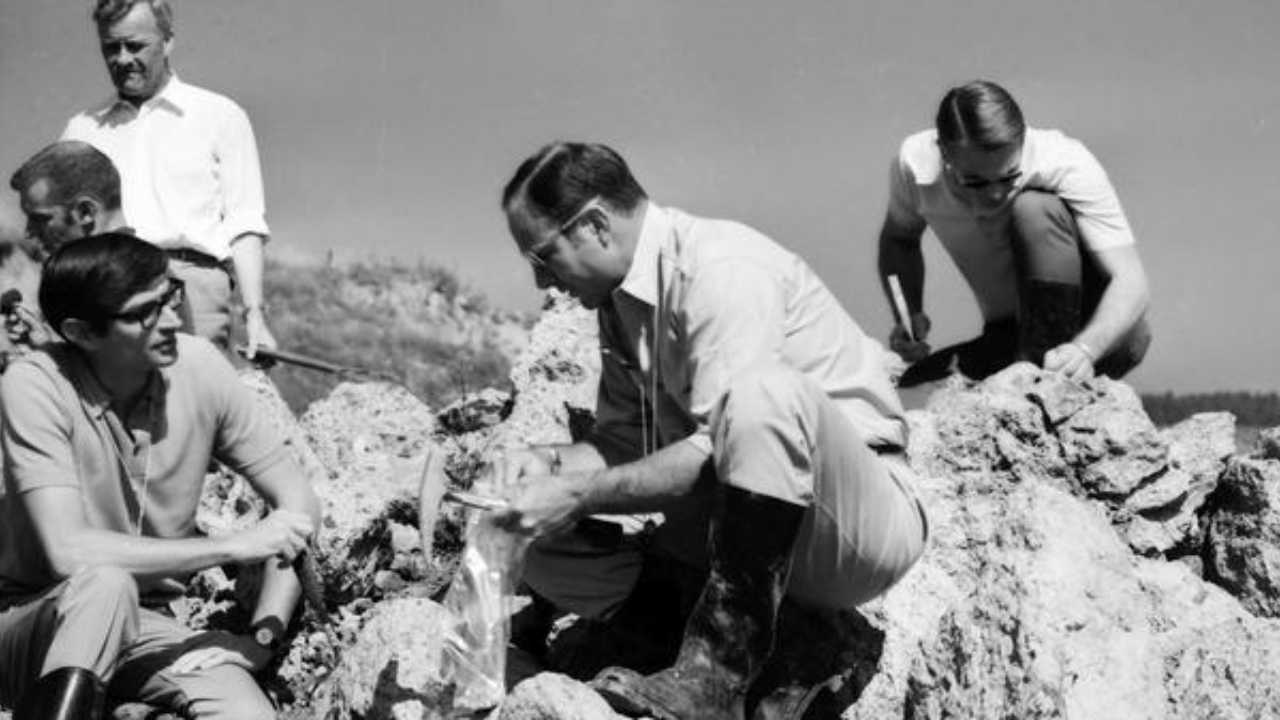
Apollo-era astronauts and geologists examine impact rocks at Reiss Crater, Germany, during NASA field training for lunar missions in the late 1960s.
The secret of the nearby twin crater
Not far from Nördlingen, there is another impact site called Steinheim Crater, which is about 4 kilometers across.Scientists believe the two craters may have formed during the same event, perhaps when an asteroid fragmenting into multiple pieces struck Earth.
Together, the Reiss and Steinheim craters are among the most important meteorite structures in Europe.
A city shaped by history and space
Nordlingen is one of the few places in the world where medieval history and planetary science exist side by side. Residents have spent centuries living inside a giant impact crater without realizing its cosmic origin. They unknowingly built their homes and churches from rocks that formed during one of the ancient asteroid collisions with Earth.Today, the city attracts tourists, geologists and space enthusiasts alike, offering a rare glimpse into how a violent deep-space event became part of humankind’s daily history.