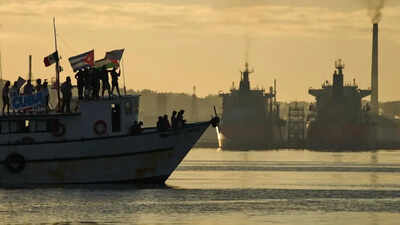
 In a statement issued on Wednesday, the US State Department said the proposed package would include direct humanitarian aid and funding for “fast and free” internet access in Cuba, while also pushing for what it described as “meaningful reforms” in the communist-run country.The State Department said, “The regime refuses to allow the United States to provide this assistance to the Cuban people, who are in dire need of assistance due to the failures of the corrupt regime in Cuba.”
“The decision rests with the Cuban regime whether to accept our offer of assistance or to reject vital (life-saving) assistance and is ultimately responsible to the Cuban people for standing in the way of vital assistance.”The renewed offer came days after Secretary of State Marco Rubio, speaking in Rome, claimed that Cuba had already rejected a previous $100 million aid proposal. Havana denied receiving any such offer.Cuban Foreign Minister Bruno Rodriguez rejected Rubio’s statements, describing the proposal as a “lie” that “no one here knows anything about.”
“Will it be a donation, a deception, or a dirty deal to limit our independence? Wouldn’t it be easier to lift the fuel blockade?” Rodriguez wrote on X.The diplomatic exchange comes as Cuba faces one of its worst energy crises in recent years. According to data collected by Agence France-Presse, about 65 percent of Cuban territory witnessed simultaneous power outages on Tuesday, amid a severe shortage in electricity generation.Cuban President Miguel Díaz-Canel acknowledged on Wednesday that the energy situation was “particularly tense” but blamed US sanctions for the deterioration.“This dramatic decline has one cause: the genocidal energy blockade that the United States is subjecting our country to, which threatens irrational tariffs against any country that supplies our fuel,” Diaz-Canel wrote on X.Cuba’s economic difficulties have worsened since January after the United States moved against the government of Venezuelan President Nicolas Maduro, disrupting fuel shipments that covered nearly half of Cuba’s energy needs.
Since then, only one Russian tanker carrying fuel has reportedly arrived in Cuba.The Trump administration has already provided $6 million in humanitarian aid to Cuba through Catholic Church charities, bypassing the Cuban government. The Church has historically served as an intermediary between Washington and Havana.Washington has also increased its pressure on the Cuban economy in recent weeks. Last week, the United States imposed sanctions on a Cuban military conglomerate that controls nearly 40 percent of the island’s economy, following an executive order signed by President Donald Trump targeting foreign banks that do business with blacklisted Cuban entities.Rubio, a Cuban-American politician and longtime critic of Cuba’s communist leadership, is said to have maintained contacts with sectors of the Cuban elite in an attempt to encourage political change on the island.The United States has imposed an embargo on Cuba for most of the period since Fidel Castro’s revolution in 1959.