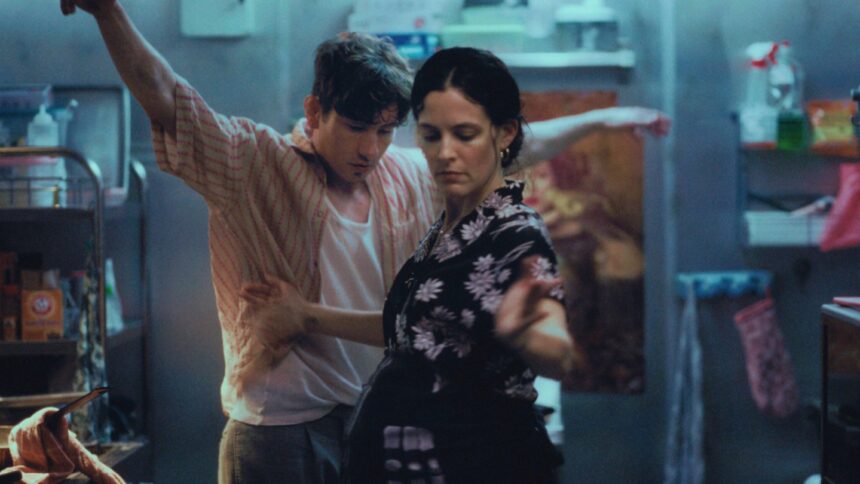
Kantemir Balagov showed talent in his debut in 2017, Proximityabout a kidnapping in a North Caucasus town, then fulfilled that promise in full with his stunning second film, Beanabout two traumatized women in post-World War II Leningrad. Both films focused on women whose bleak worlds were close to them – tomboyish car mechanics Proximity; A nurse and friend on the front lines turn on her Bean. By contrast, the Russian director’s first English-language film is testosterone-driven, a father-son story in which restrictive rules of masculinity lead to senseless loss.
The setting of a small area of New Jersey with a close-knit Circassian community is drawn in a vague way. Balagov originally intended to shoot the film in his hometown of Nalchik in the foothills of the Caucasus Mountains. But after publicly condemning Russia’s invasion of Ukraine, he was self-exiled in 2022 to Los Angeles.
Butterfly jam
Bottom line It’s an awkward collision of masculinity and weakness, as it’s awkwardly told.
place: Cannes Film Festival (Directors’ Fortnight)
He slanders: Barry Keoghan, Tahla Akdogan, Riley Keough, Harry Melling, Galia Richards
exit: Kantemir Balagov
Screenwriters: Marina Stepnova, Kantemir Balagov
1 hour and 42 minutes
This may partly explain why the characters here, though not lacking in dimension, exist in isolation. The fabric that should have been provided by a broader vision of society and by interactions with Americans outside the immediate family circle is missing. However, the actors kept me engaged, and the visuals are stunning thanks to the talented director Jomo Fry, who brought such verve and aching intimacy to Nickel Boys.
Azik (Barry Keoghan) immigrated to the United States as a young man, with his older sister Zalia (Riley Keough), with whom he runs what his American-born son Temir (Tahla Akdogan) in an angry clash calls “the dirty restaurant.” Azik works as a chef, and takes great pride in his Circassian potato and cheese pies, which he and others promote as the best in the world. But the business fails, forcing Azik to consider pursuing a position as a chef at an upscale restaurant opened by a former lawyer acquaintance in Newark.
In fact, Azik’s hopes and dreams largely rest on 16-year-old Taimir, nicknamed Petit, who speaks to his card game buddies as “my beautiful boy…future Olympic champion.” Pete showed his skill on his high school wrestling team, where he won one trophy and later went on to a state championship. The first glimpses of a shy romance spark between him and Alika (Galia Richards), another wrestler, whose progress is hampered by a skin condition that makes her too embarrassed to take off her clothes to practice her equipment.
Despite being in an advanced stage of pregnancy, Zalia works tirelessly to maintain order at the dinner, taking on responsibilities in ways that her brother seems ill-equipped for. Or too lazy. She gets angry at Azik as he brings his exhausted friends to ruin the place.
The worst of them all is Marat (Harry Melling), who plays his direct opposite one billion character), an abrasive con man and con man who reveals himself to be a complete dick from his first moments on screen. His deceptive scheme to boost revenue by installing a malfunctioning cotton candy machine in the restaurant has more symbolic meaning than a bizarre subplot involving the theft of a swan whose rare appearance in the area was on the local news.
The screenplay, co-written by Balagov with Marina Stepnova, fails to provide a satisfying development for any of these threads and severely underutilizes the film’s most interesting character, Zalia. Kyo is wonderful in the role, exhausted and impatient at having to transcend the responsibilities of a big sister from an early age. Although there isn’t much to do, Keough gives the film’s standout performance, which perhaps speaks to Balagov’s nuanced handling of the female characters.
The film struggles to find something to focus on, as it approaches Taimir’s growing recognition of his father’s shortcomings, especially the minimal effort he makes to seize the opportunities America ostensibly offers. Keoghan’s boyish physicality makes them seem like brothers at times, particularly in a lovely moment when Azik accidentally sets off a car alarm and the two then set off alarms for every vehicle parked on the street, creating a cacophonous noise level. But Temir wants a life bigger than Azik imagined.
The turning point comes when Temir, in the midst of an argument, calls his father “weak,” perhaps the worst label you can give to a man from such a patriarchal family background. Softness and even frank expression of feelings between fathers and sons is not part of the Circassian masculine factory model. This slight highlights Azik’s concerns.
In one of the film’s most powerful moments, Zalia quietly asks: “Am I weak?” She responds with silence, her face remaining out of frame, allowing us to see only one arm with which she furiously sweeps the floor. When Azik attempts to rid himself of the stigma, by calling another person weak as if to remove the physical weight of the insult, an act of astonishing violence occurs. But the tragedy of the film ultimately hangs in there.
Balagov is inarguably a director with his own distinct vision, which meshes perfectly with Evgueni and Sacha Galperine’s glowing score and with Fray’s intelligent shooting style, which often takes a cue from getting up close and personal with bodies strung out on wrestling mats. But in terms of the story, Butterfly jam Too widespread to rise to the level of brutal shock Bean.