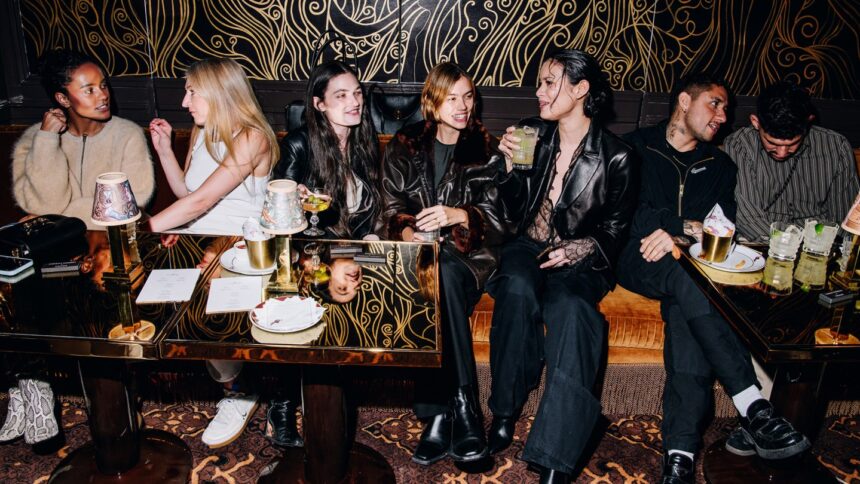
New Yorkers didn’t invent the members’ club. They decided they couldn’t live without one or 20.
Long before the current wave, the city already had its own closed circuit. Members’ clubs have shaped New York social life for more than a century, many dating back to the Gilded Age, and were built to impress before the skyscrapers closed in around them. Some of these original institutions still stand, occupying prime real estate near Central Park. The Union Club, the University Club, the Colony Club, the Century League, the Knickerbocker Club, the Doubles Club, the Racquet and Tennis Club, and the Metropolitan Club—of which J. P. Morgan was the first president—were all applying and dues, but admissions were moving slowly. I needed sponsors. I waited. It may take years. They had dining rooms, but that wasn’t the draw. They functioned like urban country clubs. For a long time, this continued.
Then came Soho House in 2003, the British importer’s first North American location located in the Meatpacking District. It has maintained the membership model but changed the pace. You can apply, get approved and be there within months, sometimes weeks. It was eclectic yet sociable. Sex and the City make it visible; A rooftop pool made it desirable. For years, nothing came close. Ludlow House followed in 2016, with Dumbo House opening in 2018.
In the past few years, a new wave has emerged. Clubs like Casa Cipriani, San Vicente Club, Maxime’s, Chez Margaux, and Crane Club have sprung up, varying in prices, access, and exactly what you get with a membership. They have filled two gaps left by the pandemic: the disappearance of “third places,” separate spaces for work and home, and the surplus of empty office space as remote work spreads.

In 2020, as New York emerged from lockdown, Zero Bond opened in the former Brooks Brothers factory at the corner of Bond Street and Broadway. Founded by Scott Sartiano, the handsome downtown restaurateur, the club spans 20,000 square feet over two floors, with work spaces, multiple bars, an omakase room and event spaces. It is designed for successful people who like to have a good time. People were knocking on the door to get in.
“I just follow the flow and instincts of what I see happening around New York and my friends and social circles,” says Sartiano, who managed several hot clubs, including Spa, Butter, and 1OAK before opening Zero Bond. “I noticed some macro trends in the business, and then some things specific to New York that made me think the members club would succeed.”
In 2021, Casa Cipriani arrived, attracting a glittering mix of European tycoons and business people, with celebrities making regular appearances. Inside the 115-year-old ferry terminal, excess is the goal: cashmere liner Loro Piana lines the walls and sweeping views of the Brooklyn Bridge (a rooftop pool is rumored to open this summer). If you can get in, there are rules. No photos in the living room — a policy that was tightened after guests took photos of Taylor Swift with Matty Healy — and a dress code that allows for jeans, but the expensive kind with no rips. Membership is completely controlled. The club has been known to quietly remove members to make room for others. No questions or complaints were answered.

Around the same time, a different breed of club began to form uptown, with much higher price points. The Aman Club opened in 2022 inside Aman New York, offering a quieter, more private extension of the hotel to a tightly controlled group, where membership carries an initiation fee of about $200,000, plus annual dues. Casa Cruz arrived that same year from London, where admission prices ranged between $250,000 and $500,000, bringing a more sociable, international group to the Upper East Side.
What are New Yorkers supposed to do with so many options? The answer, as usual, is not to choose. There is no official count, but members will tell you that they often have more than one membership, sometimes two or three. (We spoke to one man who had seven, and another who had five.) In a 2022 survey by GGA Partners, a private club consulting firm, more than 60% of clubs reported an increase in membership. Is it any surprise, then, that more clubs continue to pop up all over Manhattan?

By 2023, the question is no longer whether this model will take hold, but how many versions the city can accommodate. ZZ’s Club has opened at Major Food Group’s Hudson Yards, with interiors designed by Ken Fulk, offering a high-gloss, polished room for Carbone regulars willing to pay for a more controlled version of the experience. That same year, she brought Colette into the General Motors Building, with sweeping views of Central Park and an initiation fee of $125,000, plus $36,000 a year, for access to office space and a restaurant.

The Twenty Two, another British import; Casa Toa, best known for its locations in Miami and Aspen; And Chez Margaux, backed by chef Jean-Georges, opened in 2024. By 2025, the square was crowded enough that new openings had to locate themselves quickly. Maxim opened on Madison Avenue in March, bringing the world of Robin Burley’s London club, already established at 5 Hertford and Oswald Streets, to the Upper East Side. The San Vicente club, owned by Jeff Klein, followed the former Hotel Jane, importing a model from Los Angeles built on secrecy and a strict no-photo policy.
“I think what we do is really different from what we do at most clubs, because a lot of it is designed to be exciting for the moment, and we’re designed to last,” Klein says. “We’re very intentional about who comes, and we keep membership very tight so we never feel crowded or transactional.”
There were others who arrived in 2025 as well (perhaps none of them as big a hit as SVC), including Crane Club, The Moss, Kith Ivy, and a host of others.
“I definitely think there’s still room for new members’ clubs in New York,” says one experienced membership head at one of the city’s top-tier clubs. “I think the problem is that we’re all competing for the same 4,500 people [whom everyone wants] As members.”
Last year saw the abrupt closure of NeueHouse, once a club and very hot co-working space, whose membership spanned Hollywood, media, fashion and technology. The bankruptcy filing cited unspecified “legacy liabilities,” but the fact that the club was suddenly crowded with competitors certainly didn’t help.
The demise of NeueHouse has not slowed the club’s momentum. Stylus is expected to open as a sound-driven members’ club centered around listening and performance rooms, while The Beginning, planned for Brooklyn Heights, adds to the reach beyond Manhattan. Annabel’s, which already has a secure space in the Meatpacking District, is preparing to bring its London establishment to New York. They are all expected to open this year.

Can New York pressure more clubs? London, the city from which New York largely borrowed the model, has more than 130, according to a 2025 report. We may be just getting started.
“Do I think it’s already saturated? I don’t think so,” Sartiano says. “You know, New York is a big city with a lot of people with a lot of different expectations. And with the diversity here, there’s more room for growth. People like the feeling of community.”
Klein echoes this sentiment: “I actually think there will be more. Everyone feels very lonely; We are so “connected” through social media and the internet, that we are disconnected. People are just lonely and need community. “We used to have churches and town halls, and as gay men, we had communities in nightclubs and in other areas and whatever, but now there’s nothing, and you feel so empty.”
So we won’t be hitting peak member clubs anytime soon?
“No, this is the beginning.”
This story appeared in the May 6 issue of The Hollywood Reporter magazine. Click here to subscribe.