The French are betting that the masses want to restore their epics.
For much of the 1980s and 1990s, France regularly produced sprawling, prestigious productions on a scale that few European industries could match. Films like Jean-Paul Rapinoe Cyrano de Bergerac (1990), Claude Perry Bacterial (1993), or Patrice Chéroux Queen Margot (1994). But as production costs rose and financing became more risk-averse, these ambitious historical spectacles gradually disappeared from the big screen, replaced by smaller-scale dramas, comedies, and globally portable genre films.
Now, after years of decline, large-scale storytelling in the French period is making a comeback. Canal+, the parent company of StudioCanal, has found global audiences for its brilliant historical series such as Versailles and Marie Antoinettewhile Martin Bourbolon in two parts The Three Musketeers Adaptation, Mathieu Delaporte and Alexandre de la Patilière The Count of Monte Cristo It showed that there was still an appetite, at least in France, for strong literary adventure that was a hit. This year in Cannes, Antonin Baudry De Gaulle: Iron tiltthe first in a two-part epic biopic of the iconic French leader, to premiere out of competition, another sign of renewed confidence in prestigious French popular cinema.
Into this scene comes Fred Cavaye Wretcheda new film adaptation of Victor Hugo’s classic novel of crime, justice and redemption, starring Vincent Lyndon as Jean Valjean and Tahar Rahim. As the uncompromising Inspector Javert. The film recasts Hugo’s novel – which has been adapted dozens of times over the decades, but is probably more popular with modern audiences than Andrew Lloyd Webb.p The musical and Tom Hooper’s 2012 film adaptation – as a motive chase film. Along with Lyndon, Rahim, and veteran actors Camille Cottin and Benjamin Lavergne, the film features a supporting cast of 20- and 30-something rising stars, including Noémie Merlant (Portrait of a Lady on Fire, tar), Megan Northam (Rabia), Vasily Schneider (The Count of Monte Cristo), Mary Coulomb (Monsters) and Luis Perez (The guards).
The €40 million ($47 million) production was independently assembled by Richard Grandpierre at Eskwad (The Tochi privilege, Wolf brotherhood) and Olivier Delbosc at Curiosa Films (8 women, Wizard of the Kremlin) is supported by Canal+/StudioCanal, which releases the film theatrically across its global presence and handles international sales at the Cannes Film Market. Additional funding came from TF1 and Netflix in France.
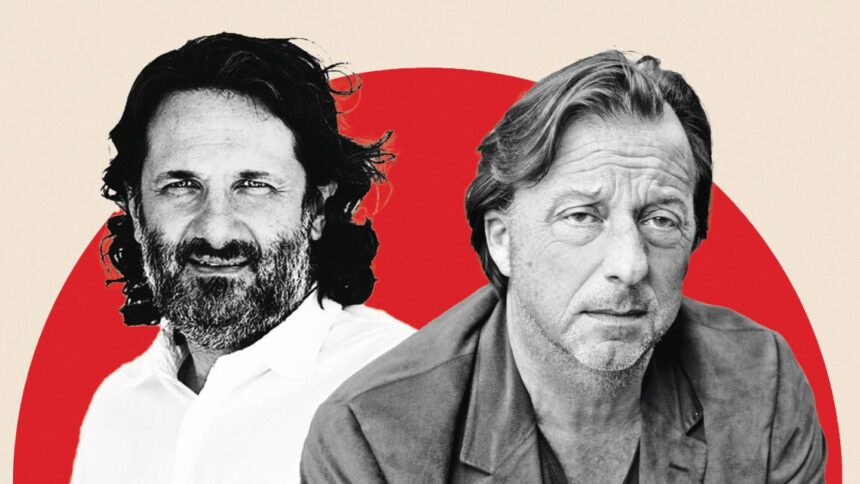
In an exclusive interview with Hollywood ReporterGrandpierre and Delbosc discuss the high-stakes gamble behind the revival of the great French folk epic, and why they think audiences are ready for another film. WretchedAnd why Victor Hugo’s classic 19th-century novel remains so politically explosive today.
Why make another version of Wretched?
Richard Grandpierre We were expecting this question. You are absolutely right. I can speak for myself, but I’m sure Olivier would agree with me – in the life of a producer, we all dream of doing something like… The Three Musketeers, Monte Cristomajor productions, the most important books in French literature.
But I think what really motivated us to do this film was meeting the director, Fred Cavaye, and hearing him talk about his idea. The other reason is that for 35 years, no one had made a copy of it Wretched In France. The last time she was with Lino Ventura Like Jean Valjean[in1982directedby[in1982directedbyRobert Hussein]. An entire generation has never had the experience of watching it on screen. If you take people under 30, I’m sure most of them haven’t read Wretched. They only know this through… [Hooper’s 2012] music.
The difference with Fred Cavaye’s vision is that the characters are young. Before, it was just [middle-aged]. We’ve brought in a whole new world of younger characters, the young men in Victor Hugo’s story, who 15- to 20-year-olds can identify with.
Olivier Delbosc We were soon convinced that Victor Hugo’s story is absolutely timeless. It is a story of inequality and social misery that unfortunately remains very contemporary.
Grandpierre The film’s power comes from the fact that it resonates in today’s world and in today’s life. You may have heard about the Yellow Vest movement a few years ago, where people took to the streets to protest and demonstrate. It’s the same thing as the barricades described by Victor Hugo in the 19th century, when people couldn’t afford bread.
If you watch the news, unfortunately they are the same topics that Victor Hugo brought up in his book.

How does Fred Cavay’s approach make this adaptation special?
delbosc He’s done a lot of thrillers and action films, and he uses those techniques to create tension. This is what adds modernity to Victor Hugo’s masterpiece.
We have big films about Charles de Gaulle and the Vichy regime showing at Cannes this year. Why do you think French cinema is returning to large-scale historical and contemporary films at this moment?
delbosc In the 1960s, 1970s and 1980s, French cinema was producing a lot of historical films, and this genre disappeared after the 1980s because they cost a lot of money and took a lot of time to produce. Now they are back with a modern twist but with the same themes of social inequality that were described 100 years ago. Because unfortunately history repeats itself and the same problems are repeated.
Grandpierre I think it’s really the desire of the producers to make this kind of movie. Olivier and I are almost from the same generation, and we grew up with these wonderful, famous French films. When we started in the industry, we watched Claude Berry films[eg[likeJean de Floret (1986), Uranus (1990) and Bacterial (1993) and we loved them, so we had the desire to make a great popular French film.
I can ask you the same question: Why does American cinema continue to produce Western films? Because they speak to the country’s collective history.
delbosc Audiences around the world love period films and historical stories, whether in series or cinema.
Do you think historical films allow filmmakers to deal with contemporary political tensions without directly dividing audiences?
Grandpierre That wasn’t our goal, we simply wanted to make a great, popular French film.
But what is true is that there is an echo between what Victor Hugo wrote in his time and what is happening today. We were not looking for this political resonance, but it happened that what Victor Hugo wrote was still in circulation – not only in France, but in other countries as well.
But once the film is released, won’t audiences inevitably interpret it through today’s political climate?
delbosc This is the idea of art and cinema: to provide the audience with different ways to read and understand film. By the way, Victor Hugo was not only a great writer, but also a politician. He fought against the death penalty and for women’s voting rights.
Can you talk about the scale of the production and how difficult it was to finance it?
Grandpierre The budget is 40 million euros. Filming took three months. We had four years of preparation between casting, finding interesting people, and putting the artistic team together.
We had ups and downs in financing, but what really convinced people to invest was that Fred Cavay wrote a 40-page synopsis that let them see what the movie was going to be and convinced everyone to take the risk. I would also like to add that he had a wonderful co-screenwriter in Victor Hugo.
But it is a rare experience today in the French system, for independent producers like us to be able to produce I like this movie.
delbosc It is the largest French production of the past year.
Can you break the financing structure?
delbosc They are StudioCanal, Canal+, Netflix and TF1 film production company. Netflix only owns French rights. [Canal+ subsidiary] StudioCanal distributes in eight territories worldwide including France, Germany, Italy and the UK and also handles worldwide sales.
Were you thinking about the global audience while making the film?
Grandpierre When you make a French film, it’s always difficult to sell it in the English-speaking market, because there are very few examples of successful French films, especially in America. They are usually genre films or smaller art films. But thanks to music, the English-speaking world knows what’s what Wretched He is.
What was the most difficult sequence to film?
delbosc Barricades. It was a three-week shoot in Bordeaux in the middle of a heatwave. It was 40 degrees [107 F]with 300 extras. I must point out that nothing has been done using artificial intelligence. We did it the old fashioned way. The hot, ethnic and old fashioned way.
Grandpierre We use visual effects in post-production, of course, but not artificial intelligence. Look at us, we are clearly people of the old generation. We do not use artificial intelligence.
Where does the film stand now in post-production, and what are the release plans?
Grandpierre The film is at the end of the editing process now. It will be released on October 14 in France. We weren’t ready for Cannes, and StudioCanal, which is selling the film, will decide whether to show it at a festival before it’s released.
For younger audiences who basically knowWretched With the musical, what will they discover in your version that feels new?
Grandpierre In France, we have a big advantage in Fred Cavalli and Victor Hugo of course, but we also have an amazing modern staff. All generations can identify with someone in the cast – Vincent Lindon for some people, the younger actors for others: Benjamin Lavergne, Noémie Merlant, Megan Northam, Vasiliy Schneider, Luis Perez. They are one of the best teams we can have in France today.
As long as Russell Crowe doesn’t sing in it, I’ll be happy.
Grandpierre No, definitely not.