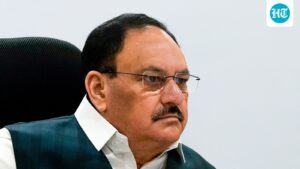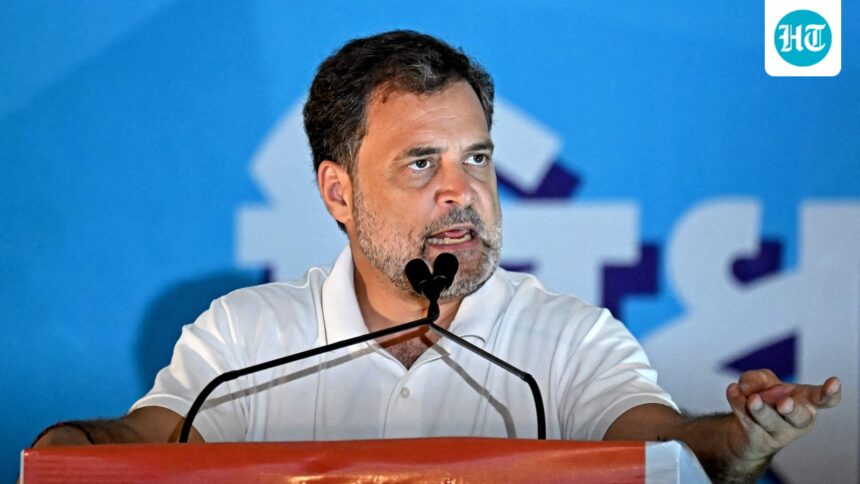
Leader of the Opposition in Lok Sabha Rahul Gandhi on Tuesday sounded a strong note of dissent over the selection process of the Central Bureau of Investigation (CBI) director during a meeting of a high-level committee headed by Prime Minister Narendra Modi, saying he did not want to be part of a “biased exercise”.

The three-member high-level committee, which also includes Chief Justice of India Surya Kant, met at 7 Lok Kalyan Marg in the evening to finalize the next CBI director. The extended tenure of Indian Police Service (IPS) officer Praveen Sood, 1986 batch, will end on May 24. The name of the new director had not been announced by the time it went to press.
In a detailed dissent note, Gandhi said he was not provided with 360-degree reports on eligible candidates, alleging that the government has turned the selection process into a mere formality and that the action plan cannot be a “rubber stamp”.
“The Leader of the Opposition is not a mere rubber stamp. I cannot abdicate my constitutional duty to participate in this biased practice. Therefore, I oppose in the strongest terms,” Gandhi said in the two-page opposition memorandum.
A senior Congress leader accused the government of repeatedly misusing the CBI to target political opponents, journalists and critics. “In order to prevent such institutional rupture, the Leader of the Opposition was included in the selection committee. Unfortunately, you continued to deny me any meaningful role in the process,” he said.
“Despite repeated written requests, I was not provided with self-evaluation reports or 360-degree reports of qualified candidates. Instead, I was expected to examine the evaluation records of 69 candidates for the first time during a committee meeting. The 360-degree reports were completely denied to me. A detailed review of these records is crucial to assessing each candidate’s history and performance. This deliberate denial of information, without any legal basis, makes a mockery of the selection process and ensures that your candidate is selected It is only pre-determined.
A list of senior IPS officers from 1989 to 1993 batches has been prepared by the Department of Personnel and Training (DoPT) for a high-level committee to consider filling the coveted post, people aware of the developments said.
The officers whose names made it to the list for consideration by the committee include current Research and Analysis Wing (R&AW) chief Parag Jain (1989 batch); Shatrujit Singh Kapoor of Haryana and Maharashtra DGP Sadanand Date (1990 batch); Central Reserve Police Force (CRPF) Director General JP Singh, his National Disaster Response Force (NDRF) counterpart Piyush Anand (1991 batch), Delhi Police Commissioner Satish Gulcha (1992 batch), among others.
The current CBI director, Praveen Sood, was appointed to the post on May 25, 2023 for a period of two years, which was extended for another 12 months by the high-level committee in May last year.
In November 2021, the government issued an ordinance to amend the Central Vigilance Commission (CVC) Act as well as the Delhi Special Police Establishment (DSPE) Act to grant three one-year extensions to the Chief of Enforcement Directorate (ED) and the Director of CBI, if desired. This was subsequently passed by Parliament a month later. The ordinance was used to grant three successive extensions to former ED director Sanjay Kumar Mishra.
Under Sood, the RBI won the extradition cases of Mehul Choksi and Nirav Modi in the UK and Belgium, respectively, but their repatriation was delayed by the governments of these countries.