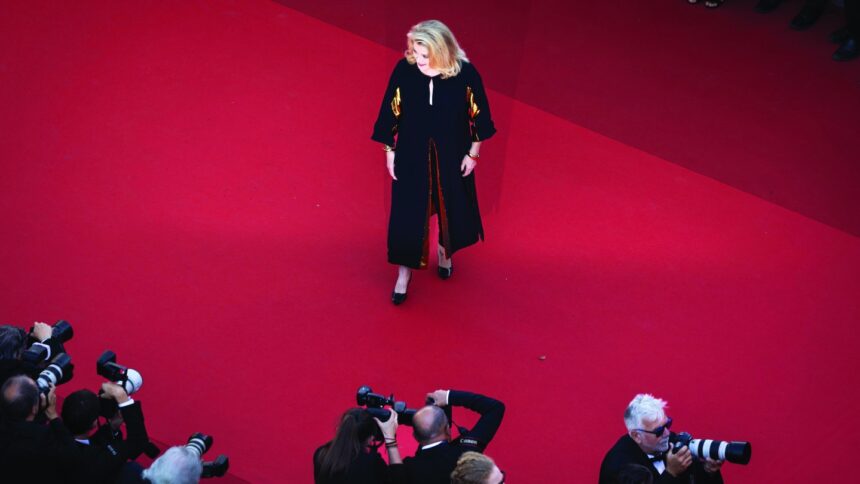
Of course, Catherine Deneuve brings her dog.
Jack – “Not Jack, Jack!” – The pointy-eared Shiba Inu, standing at attention throughout the interview, his eyes fixed on her like a discreet, furry security guard.
“I usually have him on set with me,” she says, patting him on the head. “It’s always so good.”
We’re tucked into a cozy corner of a Left Bank boutique hotel. A luxurious Louis Vuitton Deneuve handbag lies on the sofa. As we talk, her answers are punctuated by the occasional puff — “I quit smoking for a while, even did hypnosis, but I started again,” she says, waving the e-cigarette. “However, this is not smoking. It is nothing.”
It is an elegant, informal, almost domestic setting for what sometimes seems closer to a papal audience. This is Catherine Deneuve! Not only the face of French film, but the face of France in every sense of the word. In 1989, on the occasion of the bicentenary of the French Revolution, Deneuve’s face was used as an image of Marianne, the French national emblem of freedom and reason. It’s actually an icon.
Deneuve’s on-screen persona is at once the gentle Genevieve, the embodiment of romantic idealism in Jacques Demy’s magical 1964 musical. Cherbourg umbrellas; And Carole Ledoux, the Belgian girl in London whose sexual repression turns into murder in Roman Polanski repulsion (1965). She’s Severine, an upscale bourgeois housewife who works as an S&M subject in Luis Buñuel’s film Belle de jour (1967); And the camp star who channels her own iconography in both Tony Scott’s lesbian vampire thriller Hunger (1983) and François Ozon’s musical murder mystery 8 women (2002).
Liberal and conservative, radical and disciplined (some might say, sometimes reactionary), Deneuve, more than any actress, more than any filmmaker, embodies French cinema in all its glorious and confusing contradictions. Deneuve is not just a Croisette legend. that it the legend.
Deneuve returns to Cannes not as a retrospective figure, but as a working actor. She has two films in official competition: alongside Isabelle Huppert, Vincent Cassel and others in the drama group Parallel storiesfrom two-time Academy Award winner Asghar Farhadi (separation, vendor); As Lea Seydoux’s mother in Gentle monsterdirected by Austrian director Marie Kreutzer (corsage). “Oh, they’re very small roles,” she says modestly. “But even a small role has to be essential. When the role is small, I always ask myself: ‘If this character was removed from the script, would it have significance?’ If not, it’s not interesting. I’m also of course interested in the director, especially if they are young and the way they talk about the film is full of energy, something open and new. Then I want to be part of it.”
But Cannes is more than just a current stop on Deneuve’s circuit: it represents the itinerary of her career, and the stage on which she first forged her legend.
Deneuve’s story began at Cannes with the coronation. Cherbourg umbrellasher first leading role, won the Palme d’Or and turned the 20-year-old artist into an international star.
“We knew [the film] It was special when it was filmed, the story was completely different, and the entire film was sung. Everything had to be recorded before filming, so we had to learn the entire film in advance. “It was a very special experience,” she recalls. “But it was the beginning of my career, and everything was new. Even the win.” [the Palme d’Or] It felt unreal because I didn’t fully understand it yet. The moment I particularly remember from Cannes is Matthew [Lars von Trier’s] Dancer in the dark He won the Palme d’Or [in 2000]. This is a recognition that stayed with me.”

between Umbrellas and dancer – Two musicals at opposite ends of the spectrum of joy and pain – Deneuve has returned to Cannes so many times she can barely count. Her festival highlights in 1994, where she served on the jury alongside Clint Eastwood. He was the jury’s choice for the Palme d’Or Pulp Fiction. Deneuve handed the trophy to Quentin Tarantino, heralding a new generation of independent cinema, a choice that would prove to be as divisive as it was defining.
“Oh, the reaction in the theater! People were screaming, they were so angry. It was a new kind of film that some people didn’t understand,” she recalls. “But inside the jury, there wasn’t much conflict. But Clint Eastwood didn’t talk much. He knew what he had decided, but he didn’t explain it much to others.”
For Deneuve, the scandal is not new. In her more than six decades on screen playing serial killers, kinky housewives and lesbian vampires, she’s rarely witnessed a cinematic piety she wouldn’t violate. Fresh-faced Genevieve Umbrellas You will be shocked.
It was only a year later Umbrellas Which turned Deneuve into the dark, violent and exaggerated Polanski repulsion. Her performance shifted from romantic transparency, from the open joy of Genevieve, to the unreadable joy of Carole LeDoux.
repulsion More importantly, her performance two years later in Buñuel Belle de jourIt would reinforce Deneuve’s image as the “ice queen” of French cinema, as an inexplicable projection of male desire, between repression and release. To modern audiences, the film’s premise and depiction of female sexuality seem almost unimaginable.
Deneuve acknowledges some Belle de jour “The scenes were difficult. I wasn’t ready to do everything exactly as written,” she says. “Luis Buñuel didn’t explain much to the actors, so it was complicated at first. But the movie went well, and then we did another movie together[[Tristana]and that was great.”
repulsion and Belle de jour It turned her into a real sex symbol. (Two of them Playboy Photographs, in 1963 and 1965, shot by her future husband David Bailey, helped, too.) But such is the apparent contradiction of Catherine Deneuve, that the actress who helped define the language of sexual liberation rarely bares it all on screen.

“I’m not a big fan of nudity in movies,” she muses. “When you’re naked, you’re not quite a character anymore – you’re just a person, a body. It’s hard to stay in the character’s story.”
There is a similar tension in Deneuve’s public image and her cultural politics, which can seem, depending on where you stand, simultaneously progressive and reactionary.
Off screen, Deneuve was a mostly reliable progressive: a signatory of the 1971 “Manifesto of 343” protesting France’s abortion laws; Petitioner against the death penalty; At the Cannes Film Festival last year, a voice condemned the killing of Palestinian photojournalist Fatima Hassouna. But the petition most people remember is her 2018 open letter Le Mondeand rebukes the #MeToo campaign as a witch hunt. She later apologized to the victims and distanced herself from those who “found it strategic to support me.” However, for many, the letter – combined with her refusal to distance herself from Polanski and her longtime friend Gérard Depardieu – who was convicted in 2025 of sexually assaulting two women on a film set – places her firmly in the reactionary camp.
When asked who her best on-screen partner would be – from an incomparable list that includes Marcello Mastroianni, Jack Lemmon, Burt Reynolds, Daniel Auteuil and Michele Piccoli – she barely hesitates. “Gerard Depardieu. Because he is fully present. With some actors, you feel that they are not fully listening. With him, everything is alive in the moment.”
As for the lasting impact of the #MeToo movement, she is cautious. “It’s very complicated. Sometimes the accusations come after many years, which raises questions. People have to be very careful. It has made everyone more aware and more careful. A “We are very careful.” [what I say]”.
But the queen of French cinema is not the type to regret it. She would like to work with Alfred Hitchcock – “We had a project. It was a kind of spy film. It was a good script, so I met him, but after that nothing happened” – and to make a few more American films. “I had a very good experience working with Jack Lemmon[onherfirstHollywoodfilmin1969[onherfirstHollywoodmovie1969’sApril Fool’s Day]. Then I shot the movie with Burt Reynolds in the 1970s [1975’sHurry up]Which I liked very much. “He was a great actor and a nice guy.” As Deneuve said in a previous interview: “Very funny…for an American.”
She still misses celluloid and the era of the daily newspaper show. “I used to love watching the dailies, and discussing the scenes afterwards,” she says sadly. “You see some things you wouldn’t have noticed when you were filming.” “[Now] Directors watch observers rather than become directly involved in the scene. That’s gone. “Everything is faster now, less collective.”
What hasn’t changed for the 82-year-old actress is the basic appeal of the work: “I still love going to the cinema – being in the theater with people, feeling that communal atmosphere. And I still love making films. I just try to choose what I really want to do. It’s not just work – it’s something I love.”
Outside, Paris moves at its usual pace. Deneuve packs her things. Jack rises with her, attentive as ever.
“It’s great luck to have a life like this.”
This story appeared in the May 6 issue of The Hollywood Reporter magazine. Click here to subscribe.