The Petroleum Ministry said on Monday that it is working on austerity measures to conserve energy, indicating that an increase in retail prices of petrol and diesel may be in the offing.

The ministry’s joint secretary, Sujata Sharma, who mentioned this, did not provide details about the measures during the joint ministerial conference on the repercussions of the crisis in West Asia.
Sharma’s comment assumes special significance as it comes a day after Prime Minister Narendra Modi urged people to conserve energy as well as foreign exchange.
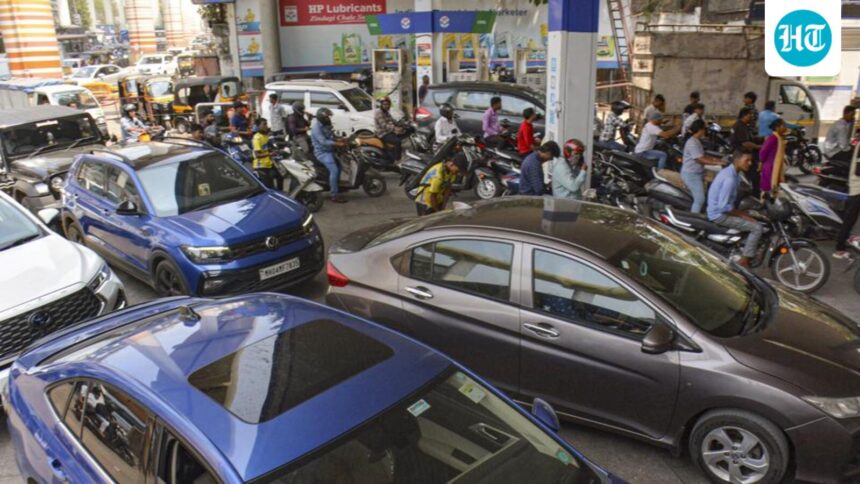
Government officials familiar with the matter said, on condition of anonymity, that the measures could range from raising gasoline and diesel prices to reduce their consumption, to working from home for up to 50% of the organization’s employees. State-run retailers sell petrol and diesel at a price $94.77 per liter and $87.67 liters respectively in Delhi in the last two years. They lose $The twentieth and $XX on each liter respectively.
Although global energy supply chains have been disrupted due to the closure of the Strait of Hormuz, India has managed the situation so far since the outbreak of war in West Asia on February 28 – but some voluntary and some mandatory energy conservation measures are required for a country that imports more than 88% of the crude oil it processes, officials said.
They said the previous United Progressive Alliance regime took similar short-term measures in 2013 when global oil prices rose. Oil Minister Veerappa Moily then launched a voluntary fuel conservation drive which included use of metro and buses by government and public sector officials and varying timings for offices.
Sharma said on Monday that indiscriminate consumption of imported energy will harm state-run oil marketing companies and the economy. She said the government has ensured uninterrupted supplies of petrol, diesel and domestic LPG to the people through international oil companies. [international] Market and sell [refined petroleum products] Cheaper in local market. “That’s why their finances are under pressure,” she added.
She said the Prime Minister’s advice to people to conserve energy should “be viewed in this context”. The three OMCs lose monthly revenue of approx $30,000 crore on the sale of petrol, diesel and cooking gas, while the government has given up revenue $14,000 crore per month from March 27 when it reduced excise duty on petrol and diesel by $10 each.
Responding to questions on the austerity measures proposed by the Prime Minister on Sunday such as working from home, use of public transport, car pooling and use of electric vehicles to save petrol and diesel, Sharma said: “On this, I would just say that the ministry will work on it and we will get back to you in due course.”
The officials added that this is not a problem specific to India only, but rather includes the entire world. Several countries, including Hong Kong, Singapore, the Netherlands, Norway, Italy, Germany, France and the United Kingdom, have raised fuel prices by 20-30% since the outbreak of war.
Some economies, such as Bangladesh, Pakistan, Sri Lanka and Egypt, have resorted to imposing austerity restrictions with or without price checks. Bangladesh announced fuel rationing on March 8, allocating 15 liters per vehicle per week, as rural areas dried up. Sri Lanka has imposed a four-day working week, with every Wednesday gazetted as a public holiday, along with a mandatory fuel permit. Pakistan has moved government offices to four days a week.