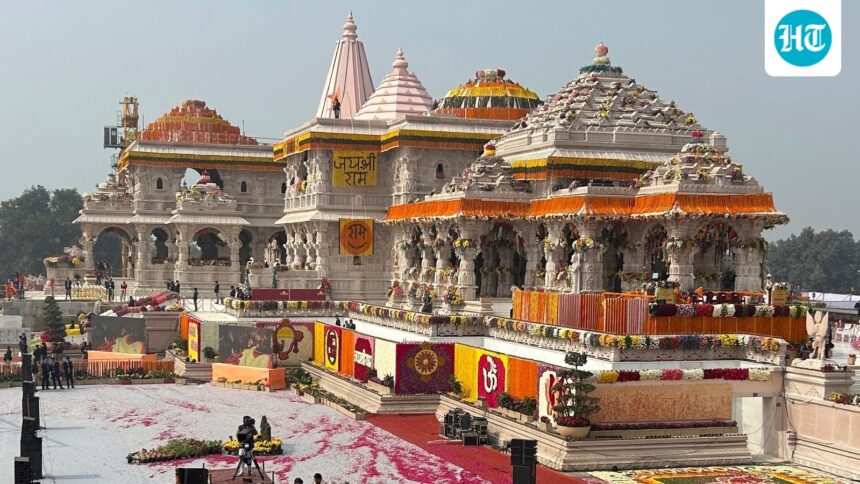
The two-day meeting of the Shri Ram Janmabhoomi Temple Construction Committee concluded on Sunday.

Speaking to reporters, Construction Committee Chairman Nripendra Mishra said that a preservation laboratory has been opened. He said that the main goal of the laboratory is to preserve and restore various artifacts preserved for display, including textile paintings, artworks, and stones that were excavated during excavations, and which may need to be revived after a period of time.
He said the conservation and preservation laboratory was set up in collaboration with the Indira Gandhi National Center for the Arts in Delhi, headed by Ram Bahadur Rai. Two experienced staff members have been deputed from the institution and are currently working in the laboratory. They will train temple staff over the next three years.
Mishra also said that the Hanuman Ji exhibition will be completed by May 30. Discussions were also held with Champat Rai about allowing devotees access to the museum, but it was felt that this might disrupt the ongoing work. Therefore, the museum will not be open to devotees until after December.
Read also: With the Sumanth Temple and a reference to Nehru, Prime Minister Modi criticizes the “appeasement” policy followed by the opposition
He also said that the next flag raising ceremony will be held on May 29.
Regarding security arrangements, Mishra said that a four-kilometre-long border wall would be constructed around the Ram Mandir complex, along with 25 watchtowers.
Meanwhile, aiming to bridge the gap between tradition and innovation, a new museum is set to use 7D technology and artificial intelligence (AI) to tell the story of Lord Ram. From his childhood to the epic battles of the Ramayana, key landmarks will be recreated using holograms for a truly realistic experience.
In addition, a special seven-dimensional ‘Hanuman Gallery’ – dedicated to the valor of Lord Hanuman – is being set up inside the ‘Sankat Mochan Vithika’ (Trouble Remover Gallery).
This exhibition will showcase the heroic exploits of Lord Hanuman through a 20-minute film featuring immersive 3D effects.
Experts from IIT Madras (Chennai) and a technical team from France are collaborating on technology and scripting for this project.
The museum will have a total of 20 galleries, depicting the pivotal stages in Lord Ram’s life – such as his birth, education, exile (vanvas) and conquest of Lanka. More than 100 ancient artifacts and sculptures discovered during excavations at the Ram Temple site will also be displayed, along with documents related to the temple movement dating back 500 years.