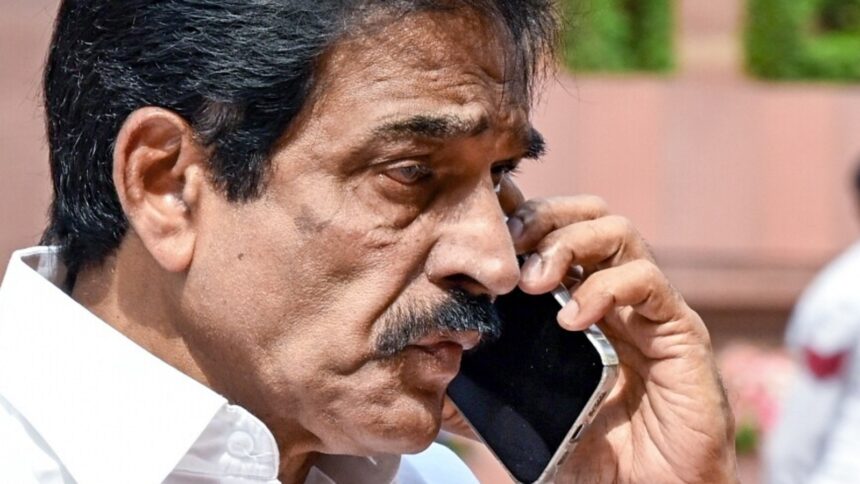
A three-time MLA between 1996 and 2009, he served as Minister of State for Tourism under Oommen Chandy before moving into national politics in the United Progressive Alliance era.

KC Venugopal spent years running party affairs for the Congress from Delhi. The question now is whether he will be able to run a government from Thiruvananthapuram.

The Congress-led United Democratic Front’s decisive victory in the Kerala Assembly elections – 102 seats in the 140-member House, with the Congress alone winning 63 – has sparked a three-way contest for the chief ministership, indicating some divisions between the party’s central leadership and its state-level workers.
Congress leader Mallikarjun Kharge and Rahul Gandhi, the leader of the opposition in the Lok Sabha, did not announce a final decision until Sunday evening, even as the May 23 deadline for forming the government approached.
Venugopal, 63, is at the center of the action. Since 2019, he has served as General Secretary (Organization) of the All India Congress Committee (AICC) – effectively the party’s chief administrator, with key roles in candidate selection, organizational discipline, membership drives and coalition management.
Venugopal is often described as the “key link” between the Congress high command and its state units, as most internal party decisions are made through his office. He is widely seen as among the most trusted figures in the Rahul Gandhi-Kharji leadership.
He is sitting next to Gandhi in the Lok Sabha, to his left.

His credentials in Kerala are great too. A three-time MLA from Alappuzha between 1996 and 2009, he served as Minister of State for Tourism under the late Oommen Chandy before moving into national politics. He won the Alappuzha Lok Sabha seat in 2009 and 2014, and served as a junior minister in the Union government, with portfolios like energy and civil aviation during UPA-2 under Manmohan Singh.
In the 2026 Kerala campaign, news agency PTI reported citing sources, Venugopal helped bring disaffected CPI(M) leaders from the then ruling LDF party to the UDF.
Who supports whom, and what about that paper?
A majority of party legislators are reportedly backing Venugopal for the top post, with news agency PTI and some news channels quoting unnamed sources as saying that his support could reach 50 of the 63 Congress members. AICC observers Mukul Wasnik and Ajay Maken presented their findings to Karg on Friday after individual meetings with all 63 people.
The photo taken by a newspaper photographer appears to show a document in Wasnik’s hands listing several MLAs – including state unit chief Sunny Joseph – as favoring Venugopal. Wasnik denied that the document was accurate.
But the MLA’s calculations are only part of the story. PTI also cited sources saying that public preference may lie with VD Satheesan.
Venugopal’s rival contenders
A six-time MLA from Paravur, Sathisan has staked his political life on this election. He had publicly declared before the campaign that he would “go into political exile” if the United Democratic Front did not return to power. He didn’t have to.
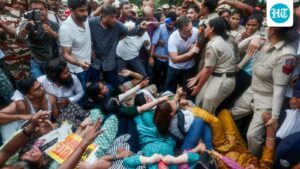
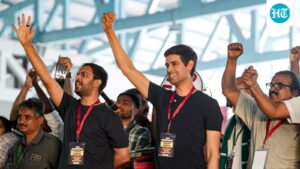
After serving as Leader of the Opposition in the council for five years, he won his own seat by more than 20,600 votes. Congress workers held demonstrations in his favor in at least five districts, HT reported. Student activists in Delhi came out to greet him upon his late-night arrival in the capital.

Sathisan called for restraint, posting on Facebook that workers should “stop installing flex panels and protesting in the streets in factions”, but the pressure campaign supporting him was clear.
Venugopal also spoke about this: “There have been some unfortunate incidents. These incidents must end.”
Sathisan also has the support of the Indian Union Muslim League (IUML), which has 22 legislators. The Kerala Congress (KEC) won eight seats and the Revolutionary Socialist Party (RSP) three. Congress has 63 members, and therefore does not form a majority of its own; The United Democratic Front won a total of 102 seats out of 140, representing a majority of more than two-thirds.
The third contender, Ramesh Chennithala, 69, has the longest political CV of the three. A six-time MLA from Haripad, he became the youngest minister in Kerala’s history at the age of 28, serving under CM K Karunakaran in 1986. He has been the state Congress unit president, president of the party’s National Students Union of India (NSUI) wing, home minister under Oommen Chandy, and leader of the opposition.
Under his leadership, the United Democratic Front swept Kerala in the 2019 Lok Sabha elections, winning 19 of the 20 seats.
Against him is weighed the defeat of the 2021 Assembly elections. This loss brought an end to a four-decade-long series of alternating governments in Kerala, where the LDF registered successive victories.
On Saturday, Karg held a meeting at his Delhi residence that lasted over three hours, attended by Rahul Gandhi, state incumbent Deepa Dasmunsi, and all three contenders for the chief minister’s post, among others. Everyone expressed their opinions and Rahulji listened to them patiently,” Chennithala then told PTI.
“The final decision on the Prime Minister will be taken by the Congress high command,” he added. Congress leader K Muralidharan added on Sunday that party workers are “bound to accept” what the high leadership announces.
Venugopal did not contest the Kerala Assembly elections. Moving into the state would require him to win a bypoll within six months of taking office. But that’s just a logistical complication, if he can manage the political part.

Arish Chhabra is an associate editor on the Hindustan Times online team, where he writes news reports and explanatory features, as well as overseeing the site’s coverage. His career spans nearly two decades across India’s most respected newsrooms in print, digital and broadcast. He has reported, written, and edited across formats—from breaking news and live election coverage, to analytical long-reads and cultural commentary—building a body of work that reflects editorial rigor and a deep curiosity about the community for which he writes. Areesh studied English Literature, Sociology and History along with Journalism at Punjab University in Chandigarh, and began his career in that city, eventually moving to Delhi. He is also the author of Big Small Town: What Life is Like from Chandigarh, a collection of critical essays Originally published as a weekly column in the Hindustan Times, it examines the culture and politics of a city that is much more than just its famous architecture – and in doing so, holds up a mirror to modern India. During his stints at BBC, The Indian Express, NDTV and Jagran New Media, he has worked across formats and languages; Mainly English, as well as Hindi and Punjabi. He was part of the crack team for the BBC Explainer project which was replicated around the world by the broadcaster. At Jagran, he developed editorial guides and trained journalists on integrity and quality content. He has also worked at the intersection of journalism and education. At the Indian School of Business (ISB) in Hyderabad, he developed a website to streamline academic research in management. At Bennett University’s Times School of Media in Noida, he taught students the craft of digital journalism: from newsgathering and writing to social media strategy and video storytelling. Having moved from small town to larger town to megalopolis for education and work, his intellectual passions lie at the intersection of society, politics, and popular culture—a perspective that guides his writing and worldview. When he’s not working, he’s constantly reading long-form journalism or watching cerebral content, sometimes both at the same time.Read more