Tamil Nadu witnessed a historic moment on Sunday, May 10, as actor-turned-politician ‘Thalapathy’ Vijay was sworn in as the state’s ninth chief minister – the first leader in nearly six decades with no connection to either the DMK or AIADMK, but with a crucial ally: the Indian National Congress.

While Tamil Nadu has a long tradition of political actors, from M G Ramachandran to G Jayalalithaa, the last five days for Vijay have been a rollercoaster. After his TVK party emerged as the largest single group with 108 seats, it fell short of the magic number of 118 seats, sparking a week of acute political uncertainty. The Congress was the first to break ranks, abandoning the DMK-led Secular Progressive Alliance to field five MLAs in support of TVK, a move that added to its momentum towards the top job.
The VCK and IUML gave mixed responses before finally extending external support, while the CPI and CPI(M) aligned with the Congress. With 120 effective MLAs behind him, Vijay met Governor RV Arlikar and took oath on Sunday morning.
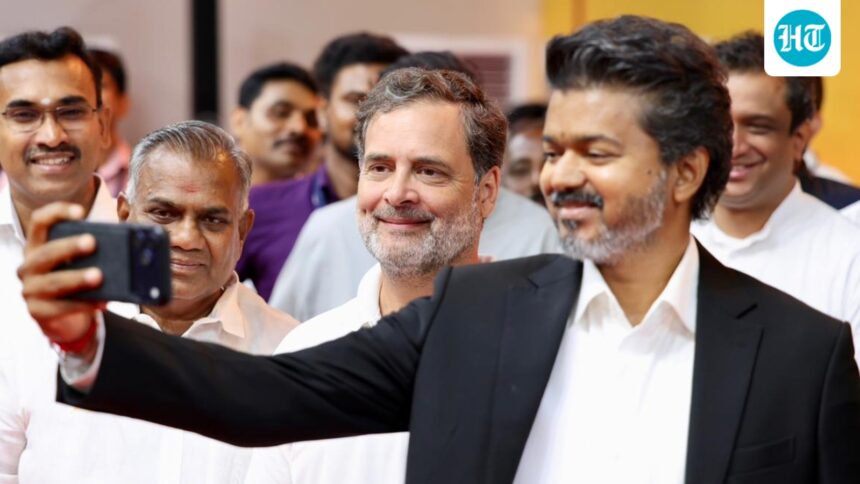
Congress MP Rahul Gandhi, Leader of the Opposition in Lok Sabha, personally attended the ceremony. Posting on
This moment carries weight far beyond protocol. For the Congress, the Tamil Nadu coalition means it will remain in power in the state.
But it also represents the latest chapter in a troubling pattern for the party.
The Congress has historically supported emerging political forces – Arvind Kejriwal’s AAP in Delhi in 2013, Mamata Banerjee’s TMC in Bengal in 2011, and the Janata Dal in the late 1980s – only to later find those same parties becoming rivals or replacing them in those same places. With TVK’s Vijay now in power, the implicit question is whether history will repeat.
AAP episode in Delhi
Before extending support to Vijay in Tamil Nadu, the Congress took a near-similar move in Delhi more than a decade ago, and is still living with the consequences.
In the December 2013 Delhi Assembly elections, the incumbent Congress came in a distant third, winning just eight seats against the BJP’s 31 and the AAP’s 28 in a hung assembly. With the BJP rejecting the lieutenant governor’s invitation to form the government, Congress extended unconditional “external support” to the RJD, specifically to prevent its main rival, which the party describes as a “communal force”, from power.
“We respect what the people of Delhi have decided and thank them for supporting us over the past 15 years,” Sheila Dikshit, the then outgoing Prime Minister, said after the 2013 Delhi result.
The APC emerged out of an anti-Congress agitation that many believe also propelled Narendra Modi’s BJP to power at the Center in 2014, although Kejriwal has since identified the BJP as his main “communal” enemy.
This is a keyword. In Tamil Nadu too, the Congress has offered its support to Vijay on the condition that “community forces” are kept out, which means the NDA of the AIADMK and the BJP.
The move to support the AAP in Delhi did not in itself help the Congress. Not only did the Congress lose the state it had ruled for 15 consecutive years, but Kejriwal’s party swept the 2015 elections by winning 67 of the 70 seats, completely obliterating the Congress; Then again in 2020, before the BJP takes power in 2025. The Congress does not have any multilateral settlement agreements in Delhi yet.
Meanwhile, the RJD has also emerged as a major contender in Punjab, which it wrests from the Congress in 2022.
The Congress and AAP later allied in Delhi in the 2024 Lok Sabha elections but lost all seven seats to the BJP. In Punjab, they are direct opponents, as the Lok Sabha elections are only 10 months away. The Congress-AAP equation is also one of the paradoxes of the India bloc that comes together in 2023.
Similar move in Bengal
Before Delhi and AAP, the Congress in 2011 entered into an alliance with Mamata Banerjee’s Trinamool Congress to end the Left Front’s 34-year rule in West Bengal. The alliance won a decisive victory, with the TMC winning a majority on its own and the Congress a junior partner.
By September 2012, just 16 months after being sworn in, the TMC had withdrawn from the Congress-led UPA coalition at the national level, citing disagreement over rules on foreign investment in retail trade and other issues. Congress withdrew from the Bengal government.
The alliance looked fairly natural on paper, given Mamata’s roots in the Congress. But the split itself was bitter. In 1997, Banerjee lost the state Congress president election by 27 votes to Somen Mitra, and found herself losing ground in an internal struggle. The breaking point came in mid-1997, when, during the party’s plenary session in Kolkata, it held a rival meeting just outside the venue. She was suspended from the party, and founded her own party, TMC, in January 1998. The Congress later had to play second fiddle to her more than a decade later.
After their alliance in the state in 2011-12, by the 2016 Assembly elections, the contest was between the TMC and the Left alliance in the Congress. The TMC once again won alone. By 2021, the BJP had replaced the Left and the Congress as the main contender. In 2026, the BJP promptly ousted Mamata, with former TMC leader Suvendu Adhikari defeating Banerjee in her Bhabanipur seat. Congress was nowhere to be seen.
Janata Dal experience
A similar pattern was seen for the Congress after Vice President Singh, who served as chief minister in Rajiv Gandhi’s Congress government at the Centre, fell out over alleged corruption in the Bofors arms deal.
He formed the Jan Morcha, and then merged with others to form the Janata Dal. In 1989, the National Front came to power with external support from the BJP and the Left, ending Congress rule. The government lasted for about a year until the BJP withdrew its support in November 1990.
That’s when the Congress extended external support to the breakaway faction led by Chandra Shekhar, giving itself a short lifeline. This pattern repeated itself in 1996-97 with HD Deve Gowda and IK Gujral who took over as Prime Ministers.
The Janata Dal eventually split into the JD(U), RJD, JD(S) and other factions. Now, both Janata Dal factions continue to challenge the Congress or make it a junior partner in their respective areas.
Pattern and question
From the late 1980s until Sunday’s swearing-in in Chennai, this pattern has remained consistent.
Congress provides the critical margin that enables a new power to cross the threshold of power. Once there, that power no longer needs Congress and often competes with it directly.
The TVK party did not exist two years ago, but it won about 35% of the popular vote in its debut, and now governs India’s sixth-largest state. Even now, Joseph Vijay has declared his allegiance to “secular” justice and described the country’s prominent force, the Bharatiya Janata Party, as his “ideological enemy”. Hence, his alliance with Congress may seem natural. for now.