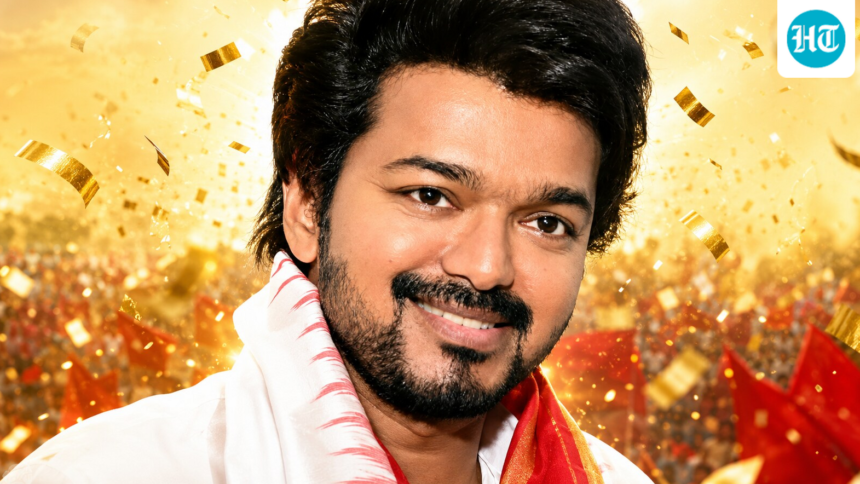
TVK is the largest single party with 108 seats, and the crown remains elusive. In a house of 234 people, here’s how VCK became Vijay’s key to the CM chair.

The calls kept coming. The meetings extended late into the night. Cars moved in and out of Raj Bhavan. Suddenly, political parties that had fought each other for years found themselves in the same conversation. For more than three days, every conversation about government formation in Tamil Nadu has come down to one party: the party Viduthalai Chiruthaigal Katchi.

The VCK, which has only two MLAs, has been the most important player in the post-election drama in the state. The party’s support has now paved the way for C Joseph Vijay to become the next Chief Minister of Tamil Nadu.
Numbers setback for TVK
Vijay The Tamilaga Vetri Kazhagam (TVK) was the single largest party in the 234-member Assembly with 108 seats. The actor-turned-politician won from two constituencies: Perambur and Tiruchirappalli East. He is required to vacate one of the parties, which further reduces the party’s actual strength and leaves it dependent on smaller parties to pass the 118-seat majority mark.
At one point, TVK thought it had the numbers. Congress support added five seats. Left parties seemed ready to join. There were also expectations of support from the Indian Union Muslim League (IUML) and Amma Makkal Munnetra Kazhagam (AMMK).
But the equations began to change one after another. Despite all the uncertainty, VCK remained the central question.

The party everyone has been waiting for
VCK’s position has fluctuated repeatedly over the past three days. VCK leaders and Left representatives met on Wednesday MK Stalin, president of the Dravida Munnetra Kazhagam (DMK), to discuss their future course after the election result.
Stalin reportedly told the parties that they were free to make decisions that served their political interest. This effectively opened the door to negotiations with Vijay’s TVK.
Soon after, TVK began reaching out to the VCK, CPI, CPM and IUML in an attempt to gather enough support to form a government.
The numbers seem manageable. TVK only needed a few seats to cross the halfway mark. However, the VCK did not immediately commit.
After one day
As the talks continued on Thursday, left-wing parties slowly moved toward supporting TVK. Initially, there were indications that they might favor an arrangement that included issue-based external support, but their position later appeared tougher. Again, the VCK did not immediately commit.
Party president Thul Thirumavalavan avoided making a direct announcement and repeatedly said the decision would be taken at a later date. As speculation grows, VCK becomes TVK’s biggest obstacle and biggest opportunity.
Meanwhile, Governor Rajendra Arlikar continued to ask Vijay to prove that he has majority support before inviting him to form the government.
Vijay said he should be allowed to prove his strength on the floor of the Assembly. the However, the governor reportedly insisted on letters of support first.
Without a clear commitment from the VCK, TVK could not cross the majority mark conclusively.
More confusion
By Friday morning, TVK leaders believed the numbers had finally been set.
With the Congress, Left parties and VCK’s expected support, Vijay’s camp felt it had crossed 118 seats. Reports also suggested that support from IUML and AMMK could see the number rise. Thinking he had enough support, Vijay met the governor again. Then the situation changed.
AMMK president TTV Dhinakaran accused TVK supporters of distributing a fake letter of support and clarified that his MLA remained with the AIADMK-led NDA alliance. IUML also backed away from supporting TVK.
Interest immediately returned to the VCK.
VCK support is declining
Late on Friday evening, a post appeared on X’s account, claiming to be a VCK official, saying the party had sent a letter of support to Vijay. For a brief moment, the impasse seemed to be over.
The social media post was deleted shortly after. The account itself was suspended within an hour.
By Friday night, there was no confirmed message of support from the VCK before the governor.
Once again, Vijay left Raj Bhavan without an invitation to form the government.

VCK denies reports of bargaining
As rumors spread about negotiations for ministerial positions, Secretary General of the VCK Dr. refused. Ravikumar alleged that the party was demanding posts.
“We request the media not to give credence to such reports. We also urge the media not to be complicit in attempts to distort VCK,” Ravikumar said.
Ravikumar described such reports as “completely contrary to the truth” and said they were attempts to discredit the party.
Penetration
The VCK finally took action on Saturday evening and sent a letter of support to TVK.
Vijay’s Tamil Nadu Vetri Kazhagam Party has now received support from Congress (5 seats), CPI (2 seats), CPI (2 seats) and VCK (2 seats). The IUML also expanded support, gaining two seats. This brings TVK’s support base to 120 seats, including its tally after Vijay vacated one constituency.
The state is still waiting for the governor to accept Vijay’s share to form the government.

Anita Goswami is a Senior Content Producer at Hindustan Times, where she primarily covers Indian and international news. With four years of experience in the field, she has led coverage of Indian general elections, Assembly elections, and national polls in the US, Canada, Bangladesh and Nepal. Its reports cover world wars and major events, including Operation Sindoor, the overthrow of Sheikh Hasina, and the Mahakumbh Mela. It verifies the facts and uses clear sources to ensure the accuracy of the reports. As a former Editor-in-Chief at Storytailors, she has managed teams to produce high-quality content for networks such as NDTV, Profit, CNBC-TV18, Upstox and News18. Her work has appeared on NDTV, Meaww and Global Pulse. Throughout her tenure, Anita has collaborated with and received mentoring from leading industry experts. When she’s not reading, Anita can be found outside or at a bakery. Areas of interest: Indian political history, international elections, historical policy analysis, global conflicts, cultural events, Formula 1, art, media ethics, reporting on social and political change over time.Read more