In the 1996 midterm assembly elections, the Bharatiya Janata Party (BJP) won 174 seats, emerging as the single largest party in the 424-member assembly in undivided Uttar Pradesh. The BJP failed to muster support from any political party in the hung house.

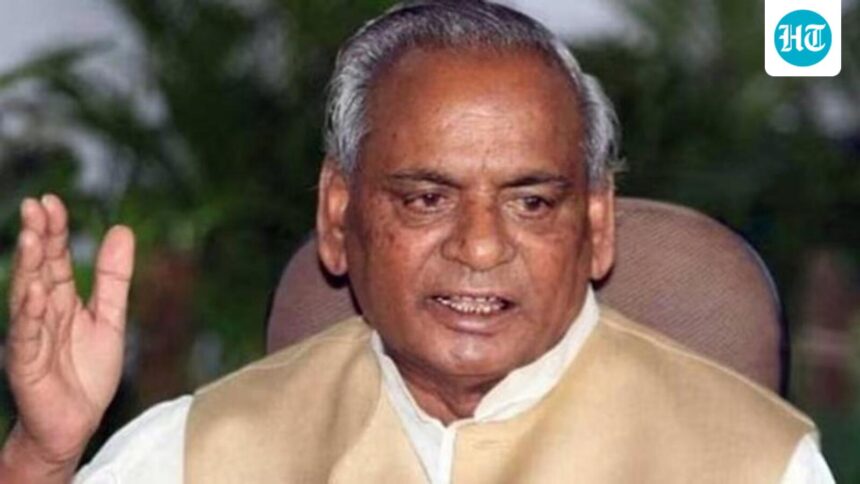
Prime Ministerial candidate Kalyan Singh staked his claim to form the government. The BJP, citing the SR Bommai vs Union Govt (1994) judgment and other precedents, argued that the floor test was mandatory to prove majority and could not be decided by the governor at Raj Bhavan.
It is worth noting that political parties believe that an invitation from Raj Bhavan/Rashtrapati Bhavan will secure them the required numbers in a pending house. At the end of the game of cat and mouse in a hanging house, calculations play a decisive role in determining who will ultimately wear the crown.
Governor Romesh Bhandari rejected Singh’s invitation, citing neither a majority nor a workable mix. Bhandari stressed that no party, including the BJP as the single largest party, got a majority. Moreover, no one came forward to prove the majority, even though he set October 17 as a deadline to discuss the possibilities of forming a government. His hypothesis was that the governor must be convinced of the stability of the government. The results of the survey were announced on October 10.
Bhandari also cited President Shankar Dayal Sharma’s decision to invite Atal Bihari Vajpayee, the leader of the largest party in the Lok Sabha, to form the government in April 1996. Sharma held that in the hung house, the president should first invite the leader of the single largest party, as recommended by the Sarkaria Commission and precedents in state assemblies. The plaintiff bears the majority’s burden of proof.
The 1996 Lok Sabha polls resulted in a hung house with the BJP bagging 161 seats and later garnering support from some regional parties. Vajpayee resigned after 13 days because he failed to prove a majority for his government.
Bhandari recommended imposing president’s rule in the state, sparking protests from the BJP. He called an angry Kalyan Singh to ‘Gherao Raj Bhavan’.
Prime Minister HD Deve Gowda supported Bhandari’s decision in Parliament.
Read also:UP Keeping Up: Will Women Help BJP Retain Power
The Assembly was suspended and President’s rule was imposed until March 1997, when the BSP-BJP formed an alliance. The BSP got rid of its pre-election partner, the Congress. A rotating government was formed with Mayawati serving as Prime Minister for the first six months.
The decisions of both Bhandari and Sharma became moot points, as the majority factor proved vital to government formation in later years. But conservative decisions sometimes carry political connotations, as Bhandari revealed through his subsequent conflicting moves in quick succession.
A reluctant Mayawati handed over the baton of power to Kalyan Singh after six months but withdrew her support within 20 days. Governor Bhandari did the following: He gave Prime Minister Singh 36 hours to prove his majority in the House and, in a rare move, appointed three independent observers to record the proceedings.
The drama followed with Kalyan Singh and then rising politician Rajnath Singh displaying their political skills, dividing all major opposition groups. In October 1997, the parties broke out and Kalyan Singh established his majority after the chaos in the Vidhan Sabha.
Bhandari accepted the opposition’s demand to dismiss the government, which the Cabinet agreed to after marathon sessions in Delhi. It recommended imposition of President’s Rule under Article 356 of the Constitution in Uttar Pradesh and dissolution of the state assembly.
The BJP sprang into action and paraded 222 MLAs before President KR Narayanan the next day. The BJP also moved the court and termed the governor’s action as mala fide. In an unprecedented move, President Narayanan asked the United Front government to reconsider its decision to invoke Article 356 of the Constitution because Kalyan Singh had proven his majority. The President also made it clear that he would not hesitate to seek legal advice if the government went ahead with the move. The governor and the government retracted their decision.
The ruler did not remain calm for long. A few months later, in February 1998, another attempt was made to overthrow the Kalyan Singh government. The plan was likely hatched by Bhandari, Samajwadi Party’s Mulayam Singh Yadav, the late Arjun Singh and his former aide Jagdambika Pal, president of the Loktantrik Congress party.
In early February, they all met in Jhansi at a mutual friend’s wedding. In view of the 1998 Lok Sabha elections, they discussed a foolproof strategy to topple the BJP-led government in Uttar Pradesh. After hectic meetings and support from allies, Pal asserted his claim to form the government even though his flock of 22 people were not present with him in person. But he received written support from all the other major political parties – Congress, the Republican Party.
Samajwadi Party, Bahujan Samaj Party and Communists. They submitted their letter of support to Governor Romesh Bhandari on February 20, 1998.
The state was in the midst of elections, but Bhandari dismissed the Singh government and accepted letters of support “at face value”, which plunged the state into its worst ever constitutional crisis when two chief ministers took charge of the state for a few hours. He also administered the oath of office to the new government under Pal’s leadership at around 10:30 p.m. The BJP moved the court which stopped the dismissal of the state government.
For 48 hours, Lucknow witnessed political unrest. Even as Pal was preparing for the next round, the 22-member LCP decided to make a shake-up as they had last-minute reservations on Pal as their leader and went back to Kalyan Singh.
The drama continued as lawmakers remained unsure about which direction events would take.
Interestingly, Bhandari, who had not invited the larger party in 1996 to form the government because he needed convincing about its stability, did not question it a year later when Pal met him with 22 members.
Once again, the BJP staged a dharna outside Rashtrapati Bhavan and moved the court but the state had two “prime ministers” from 11 pm on February 21, 1998 to February 23, 1998. A three-member bench of the Supreme Court ordered a composite floor test at a specially convened session of the state assembly on February 26, 1998 to decide who would lead the majority. Kalyan Singh won.
The truth is that constitutional presidents are often guided not by the Constitution of India, but by their personal whims or political allegiance.
There are other interesting patterns that influence the formation of fragile governments – the timing of swearing-in ceremonies and the time frame for confidence votes.
For example, in Maharashtra, Governor Bhagat Singh Koshyari held a swearing-in ceremony at 8 am, while in Uttar Pradesh, Romesh Bhandari called for a swearing-in ceremony at 10:30 pm. There is always a rush.
The time frame for a vote of confidence is often seven to 15 days. Moreover, the courts had to intervene when the aggrieved party was knocking on their door for justice, even at odd hours.