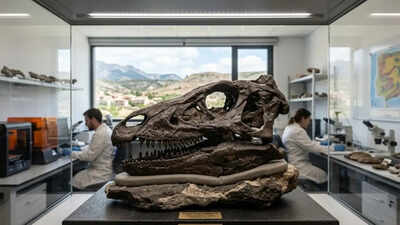
In Teruel, Spain, paleontologists have discovered an almost complete skull of the armored dinosaur Dacentrurus armatus. This exceptional discovery dates back 150 million years, i.e. to the Late Jurassic period.
The skull emerged from the Villarubio Formation and is the most intact stegosaurus skull ever found in Europe. Dinosaur skulls are often brittle, so they rarely fossilize, making this discovery crucial to understanding the skull structure of these ancient plant-eaters. The discovery, published in the Journal of Vertebrate Zoology, has allowed researchers to formalize a new evolutionary group called ‘Neostegosauria’. This breakthrough clarifies the lineage of stegosaurus dinosaurs in the Iberian Peninsula and provides new insights into how these famous dinosaurs evolved across different continents long ago.
rare Discovery of a dinosaur skull In Spain, Jurassic history is being rewritten
The fossil was found at the Están de Colón site in Riodiva, a place famous for its abundant fossil finds. As reported in the Journal of Vertebrate Zoology, the skull belongs to Dacentrurus armatus, a species of stegosaurus known for its spiky carapace rather than the skin plates possessed by its relative Stegosaurus. This discovery is very important as a “landmark in paleontology”, mainly because it is rare to find Stegosaurus skulls in Europe.
Their bones are usually too thin and fragile to last long enough to become fossils.
3D modeling reveals hidden features of Riodiva’s skull
Sergio Sanchez Fenollosa and his research team used advanced 3D modeling and comparative anatomy techniques to discover previously unknown features in the Riodiva skull. With this new information, they officially identified the “Neostigosauria” branch. This group includes two main families: Stegosauridae and Huayangosauridae.
Surprisingly, the discovery shows that Dacentrurus had a more complex evolutionary relationship with North American species than previously assumed.
How a fragile skull from the Jurassic period survived
Scientists have discovered a skull in the Villar del Arzobispo Formation. According to the Journal of Vertebrate Zoology, this formation dates back to about 150 million years ago, and covers the Kimmeridgian-Titonian boundary. It reconstructs the ecology of coastal areas filled with deltas and lagoons where huge herbivores once inhabited. Finding such a fragile skull here sheds light on how fossils formed on the Iberian Peninsula during the Jurassic period.