Deputy Chief of Army Staff (Strategy) Lieutenant General Rajiv Ghai said on Thursday that terrorist sanctuaries in Pakistan are no longer safe as India will hit them hard on its own terms, choosing the timing, conditions and modus operandi.

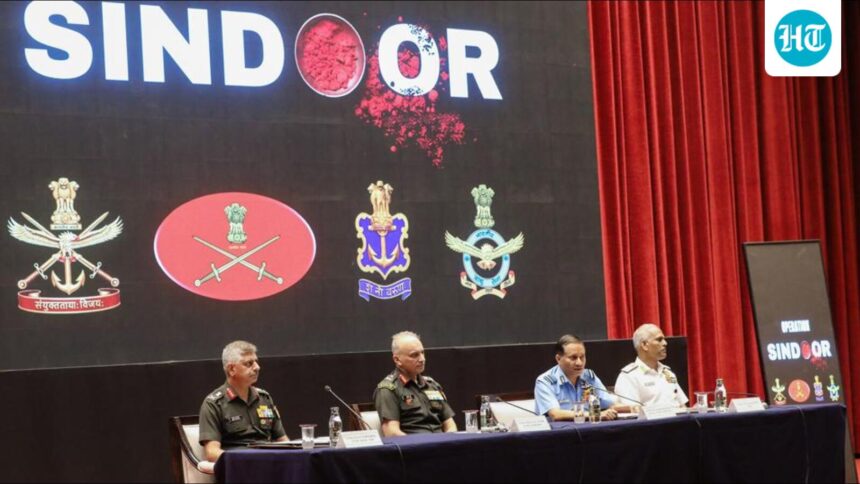
“We will hit everything,” he said at a joint press conference of senior officials from the three agencies on the occasion of the first anniversary of Operation Sindoor. Guy supervised the operation last year in his capacity as the Army’s Director General of Military Operations. He described it as a “defining moment in India’s strategic journey.”
The operation, which began in the early hours of May 7, 2025, was New Delhi’s strong response to the Pakistan-backed Pahalgam terror attack that killed 26 people. It caused four days of strikes and counter-strikes with combat aircraft, missiles, drones, long-range weapons and heavy artillery before the two sides reached an understanding on cessation of all military actions on May 10.
Ghai said the confrontational precision strikes were perfectly timed, achieved complete surprise, and inflicted maximum damage on every terrorist hub struck by Indian forces deep in Pakistan-occupied Kashmir and the heart of Pakistan, indicating that there is no safe haven.
He said that some terrorist camps moved deep into Pakistan after the four-day military confrontation between the two countries within the framework of Operation Sindoor.
“I think people on the other side are also wise,” Ghai said. “So, yes, some of these camps and launch pads have moved to ‘deep’ areas in Pakistan where they feel it will be safer. But there is no safe haven for terrorism. We have talked about the depths… and we will go after everything.”
Pakistan-sponsored terrorist groups, such as Jaish-e-Mohammad (JeM) and Hizbul Mujahideen (HM), have begun moving into the country’s Khyber Pakhtunkhwa (KPK) province after Indian forces bombed nine terror camps in Pakistan and Pakistan and killed at least 100 terrorists in the early hours of May 7.
The IAF struck two terrorist sites at Subhanullah Center in Bahawalpur and Taiba Center near Muridke, both in Pakistan’s Punjab province, while the Army struck targets at seven places, including Mahmuna Joya in Sialkot, Sawai Nala and Syed Na Bilal in Muzaffarabad, Gulpur and Abbas in Kotli, Barnala in Bhimber, and Sargal.
Ghai said that Operation Sindoor witnessed India going beyond its previous methods and approaches, targeting terrorism across the Line of Control and the international border with Pakistan, with precision, proportionality and clarity of purpose, adding that it was a statement of resolve, responsibility and strategic restraint on the part of India.
“When our desire for peace is mistaken for weakness, there is no option but action. When we act, there are no half-measures—they are decisive and lethal and translate into Operation Sindoor,” said Indian Air Force Vice Chief Marshal AK Bharti, who was Director General of Air Operations last year.
From 9 to 10 May, the IAF struck military targets at Rafiqi, Murid, Chaklala, Rahim Yar Khan, Sukkur, Chunyan, Pasrur, Sialkot, Skardu, Sargodha, Jacobabad, Bullari and Malir Cantt in Karachi. Pakistan lost as many as 12 to 13 aircraft, including fighter jets like US-made F-16s and Chinese-origin JF-17s, due to precision air strikes on the ground and in the air during the military clash.
“Our fight was with the terrorists and their supporting infrastructure. This is what we hit, ensuring there was no collateral damage. We achieved our objectives and our mission was completed (on May 7) but when the Pakistani establishment decided to side with terrorism and make it their own fight, we had no choice…and when we hit back, it was lethal and cruel.” Bharti said.
Director General of Naval Operations, Vice Admiral A N Pramod, said Operation Sindoor is a clear testimony to India’s determination to fight terrorism and the decisive strategic vision of the country’s national leadership. He said that the operation represents “the emergence of a new dimension of deterrence.”
The journalists were briefed by Bharti, Jay, Pramod and Lt. Gen. Zubin Minwala, Deputy Chief of Integrated Defense Staff (Operations). Bharti, Ghai and Pramod had addressed the media during Operation Sindoor last year as they were heading the operations in their respective services. Minwala’s presence on the scene Thursday indicates the strong emphasis on unity in the armed forces — a prerequisite for establishing theater commands.
“Operations were seamlessly integrated across not only traditional domains, but also across cyber, space and information domains, representing a critical development in our warfighting philosophy. Operation Sindor demonstrated our ability to deliver integrated effects with speed, precision and clarity of purpose, serving as a foundational step towards multi-domain operations,” Minwala said.
Ghai said that the operation demonstrated indigenous capabilities, as a large proportion of the weapons systems, ammunition, missiles, missiles, sensors and electronic warfare equipment that were used were developed and produced in India.
“Indigenous equipment means not only self-reliance, but flexibility to adapt it to our operational requirements, maintain and maintain supply chains, and respond quickly and confidently. Operation Sindoor has proven that ‘Atmanirbharta’ is not just a slogan, it is a force multiplier,” he said.
Speaking about India’s exit and escalation control strategy, Ghai added: “In an era of protracted conflicts around the world, we struck hard, achieved clearly defined objectives and then decided to cease hostilities when the Pakistanis were forced to negotiate and asked us to stop. The objectives were achieved through a calculated, short and sharp shock that changed the enemy’s appetite for risk and disrupted its command and control, without locking India into a war or protracted conflict… its ill effects that we are witnessing in ongoing conflicts around the world.”