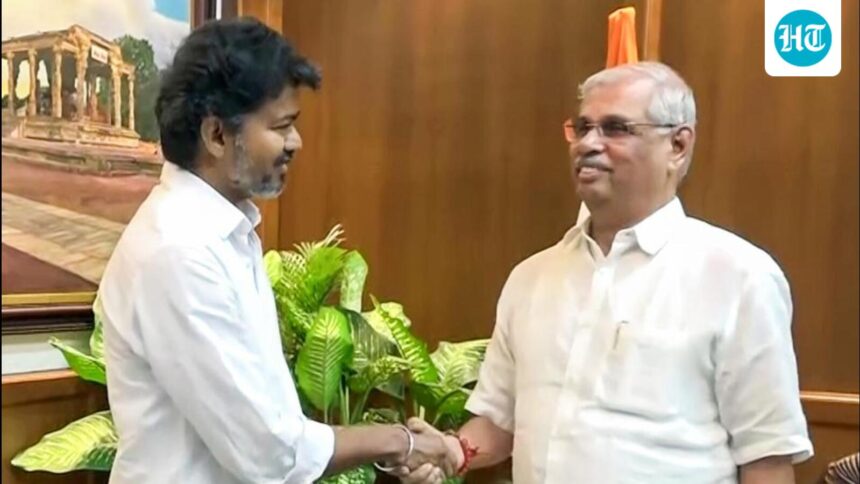
The delicate constitutional balance between the discretion of the ruler and the democratic right of the largest party to try to form the government has again come into sharp focus in Tamil Nadu, where TVK chief Vijay met Governor Rajendra Vishwanath Arlikar for the second straight day on Thursday amid continued uncertainty over who should be invited to form the next government.

These developments have revived an old constitutional debate that has repeatedly moved to the Supreme Court over the past three decades: Can a governor insist on proof of a majority before inviting any party to form a government, or should the single largest party automatically get the first shot and prove its power later on the House floor?
The response of the constitutional courts was not at all unilateral.
The fundamental constitutional question
While the Supreme Court has consistently held that the Governor cannot conduct a “floor test in the Raj Bhavan”, it has equally recognized that the Governor is empowered, and perhaps constitutionally bound, to make a limited “prima facie” assessment of whether the plaintiff is likely to enjoy majority support in the Assembly.
Vijay’s Tamil Vetri Kazhagam (TVK), which is contesting its first Assembly elections, has emerged as the single largest party with 108 seats in the 234-member Assembly. With the support of five Congress members, the party received the support of 113 legislators, which is still below the halfway mark of 118.
According to people familiar with the matter, Governor Arlikar during a meeting on Thursday asserted that Vijay would need to show support from 118 MLAs before he could be formally invited to form the government.
Read also | Vijay’s fight for majority: Won 108, stalled at 113, How TVK’s winning numbers stack up in Tamil Nadu poll
The governor’s office also reportedly sought to clarify which additional parties were willing to support TVK, especially since the party itself had put forward its claim as part of broader coalition arrangements.
The jury was undecided whether this was a superficial assessment or more.
First principles
The basic principles were laid down in the landmark judgment of the Supreme Court in S R Bommai v. Union of India (1994), where the court held that the “proper forum” for the majority test is the House of Representatives and not the personal satisfaction of the ruler.
The ruling also noted that the governor may invite “the leader of the party that controls the majority in the House or the largest party/group” to form the government, suggesting that the single largest party remains a constitutionally recognized claimant in a fractured government.
The warning is apparent
In the Constitutional Court judgment in Rameshwar Prasad v. Union of India (2006), the Supreme Court made it clear that the role of the Governor at the stage of formation of the government is limited to a “prima facie” assessment.
The court observed that at the stage of government formation, the Governor’s satisfaction is “only apparent, not conclusive”, suggesting that Raj Bhavan cannot be expected to decide conclusively on majority support but cannot ignore the question completely either.
This ‘ostensibly’ principle gained central importance again during Maharashtra’s 2019 political crisis in Shiv Sena vs Union of India, where rival political formations questioned the governor’s decision to take oath of government amid rival claims.
Before the Supreme Court, parties challenging the governor’s decision argued that constitutional morality only required a minimum level of satisfaction based on objective materials such as letters of support, with the final decision necessarily left to actual testing.
The Supreme Court eventually ordered an immediate floor test, affirming the now-settled constitutional principle that legislative majorities can only be conclusively determined within the Assembly. However, significantly, the Court did not hold that governors were prohibited from requesting any materials at all before extending an invitation.
Material testing
Later, in Subhash Desai v. Union of India (2023), which arose out of the split in the Shiv Sena and the subsequent dispute over the formation of the Maharashtra government, the Supreme Court directly considered the validity of the Governor’s decision to invite Eknath Shinde to form the government. The court eventually upheld the governor’s decision, noting that the call was extended after the BJP formally communicated its support to Shinde.
“Based on the materials before him, i.e. the letters received, the Governor invited Mr. Shinde to take the oath of office and directed him to prove his majority on the floor of the Assembly within seven days…Hence, the Governor’s decision to invite Mr. Shinde to form the government was justified,” the Constitution Bench said.
The Court’s emphasis on the phrase “based on the material before it” is significant in the present Tamil Nadu context. She points out that while the governor cannot definitively determine majority support outside the assembly, the office has the right to examine substantive materials, such as letters of support and coalition claims, before deciding who to invite to form the government.
Why is Tamil Nadu in the gray zone?
This distinction becomes particularly important in the case of Tamil Nadu.
Unlike cases involving a clear post-poll coalition that crosses the majority mark before the claim is staked, the TVK currently remains numerically below the midpoint number, even after Congress support.
While parties like VCK, CPI and MNM have publicly expressed their support for Vijay and urged the governor to invite him to form the government, formal messages of support from enough lawmakers to cross 118 are yet to emerge.
This creates a gray area where both competing principles – the right of the single largest party to try to form a government and the governor’s obligation to ensure a viable candidate – intersect uncomfortably.
The Sarkaria Commission’s recommendations, which the Supreme Court has repeatedly endorsed, recognize “the single largest party asserting a claim with the support of others” as one of the preferred claimants in the pending Assembly. But the recommendations also include some clear support, albeit temporary, before an invitation is issued.
Past flashpoints
The constitutional history of India provides many examples where rulers have adopted different norms while inviting parties to form governments in fractured provisions.
In 1997, Uttar Pradesh Governor Romesh Bhandari rejected the BJP’s invitation despite being the single largest party, expressing doubts about the stability of the proposed Kalyan Singh-led government. Singh was confident of securing support from the additional MLAs invited once invited, but Raj Bhavan remained unconvinced.
However, just a year later, the same governor administered oath to Jagdambika Pal, whose Loktantrik Congress party got just 22 MLAs in the 424-seat House, after fielding messages of support from parties other than the BJP. The contrasting approaches highlighted how state governors’ discretion often varied depending on political circumstances.
A similar controversy erupted after the 2005 Jharkhand Assembly elections. The BJP emerged as the largest single party with 30 seats, while the JMM got 17 seats. Despite this, Governor Syed Sabti Razi called on Shibu Sorin and the United Progressive Alliance coalition to form the government, claiming that they had majority support.
The decision sparked severe constitutional criticism because the BJP-led NDA also asserted that it had the numbers. Soren was ultimately unable to prove a majority and resigned within days, paving the way for Arjun Munda to take over.
These events confirm that no single constitutional convention uniformly governs the suspended assemblies. Questions surrounding the timing of swearing-in ceremonies, the adequacy of letters of support, and the time frame for floor tests have repeatedly generated constitutional disputes.
The middle path
Perhaps this is why the courts repeatedly insist on following a careful middle course.
The governor cannot insist on presenting a decisive majority, similar to a floor test before calling on the plaintiff. But likewise, the office is not expected to function merely as a ceremonial conveyor belt that automates By inviting every large party regardless of the numbers available.
Instead, constitutional design favors limited prima facie scrutiny followed by a cursory ground test.
Now, developments in Tamil Nadu highlight how India’s frequent suspended sentences continue to test constitutional norms that remain partly codified in sentencing and partly dependent on political wisdom.
Whether Vijay ultimately manages to secure the numbers or not, the furore around Lok Bhavan once again highlights that in India’s parliamentary democracy, government is often shaped as much by constitutional conventions as by constitutional text. It also highlights how calls to form governments involve the discretion of state governors – an area that has drawn repeated criticism over perceived political proximity and unequal standards in dealing with competing claimants to power.