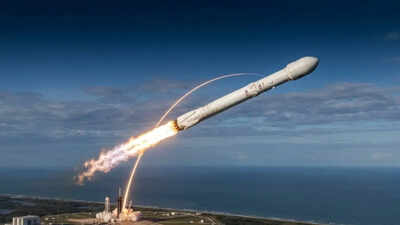
Have you ever wondered why rockets end up leaning after launch? Most people assume that a rocket’s goal is to fly as high as possible, but “higher” is only the first step. If the rocket flies perfectly straight, it will eventually run out of fuel and fall straight to the ground like a stone thrown in the air.
To reach orbit, it must perform a maneuver known as a “gravitational rotation.” This movement takes advantage of the Earth’s gravity, and transforms from vertical ascent to rapid horizontal movement, which is necessary for survival in space. By performing a lateral transition, the rocket uses less fuel and reduces atmospheric pressure. This action marks the beginning of its continuing fall around our planet.
This is why rockets bend after launch (that’s cool physics)
In flight, a movement called a gravitational cycle, rockets tend to accelerate horizontally.
NASA explains that for the spacecraft to remain in orbit, it must reach about 17,500 mph (28,000 km/h) moving horizontally. If the rocket rises straight up and does not tilt, gravity will pull it back down after the engines stop. Instead of just rising to the top, the rocket arches its flight path to take advantage of gravity. This optimal path means using less fuel in the steering thrusters than if they were traveling straight.
How do rockets get past the thickest part of the atmosphere?
To quickly leave the thickest part of the Earth’s atmosphere, rockets are initially launched straight up. This reduces aerodynamic drag. But as discussed in Fundamentals of Rocket Propulsion, moving vertically for very long is not practical. As the atmosphere becomes thinner, the rocket begins to tilt. This transformation prevents it from structural failure due to air pressure and helps it gain lateral speed to navigate the curve of the Earth effectively.
Speed matters more than height
The interesting part is that a rocket in orbit always falls. The Smithsonian National Air and Space Museum explains this by saying that its path matches the curve of the Earth. When the rocket reaches the appropriate horizontal speed, it falls toward the Earth at the same rate as the Earth’s surface is curving away. Without starting this side path shortly after launch, it would not have been able to continue “falling without hitting the ground.”
Why don’t rockets just “brute force” their way up?
Physics shows that rockets work best when they hurtle forward at high speeds. According to joint research by the American Institute of Aeronautics and Astronautics (AIAA), when a rocket follows a path in line with gravity, it reduces what is known as “gravity loss.” This way, more fuel is used to reach its intended orbit rather than resisting Earth’s gravity.