

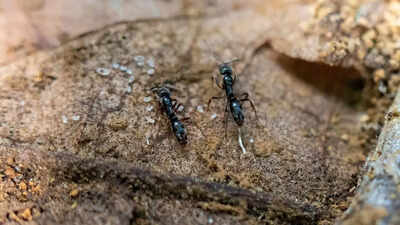
An inconspicuous creature is invading certain parts of the United States and is beginning to attract the attention of experts and safety agencies. The Asian needle ant is native to East Asia, and although it is small and unassuming, this creature’s bite is extremely painful.
Victims describe the pain as being punctured by an incredibly sharp needle. While some people may have allergic reactions to the bites of these creatures, the danger these creatures pose is beginning to attract the attention of agencies. This type of ant has been a part of life in the United States for years now, but the latest news is that the population is expanding further into new areas.
Identification of the Asian needle ant in the United States: why it is so difficult to detect
The Asian needle ant is not the type of insect that stands out immediately.
It is small, usually dark brown or black, and often mixed with soil, wood or leaf litter. For this reason, many people do not notice it until after they are stung. Experts say it is often confused with other common ant species. Its appearance is not dramatic, and there are no obvious warning signs when it is nearby. This makes identification difficult even for people accustomed to seeing insects outdoors.As the New York Post reported, ants were first recorded in the United States in the early 1900s, especially in the Southern states.
Since then, they have slowly expanded their presence. Reports indicate they are now found in more than 20 states, with larger numbers in places like Georgia, Alabama, North Carolina, and South Carolina. They tend to live in hidden environments such as under rocks, inside decaying wood, and in moist soil.
These quiet habits make it easy to ignore them for long periods.
Asian needle ant sting Symptoms and Pain: What makes it so worrying?
What makes the Asian needle ant even more alarming is its sting.
People who have experienced it often describe it as sudden and very severe. According to researchers, it feels like a needle entering the skin. The pain is usually localized but may be strong enough to surprise people. In many cases, the pain does not go away quickly. Some reports indicate that it may come and go for hours, which could make the experience more uncomfortable than expected.
Most stings do not result in serious harm. Usual effects include redness, swelling, or irritation at the site.
These symptoms often go away after some time.However, experts point out that allergic reactions can occur in rare cases. In sensitive individuals, the body may respond aggressively, causing symptoms such as hives, difficulty breathing, or swelling in the throat. These conditions are uncommon but may require immediate medical attention.
Why are Asian needle ants so difficult to detect and control?
One of the main challenges facing this species is how easily it hides. Unlike some invasive ants that form large, visible mounds or move in orderly paths, Asian needle ants behave differently.
They do not create clear paths and rarely form large surface colonies. Instead, they remain hidden under debris, stones or rotting plants. This makes detection difficult until their population becomes established in the area.
This cryptic lifestyle is one reason the species was able to spread across multiple states without attracting widespread attention earlier, experts say.Control efforts are also complex. Some insecticide baiting methods appear to reduce populations, but do not completely eliminate colonies once they are established.
This means that management, rather than complete removal, is often the only practical option.
Impact on nature and local ecosystems
The concern is not limited to human stings. Scientists also point to potential environmental impacts. Ants may compete with native species that play important roles in ecosystems, such as dispersing seeds and supporting soil health. When native insects are displaced, the balance of local ecosystems can slowly change. The researchers suggest that these changes may accumulate over time rather than appear suddenly.
For this reason, environmental agencies continue to monitor their spread and study their long-term impact.
Living with Asian needle ants in the United States: Awareness and prevention tips
At this point, experts say it is unlikely that this species will be completely removed from areas where it is already established. Instead, the focus has shifted toward awareness and caution. People are advised to wear gloves when handling wood, gardening, or working in wet outdoor areas. Simple care can reduce the chance of accidental contact.Ants are not generally aggressive and do not swarm like some other invasive species. Most encounters occur by chance rather than attack.However, officials suggest paying attention in environments where they may be found. It’s easy to ignore small insects, but in this case, a short sting can be memorable.