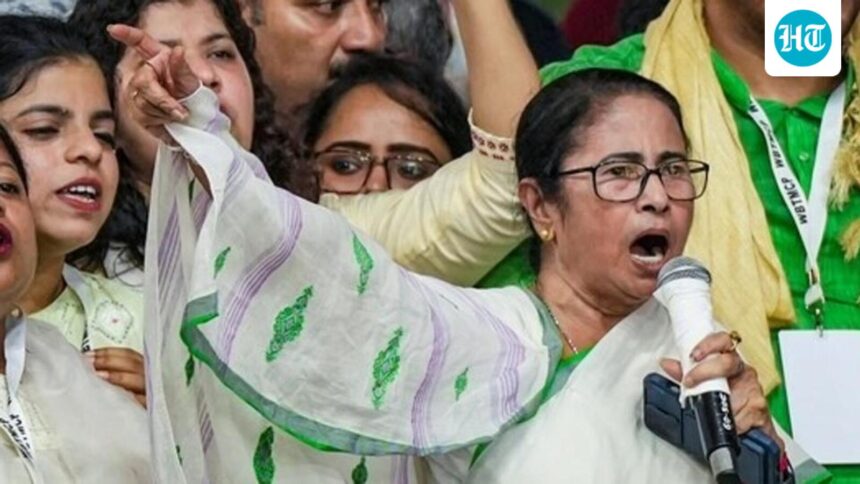
KOLKATA/NEW DELHI: “Chor, chor (thief),” chanted BJP supporters as Abhishek Banerjee, the prime minister’s nephew and second-in-command, entered Sakawat Memorial Girls School on Monday, where votes from Mamata Banerjee’s constituency were being counted. By afternoon, Bengal had turned saffron – and Banerjee’s 15-year government was voted out in political turmoil bearing the same shape as 2011, when street protests ended 34 years of Left rule.

The BJP is set to rule Bengal for the first time since independence. The TMC’s vote share collapsed from 48% in 2021 to 40.8%, a loss of more than 7 percentage points. Banerjee lost her constituency, Bhabanipur, by 15,105 votes. The decisive turn came in the second phase, which covered 142 seats: the BJP, which had won just 18 seats in 2021, won 66 seats on Monday. Participation rose sharply, with 63.4 million votes cast, or 93%, compared to 59.9 million, 82.3%, five years ago. For many observers, the BJP’s victory in Bengal is the party’s biggest political moment since the 2014 Lok Sabha win that installed Narendra Modi at the Centre.
“The lack of rule of law is what the people of Bengal voted against,” said Abirup Sarkar, a former economist at the Indian Statistical Institute. “Everyone, especially industries and businesses, have suffered due to extortion and crime. This is the first time that Hindus and Muslims want to vote against the TMC.”
He added that the middle class and upper middle class shunned the TMC precisely because of governance failure — a pattern most evident in Kolkata, where the BJP swept seats long held by Banerjee’s government. “In areas where senior leaders are based in Kolkata, TMC has not performed well.”
Before the first vote was held, the election was constituted by a Special Intensive Review (SIR) of the electoral roll notified in October 2025. Of the 76.6 million registered voters, 9.1 million names were removed – 6.3 million dead and absentee voters and 2.7 million declared ineligible after adjudication. Banerjee accused the BJP of using the Election Commission to delete the names of her supporters. The EC, proactive security forces, and a congressional candidate who requested to remain anonymous helped drive turnout.
But the seeds of Monday’s result were planted over 15 years. In 2012, Banerjee’s decision to pay $2500 per month for imams $The 1,500 muezzins had directed the Calcutta High Court in 2013 that the payments violated constitutional guidelines on secularism. The state redirected them through the Waqf Board.
The gathering tide
The corruption issues – Saradha and Narada – have remained a focus over the years but failed to sway the TMC in 2016. Banerjee won by a landslide in 2021, and months later UNESCO added Durga Puja to its list of intangible cultural heritage. She has collected Durga Puja scholarship from $10,000 in 2018 to $1.10 lakh in 2025, with total expenditure $495 Crores. “Mamata ji toh durga puja karne nehi deti,” she sarcastically said at rallies this year, imitating her critics from the Hindi belt.
Professor Sarthak Roychowdhury of Gokhale College cited the TMC’s minority consolidation strategy as sparking a Hindu counter-consolidation process, exacerbated by developments in Bangladesh and the rape and murder of a doctor at RG Kar Hospital. “Education, medical facilities and employment have become the biggest casualties.”
Banerjee tried to counter polarization with temple projects – A $The Jagannath Temple in Digha was opened at a cost of Rs 250 crore in June 2025, and $The Rs 344.2-crore Mahakal temple near Siliguri, which laid its foundation in January. The BJP’s election song, “Paltano dorkar, chai BJP sarkar” (We need a BJP government because change is necessary), blared from loudspeakers even in Kalighat, where Banerjee has lived since his childhood. The correction came too late.
Dwindling support
The Muslim voice, which the Transitional Military Council relied on, was broken. The ISF, led by Nausad Siddiqui, and the AJUP, led by Humayun Kabir, won two seats each. Parties outside the four main formations received 4.6% of the vote – 2.19 million ballots, which, under a different distribution, would have protected the TMC in marginal seats.
Johar Sircar, a former Trinamool MP, was not surprised. “Bengali Hindus voting for the BJP does not signify socialism of the community – they did so out of sheer disgust,” he said, adding that Muslim voters also have reason to feel abandoned: Muslims made up 5% of the Bangladesh police force in 2011 and 4.5% in 2026.
Professor Udayan Bandopadhyay of Panjabasi College in Kolkata noted that the BJP had arranged trains for about 2.2 million migrant workers – many of whom were expelled from Bengal due to lack of job opportunities – to return and vote.
Women voters, who were previously Banerjee’s most reliable constituency, seemed to have changed as well. The BJP promised to $3000 per month directly undermines the Lakshmir Bhandar – TMC scheme push $1500 for general category women and $1,700 for SC/ST women – and transfer of votes in seats where the margin was decisive.
Despite Mamata’s attack
At the age of 71, Banerjee has campaigned ferociously: 90 rallies and 22 roadshows in two months, numbers that no BJP or TMC member has matched. But political analyst Debasish Dasgupta said the result revealed a structural weakness that no personal effort could hide. “It is a party that relied entirely on Mamata’s image rather than its organizational strength. It also relied heavily on the perks of power and did not have any ideological base.”
Several TMC leaders, who declined to be named, admitted that Banerjee’s drive to make Bengal opposition-free during her first term became the reason for her downfall – breaking the Congress alliance within a year of 2011, pushing the BJP into the political void, and initiating the polarization that ended on Monday.
“Just as people voted against the Left in 2011, they will do so against the TMC in 2026,” Dasgupta said. For Mamata Banerjee, who entered Jadavpur as Youth Congress leader in 1984 and reshaped Bengal through the unrest in Nandigram and Singur, accountability carries special weight.