The most shocking election result this cycle came from Tamil Nadu, the largest state in southern India and the fifth largest in terms of Lok Sabha MPs among the states. Political entrant Tamilaga Vettri Kazhagam (TVK) formed by film star Vijay has finished first in the state with 107 seats leaving behind the Dravida Munnetra Kazhagam (DMK) and All India Anna Dravida Munnetra Kazhagam (AIADMK) led alliances. To be sure, TVK is still short of the halfway mark in the 234-seat Assembly, and forming a government will require some understanding after the elections. How can this result be explained? Here are four important key data points.

Tamil Nadu politics is back to being a tripartite after 50 years
This appears not only in the fact that a party or coalition fails to obtain a majority of its own in the country, but also in the more personal statistical measure of the degree of political division. The average effective number of parties (ENOP) in Tamil Nadu in the 2026 elections is 3.23. This number exceeded three for the first time in the state after the 1977 elections. ENOP is the reciprocal of the sum of the squares of each candidate’s vote share held constant. This means that if three candidates get exactly equal vote shares, the ENOP will be 3. If the three parties get a vote share of 70%, 20% and 10%, the ENOP will be 1.85. Unless one of the three parties sinks, Tamil Nadu politics will enter historically uncharted territory after these elections.
Both the DMK and AIADMK are facing a moment of reckoning now
TVK is the second political force to make its debut after the Aam Aadmi Party (AAP) which made an impressive debut in state elections in India in the recent past. What makes TVK’s debut in this election even more special is the fact that it has caused severe pain to both the incumbent and the main opposition party in Tamil Nadu. The AAP’s entry into politics was different because it primarily hurt the Congress rather than the BJP in Delhi, where it had political influence for the first time. The DMK and AIADMK recorded among the worst contested vote shares ever in Tamil Nadu. This makes TVK’s success a damning indictment of the entire political establishment in Tamil Nadu. Of the 159 constituencies won by DMK+ in 2021, only 54 remained with the alliance in 2026. TVK+ captured 77 of them, while ADMK+ got 28. AIADMK’s map for 2021 was also compromised. Of the 75 seats won by AIADMK+ last time, TVK+ won 30, and ADMK+ retained 25 20 seats, DMK+ won 20 seats.
This can also be seen in the infiltration of the party’s strongholds in the state. There were 57 Assembly constituencies won by the same party in all three elections between 2011 and 2021. Of these constituencies, the AIADMK got 38, the DMK got 16, and the Congress got three. In 2026, the AIADMK retained only 14 of its 38 strongholds, while the DMK retained 10 of its 16 strongholds. TVK won 16 AIADMK strongholds and three DMK strongholds, showing that the party’s penetration was not limited to swing seats.
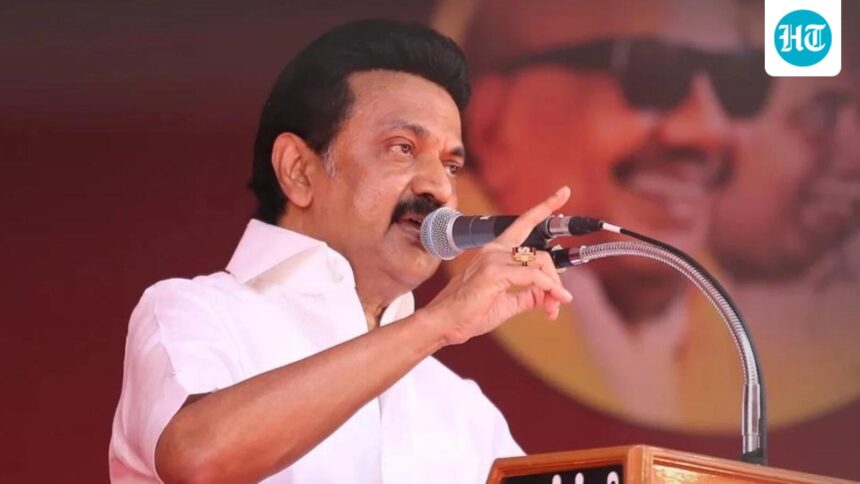
The symbolic center of this transformation was Kolattur, where Prime Minister M K Stalin lost to TVK V S Babu. Kolathur has been Stalin’s headquarters since 2011 and was widely seen as a DMK stronghold. The AIADMK damage was different. Edappadi K Palaniswami retained Edappadi, but TVK penetrated the western region, the most important region for the AIADMK.
The DMK alliance is better off than the AIADMK because of its allies
The DMK and AIADMK alliances will have 74 and 53 MLAs in the new Assembly. The difference between the numbers of the DMK and the AIADMK is much less: 58 and 46 respectively. The reason is that the DMK alliance has much more credit than the AIADMK and is performing better by its allies. This is clearly visible in the strike rate of DMK, AIADMK and their allies in the state. The worst strike rate among the DMK and AIADMK allies is the BJP’s strike rate, just 3%. The BJP contested the highest number of ACs among the AIADMK allies. It would not be wrong to say that the BJP’s poor performance carries a bigger message for the AIADMK and other parties in the state.