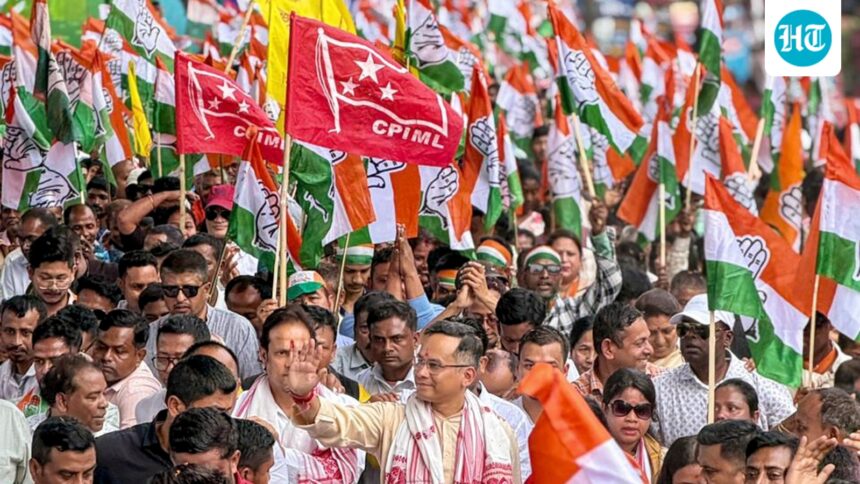
In the recently concluded Assembly elections in several states, the Indian National Congress and its allies recorded notable results among Muslim candidates, even as the party’s overall performance remained mixed.

In Assam, the Congress party won 19 seats, of which 18 seats were won by Muslim candidates. Of the 20 Muslim candidates fielded by the party, 18 emerged victorious, indicating a high rate of conversion. In contrast, only one of the 79 non-Muslim candidates presented by the party was able to win.
Congress ally Raijor Dal won two seats. One of the winning candidates is a Muslim, while the other, Akhil Gogoi, has faced investigation by the National Investigation Agency in the past for his alleged links with Maoists.
In Kerala, 35 Muslim members were elected out of 140 members of the Assembly. Of these, 30 belong to the Congress-led United Democratic Front. Within this bloc, eight Congress members are Muslims, while all 22 members of the Indian Union Muslim League (IUML), a key ally of the United Democratic Front, are from the community.
In West Bengal, the Congress Party won two seats, in Muslim-majority constituencies, both represented by Muslim candidates. The party had fielded 63 Muslim candidates in the state, more than the Trinamool Congress (TMC), which fielded 47 candidates.
Meanwhile, in Tamil Nadu, the Congress nominated two Muslim candidates, one of whom won.
Across Assam and Kerala, Muslim candidates fielded by the Congress and its allies recorded a winning strike rate of more than 80%, reflecting strong electoral consolidation in specific constituencies.
However, political analysts caution against broad generalizations. They point out that candidate selection in Indian elections is often shaped by constituency demographics, local alliances, and voting patterns, rather than any single factor that determines electoral success.