

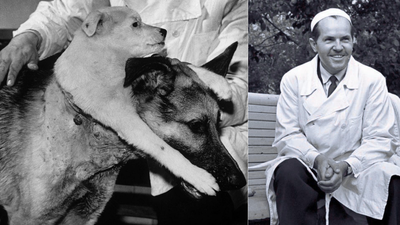
In a Soviet laboratory in the 1950s, she captured a photo of a scene that still disturbs viewers today. A large dog was standing while the head and forelimbs of a smaller dog were surgically grafted onto its body, and both heads were alive and responsive.
The man behind this experiment was Vladimir Demikhov, a surgeon working on the limits of what biology could achieve. Although controversial, his work was driven by the scientific goal of understanding whether organs and tissues could be transplanted and sustained in another living organism, laying the early foundations of modern transplant medicine.Vladimir Demikhov was born in 1916 in the Volgograd region of Russia. While a student at Moscow State University in the late 1930s, he demonstrated extraordinary technical ability by constructing one of the first experimental mechanical heart devices and implanting it in a dog.
From the beginning, his research focused on whether vital organs could be removed, transplanted, and made to function in another body. While these ideas were largely theoretical, he followed them up through direct surgical experiments.
Vladimir Demkhov Two-headed dog Experiments
Between 1954 and the early 1960s, Vladimir Demikhov conducted a series of experiments in which he grafted the head and upper body of a smaller dog onto a larger host dog. The procedure involved ligating major blood vessels such as the carotid artery and jugular vein so that the transplanted body could receive blood from the host.
Both heads can exhibit independent behavior, including drinking milk. However, the operations were very complex, and most animals could only survive a few days due to immune rejection and surgical complications.
The longest recorded survival period was about 29 days. The goal of these experiments was to test whether transplanted organs could be kept alive through shared circulation.
pioneer Organ transplant surgery
Besides dramatic images, Vladimir Demikhov made several major contributions to medical science.
In 1946, he performed one of the first successful heart-lung transplants in animals, demonstrating that vital organs could function after transplantation. In 1951, he performed an orthotopic heart transplant on a dog, placing the donor heart in its normal anatomical position. In 1953, he performed the first experimental coronary bypass surgery, a technique that later became routine in human medicine.
Together, these procedures demonstrated that transplantation of complex organs was technically feasible, even if long-term survival remained a challenge.Christian Barnard, who performed the first successful human heart transplant in 1967, visited Demikhov’s laboratory in Moscow in 1960 and 1963. He later acknowledged that Demikhov’s work provided important experimental knowledge that helped make human heart transplantation possible.
Demikhov’s research was also published in his 1960 book Experimental Transplantation of Vital Organs, which was translated into several languages and studied by surgeons around the world.
Ethics and controversy
The experiments conducted by Vladimir Demikhov remain ethically troubling. By modern standards, such procedures would not be approved due to concerns about animal welfare and suffering. At the same time, his work addressed real medical challenges, including organ rejection, circulation, and surgical technique.
The moral tension lies in the fact that this progress came through methods that might now be considered unacceptable.
Legacy and recognition
Despite his influence, Vladimir Demikhov did not achieve widespread recognition for most of his life. He only received the title of professor in 1998, the year he died at the age of 82. Today, he is remembered as a controversial but important figure in the history of medicine. The image of the two-headed dog is still disturbing, but it represents a period in which the foundations of organ transplant surgery were laid through difficult experiments.What makes Demikhov’s story enduring is the contradiction it represents. His experiments are among the most disturbing in medical history, yet they contributed to techniques that now save countless lives through organ transplantation. The two-headed dog was part of a broader effort to understand whether life could continue across bodies, a question that ultimately helped reshape modern medicine.