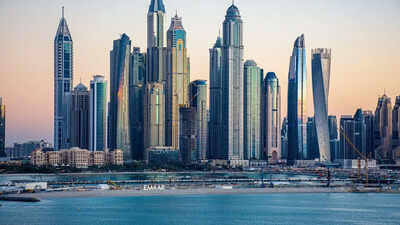
Skyscrapers have become a kind of silent competition between nations. It’s not always planned this way, but it’s clearly on the horizon. Cities are rising up, faster than abroad.
The idea of “top 10 countries with the most skyscrapers” is usually associated with urban growth, population pressure and economic ambition. China dominates this space by a large margin, while the United States still maintains a historical lead in developing famous high-rise buildings. Other countries in Asia and the Middle East are quickly catching up. Recent construction trends, business centers and real estate demand are pushing cities to build higher than ever before.
Some skylines are still developing, while others appear almost entirely filled with glass towers and steel giants.
List of countries with the largest number of skyscrapers 2026
| nation | Skyscrapers |
| China | 3,492 |
| US | 905 |
| United Arab Emirates | 342 |
| Malaysia | 319 |
| Japan | 283 |
| South Korea | 281 |
| Canada | 178 |
| Australia | 163 |
| Thailand | 144 |
| Indonesia | 139 |
Source: World Population Review
Top 10 countries in the world with the largest number of skyscrapers in 2026
China
China ranks first, but by a huge margin. Cities like Shenzhen, Shanghai and Guangzhou have an abundance of high-rise buildings. The areas look like entire vertical cities. The reason behind this rapid growth seems to include urbanization as well as the development of industries.
Most of the country’s skyscrapers are mixed-use buildings housing office space, hotel accommodation, and residential properties.
It is clear that construction activity in China over the past few decades has exceeded anything that has occurred anywhere else. Some of the cityscapes look almost futuristic, even more so during the evening. However, the pace of construction continues, but slightly slower than before.
US
The United States has a long tradition with skyscrapers and ranks second. New York and Chicago were among the first cities to form the identity of skyscrapers. In terms of the country’s architectural lore, its dominance in the world of global architecture is quite clear. The contribution of New York City alone is enormous in sheer numbers. It seems that the goal here is not quantity but quality, and that modern skyscrapers are used for luxury housing or corporate headquarters.
United Arab Emirates
What makes the UAE unique includes Dubai and Abu Dhabi. In fact, Dubai has changed its skyline in an unprecedented way in just a few years. The presence of landmarks like Burj Khalifa indicates its ambition to become a global power. Dubai’s skyscrapers are known to focus on luxury, tourism and corporate branding. In other words, the UAE seems to be using high-rise buildings as a way to create a global image for itself.
Malaysia
Malaysia, especially Kuala Lumpur, contributes significantly to the number of skyscrapers in the country. The city is characterized by a dense collection of modern towers, including residential and commercial buildings. The Petronas Towers remain an iconic part of the skyline. Urban development policies appear to have encouraged vertical growth for efficient land use management. Skyscrapers here are often functional and integrated into public transportation networks.
The overall horizon continues to expand steadily, but not as aggressively as China or the UAE.
Japan
Japan’s skyscrapers are shaped to strict engineering standards due to earthquake hazards. Tokyo leads the way in high-rise development in the country, with a mix of commercial and residential towers. The design focus is often on safety and functionality rather than extreme height. The scarcity of land in major cities appears to have encouraged vertical expansion.
Japanese skyscrapers tend to be compact but highly efficient. The skyline continues to gradually evolve with advanced construction techniques.
South Korea
There have been many high-rise buildings being built in South Korea, especially in Seoul. Songdo, for example, shows an emphasis on modern urban planning. South Korea’s progress appears to be related to the technological sector and globalization. Skyscrapers in South Korea tend to be efficient and in keeping with today’s lifestyle requirements.
Canada
Canada’s skyscrapers are dominated by cities like Toronto and Vancouver. It has grown steadily, not suddenly. In Toronto, skyscrapers form a densely populated central part of the city, with many residential buildings. It appears that migration and the growth of urban populations contributed to the development of skyscrapers. The skyscrapers are fairly new but well proportioned, leaving enough room for further expansion.
Australia
High-rise building construction in Australia is mostly concentrated in the cities of Sydney and Melbourne. This is closely related to the planning and design of coastal cities. The buildings feature a mix of residential and commercial functions. The high demand for land in the city may have necessitated building the building upwards. Modern high-rise buildings in Australia feature elegant designs and integration with the waterfront.
Thailand
Thailand, especially Bangkok, is showing rapid growth in skyscrapers. The city’s skyline is becoming denser with residential towers and hotels. Tourism plays a strong role in this expansion. Urban migration also appears to contribute to vertical development. Bangkok’s skyline continues to change, with ongoing construction projects shaping its future identity.
Indonesia
Indonesia, led by Jakarta, is gradually expanding its skyscraper presence. The city faces high population density which encourages vertical construction. Economic growth and urban demand appear to be driving new developments. Although the horizon still lags behind regional leaders, the horizon is changing rapidly. The new projects indicate continued expansion in the coming years.