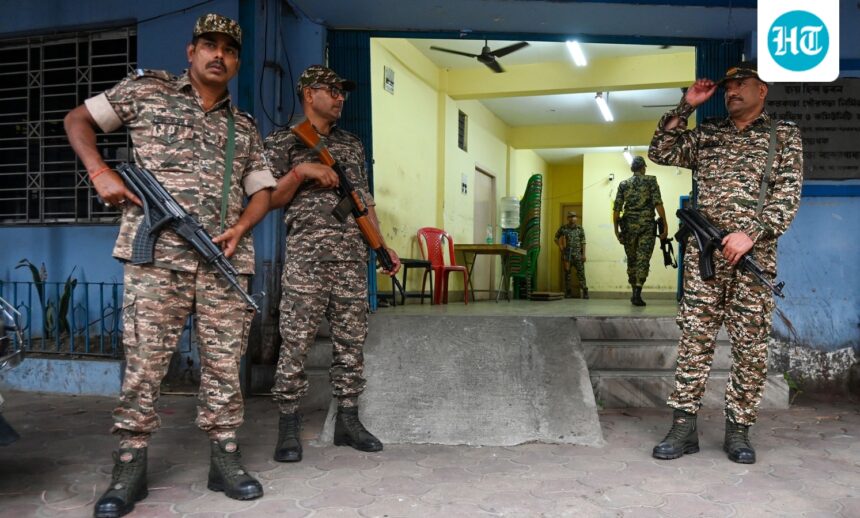
The Election Commission of India (ECI) has decided to retain around 700 companies of the Central Armed Police Force (CAPF) in West Bengal until further orders, officials said on Wednesday, even as the ruling Trinamool Congress (TMC) criticized the massive security deployment for the assembly elections in the eastern state.

Polling for the Lok Sabha elections in West Bengal concluded on Wednesday in two phases. The results will be announced on May 4.
“After the completion of the survey today, 700 companies of the CAPF police force will continue to remain deployed in the state for security arrangements and law and order duties, till further orders,” an ECI official said. He added, “The forces will be stationed in sensitive areas and will help the state administration maintain normal life.”
While TMC leaders, including Lok Sabha MP Mahua Moitra, shared on social media an unverified internal circular claiming that troops have been removed after the elections and orders have already been issued, CRPF Director General Singh said in a post on X: “As mentioned earlier, 500 CAPFs will remain in West Bengal after the polls till further orders.”
Singh was also involved in the distribution of 500 companies of CAPF that will remain in the state, as per the March 19 order – 200 companies of CRPF, 150 BSF, 50 CISF, 50 ITBP and 50 SSB. CRPF is the nodal power of all CAPFs. Each CAPF company has between 100 and 120 security personnel.
For the two-phase assembly elections in West Bengal, the EC deployed a much larger number of CAPF companies – 2,550 in total – almost three times the 845 companies fielded during the 2021 assembly polls, which were conducted in eight phases, and the 800 companies in the 2016 assembly elections, which were conducted in six phases.
For the first time, the troops also brought bulletproof armored vehicles by road from Chhattisgarh and Jammu and Kashmir. In another first, the CAPFs opened a control room in the state to monitor social media contents and relay information to rapid action teams.
However, an officer requesting anonymity said: “The cancellation of recruitment for the rest of the companies will begin from Thursday. The first batches of troops to return will be those who came from Jammu and Kashmir and Manipur. Several bulletproof vehicles brought by the troops from Jammu and Kashmir will also be recovered, while some will remain due to the law and order situation there.”
The heightened security measures are due to a history of election-related violence in the eastern state, including deaths reported during the previous Legislative Assembly and panchayat elections. At least 48 election-related deaths were reported during the 2023 Assembly elections, with both the ruling TMC and the opposition Bharatiya Janata Party accusing each other of violence.
On April 27, the last day of campaigning for the second phase of elections, Union Minister Amit Shah said that central forces would remain in the state for 60 days after the elections.
Speaking on the issue, retired IAS officer KBS Sidhu, who was a former special secretary in Punjab, said: “After elections, law and order become subjects of the state. The AFP works under the administrative command of the Democratic Party or the Socialist Party. If the new government thinks it has enough forces, the large number of troops stationed there will not have any independent authority. They will be confined to their barracks without work. The PAF is always brought in to assist the civilian authority.”
Former Chief Election Commissioner S.E. Qureshi said that the European Union Company has its rights to decide to retain the forces. “The Home Ministry and the EC always take into account the law and order situation before taking a decision to retain such a large force after elections. The IEC is legally right to take the decision to keep the forces on till it is later reviewed by the responsible person. In my opinion, even after the results day or the formation of a new government, the state government cannot and should not withdraw the force immediately without any valid reason,” he added.