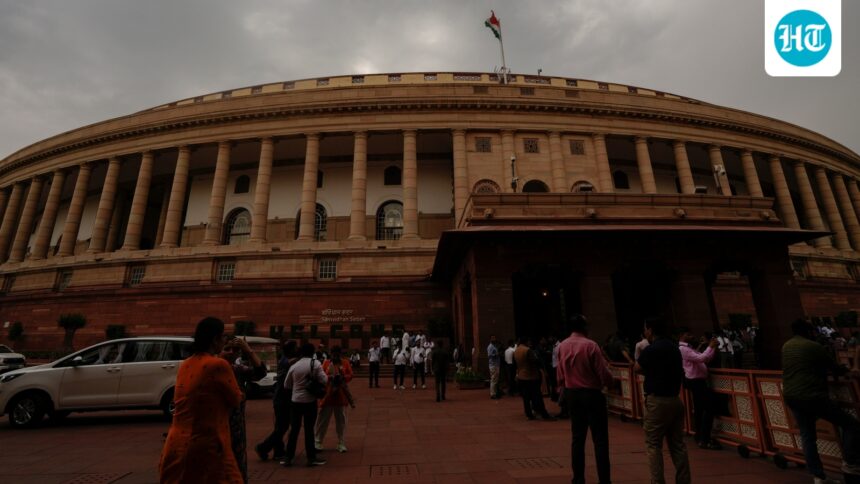
The India Meteorological Department (IMD) has issued orange alert for Delhi, Noida and Ghaziabad, forecasting rain and thunderstorms on Thursday evening, while Gurugram and Faridabad have been placed under yellow alert.

Outer parts of the National Capital Region (NCR), such as Meerut in Uttar Pradesh, are under red alert. The sky turned gray in various parts of the national capital, indicating the possibility of a storm.
According to the IMD, areas under red alert may witness moderate to severe thunderstorm, while areas under orange alert may witness moderate thunderstorm.
Light rain and thunderstorms are expected in areas under yellow alert.
The national capital recorded a minimum temperature of 25.4 degrees Celsius at Safdarjung on Thursday morning, with the International Meteorological Department forecasting thunderstorms with rain at isolated places later in the day.
Among other stations, Palam recorded a minimum of 24.9 degrees Celsius, Lodhi Road 23.6 degrees Celsius, Ridge 25 degrees Celsius and Ayanagar 24.1 degrees Celsius.
The maximum temperature is expected to reach around 36 degrees Celsius, with thunderstorms and rain in isolated areas, according to the IMD morning forecast.
The city’s air quality index (AQI) reached 136, putting it in the “moderate” category.
Contrast to April’s Delhi weather
Delhiites experienced a dizzying mix of weather conditions in April this year, with spells of rain, bouts of heat and days of clean air every now and then, making it the wettest April in more than a decade, among the least polluted, and one of the coolest Aprils in recent years.
The city recorded the wettest April in 18 years, as pre-monsoon rains hit parts of the capital in the first half of the month. So far, the average rainfall in the capital has reached 27.9 mm during the month of April, compared to 38.6 mm recorded in April 2008, according to official data.
Although it has seen phases of extreme heat, the city also enjoyed one of the coolest April in two years, with the average maximum temperature reaching around 37 degrees Celsius. It is worth noting that only one day of heat wave has been recorded so far, according to the International Meteorological Institute.
Rain and gusty winds also helped lower pollution levels, making this April the cleanest in four years, according to an analysis by the Center for Research on Energy and Clean Air.
The data revealed that the city recorded an average air quality index of 179 as of April 28, with one “satisfactory,” 17 “moderate,” and 10 “poor” air quality days.
In contrast, the average base quality index for April last year was 210 days, with 10 “average” days and 20 “poor” days. In 2024, the average AQI was 182, comprising 23 “moderate” days and 13 “poor” days, while in 2023, it was 180 days, with 17 “moderate” days and 13 “poor” days. In 2022, Iraq’s AQI was much higher at 255, including 29 “poor” days and one “very poor” day.
According to the Central Pollution Control Board (CPCB), an air quality index (AQI) of 0-50 is considered ‘good’, 51-100 ‘satisfactory’, 101-200 ‘moderate’, 201-300 ‘poor’, 301-400 ‘very poor’ and 401-500 ‘severe’.